
If you are in a hurry
- A bladder infection usually does not cause a fever. If a high fever, chills and back pain are added to pain when passing urine, think of pyelonephritis (a kidney infection)
- Pyelonephritis is more common in women. In men, doctors also look for a hidden underlying cause
- Vomiting so that you cannot take medicine, being limp, or low blood pressure may mean you need hospital admission or an IV drip. If you are pregnant, contact your obstetrics and gynecology clinic first, even at night
Hello. I am Shunichi Gamo, MD, PhD, a board-certified pulmonologist and the director of Sendai Airport North Clinic.
When a fever appears, many people think of a cold, influenza or COVID-19. But those are not the only causes of fever. For example, this is the person I have in mind:
“I have a fever and chills, and for some reason my back (or lower back) hurts too.”
Please think back: did you have symptoms a few days earlier, such as stinging when passing urine or needing to go to the toilet often?
Let me give you the answer first. If a high fever, chills and back pain appear after pain when passing urine, we think of pyelonephritis. Pyelonephritis is an illness that urine tests help us suspect, and that we treat thoroughly with antibiotics (medicines that kill bacteria).
In this article I explain, in broad terms, how cystitis (a bladder infection) differs from pyelonephritis, why it is more common in women, what urine tests can tell us, how to take antibiotics, and the signs that mean you need hospital admission or an IV drip.
First, a note about our fever clinic on Sundays and holidays. PCR tests (tests that copy the virus’s genetic material so it can be detected) for influenza and COVID-19 give results the same day.
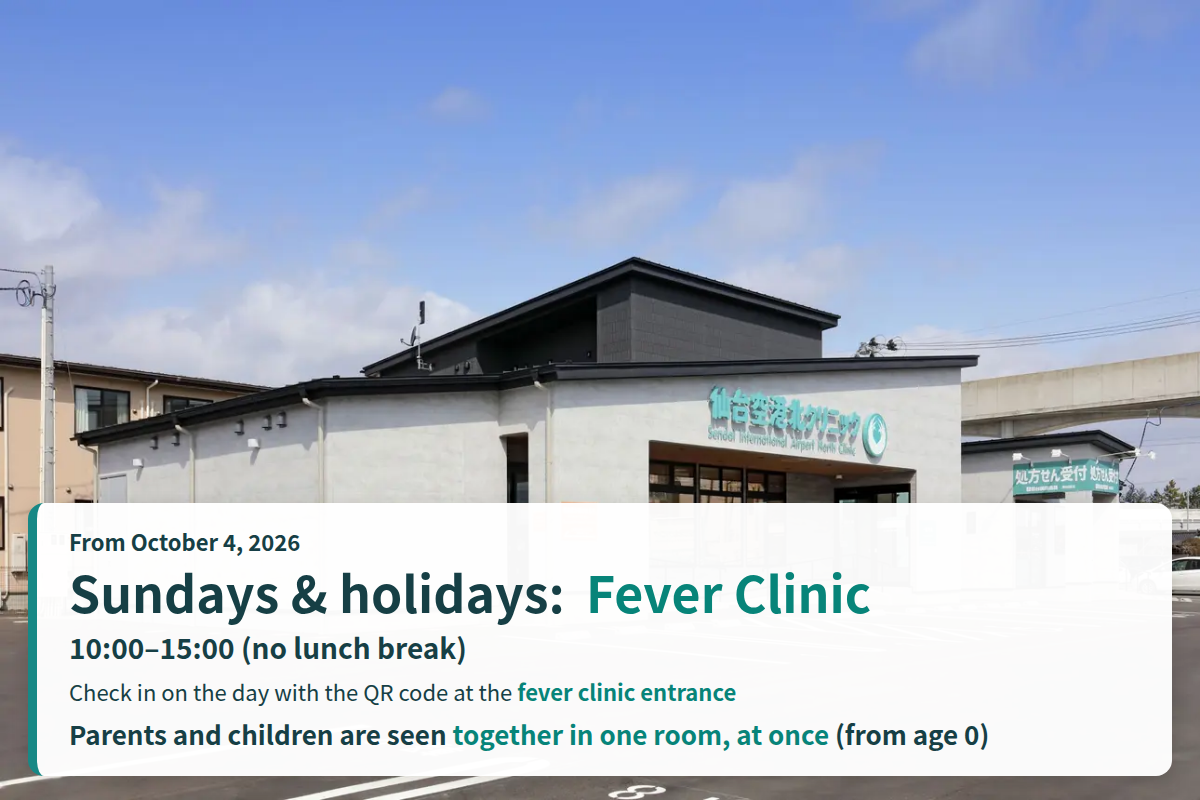
From October 4, 2026, our fever clinic is also open on Sundays and holidays
10:00 to 15:00 (no lunch break). You register by checking in on the day. We tell you the PCR result the same day. On Sundays and holidays we run the fever clinic only, with no general outpatient care and no IV drips. Please check the clinic calendar for clinic dates and closed days. Notice about the Sunday and holiday fever clinic
Shunichi Gamo, MD, PhD
Director, Sendai International Airport North Clinic
Born and raised locally, he attended Yuriage Elementary School and Yuriage Junior High School in Natori City. After graduating from Tohoku University School of Medicine, he worked at Sendai Open Hospital and Kesennuma City Hospital, and then at Tohoku University Hospital. In April 2021, in the middle of the COVID-19 pandemic, he opened Sendai International Airport North Clinic. Holding to a fever clinic that never turns patients away, he cared for well over 20,000 patients with fever in the two years before COVID-19 was moved to Class 5 under Japan’s infectious disease law.
Society memberships and board certifications
Certified Member and Board Certified Fellow, Japanese Society of Internal Medicine
Board Certified Pulmonologist, Japanese Respiratory Society
Board Certified Allergist, Japanese Society of Allergology
Board Certified Specialist, Japanese Society of Anti-Aging Medicine
PhD in Medicine (Tohoku University)
[Conclusion] “Bladder infection symptoms plus a high fever, chills and back pain” is a sign of pyelonephritis
Pyelonephritis is an infection in which bacteria get into the kidney’s collecting chamber (the renal pelvis, where urine gathers) and the kidney itself. In most cases, the bacteria that cause a bladder infection travel up the urinary tract and reach the kidney[1].
| Cystitis (bladder infection) | Pyelonephritis (kidney infection) | |
|---|---|---|
| Where | The bladder (the sac that stores urine) | The kidney (the organ that makes urine) |
| Fever | Usually none | Fever (sometimes with chills and shaking) |
| Main symptoms | Pain when passing urine, frequent urination, a feeling that the bladder is not empty, cloudy urine | The symptoms on the left, plus pain on one side of the back or flank, tiredness, nausea and vomiting |
| Severity | Few symptoms affecting the whole body | Bacteria can easily get into the blood; it can become serious |
The guideline of the Japanese Association for Infectious Diseases and the Japanese Society of Chemotherapy (a clinical manual compiled by the societies) also says that cystitis “usually does not come with a fever”[1]. In other words, if a fever is added to cystitis-like symptoms, the bacteria may have reached above the bladder, to the kidney.
It also notes that people often do not realize they had bladder symptoms beforehand[1]. Pyelonephritis is a possibility even if you say, “I didn’t have pain when passing urine, but I have a high fever and back pain.”
Back pain: it echoes when you gently tap a little above the waist
The kidneys sit toward the back, not the belly, a little above the waist. The area where the lowest rib meets the spine is called the costovertebral angle.
In pyelonephritis, when this spot is tapped lightly with a closed fist, it can hurt with a deep, dull jolt. This is called percussion tenderness, and doctors often check for it during an examination[1].
However, back or lower back pain can also come from muscle pain such as a strained back, or from a urinary stone (a stone that forms in the urinary tract). The combination of a fever and pain when passing urine is a hint for telling them apart.
 Dr. Gamo
Whether back pain comes together with a fever is an important hint in telling them apart.
Why is pyelonephritis more common in women?
Pyelonephritis is overwhelmingly more common in women. The guideline also states that pyelonephritis without complications (factors that make it harder to cure, such as an abnormality of the urinary tract or an underlying illness) “occurs most often in sexually active women”[1].
In a study of members of a health cooperative in Seattle, USA, from 1997 to 2001, the yearly cases of pyelonephritis per 10,000 people were as follows[2].
| Treated as outpatients | Treated in hospital | |
|---|---|---|
| Women | 12 to 13 people | 3 to 4 people |
| Men | 2 to 3 people | 1 to 2 people |
It was most common in young women, followed by babies and older adults. The bacterium behind it was E. coli (Escherichia coli) in 80% of women and 70% of men[2].
Put simply, the reason it is more common in women is body structure.
- Women have a short urethra (the tube that carries urine from the bladder out of the body)
- The opening of the urethra is close to the anus, where bacteria from the bowel are found
- As a result, bowel bacteria can easily get from the urethra into the bladder (most urinary tract infections are caused by bacteria from the bowel that travel up from below[1])
The guideline treats all pyelonephritis in men as “complicated,” that is, on the assumption that something in the prostate or the urinary tract is behind it[1]. If a man has a fever and pain when passing urine, please see a doctor early.
Dr. GamoPain when passing urine may be a symptom that is embarrassing to mention. If a fever or back pain is added, please don’t put up with it, and tell us.
What can urine tests tell us about pyelonephritis? [urinalysis, urine culture, blood tests, imaging]
These are the main tests done when pyelonephritis is suspected[1].
- [Urinalysis]
We look for white blood cells (pyuria) and bacteria (bacteriuria) in the urine. This is the best clue for suspecting a urinary tract infection - [Urine culture]
We grow the bacteria in the urine to find out the type of bacteria and which antibiotics work against it (drug susceptibility). The results take a few days - [Blood tests]
White blood cells and CRP (a marker of how strong the inflammation in the body is) show the degree of inflammation. If it is severe, we also check whether bacteria have entered the blood (blood culture) - [Imaging]
When needed, we use ultrasound (echo) or CT (computed tomography, a test that takes cross-sectional pictures of the body) to check whether a stone or something else is blocking the flow of urine, and whether pus has collected in the kidney
The guideline states that urinalysis and urine culture before starting antibiotics are “essential”[1]. If you take antibiotics first, the bacteria do not grow well, and it becomes harder to tell which bacteria are responsible and which medicine works.
In older adults, symptoms may not be clear
Pyelonephritis in older adults may come without complaints of pain when passing urine or back pain, with only “a fever” or “low energy.” One study examined 473 people aged 65 or older at a hospital in Fukushima Prefecture from 2015 to 2018, who were suspected of having an infection but whose site of infection was unclear at admission[3]. Of these, 61 were finally diagnosed with pyelonephritis. In this study, CT findings were said to help with the diagnosis.
Why urine culture matters [bacteria that resist treatment are increasing in Japan too]
The Japanese guideline also says that E. coli that resist antibiotics are gradually increasing[1]. Specifically, these are E. coli that resist quinolones (one group of commonly used antibiotics) and ESBL-producing bacteria (bacteria that make an enzyme that breaks down many antibiotics).
A survey at 55 facilities across Japan, from April 2020 to September 2021, examined bacteria in the urine of people with uncomplicated cystitis[4]. The proportions of resistant bacteria among the E. coli found in urine were as follows[4].
- Before menopause: quinolone-resistant E. coli 10.5%, ESBL-producing E. coli 6.8%[4]
- After menopause: quinolone-resistant E. coli 32.1%, ESBL-producing E. coli 15.4%[4]
This survey looked at people with cystitis, so these are not figures for people with pyelonephritis. However, the bacteria that cause pyelonephritis are the same as in cystitis[1]. So it is important to use the urine culture result to confirm that the first medicine is working.
Dr. GamoThe urine test is also very important for checking whether the first medicine is working.
Pyelonephritis is treated with antibiotics [start without hesitation and finish the whole course]
Pyelonephritis is a bacterial infection, so antibiotics are the core of treatment. When they are needed, we start them without hesitation and firmly bring down the inflammation in the kidney.
According to the Japanese guideline, people who have no nausea or dehydration (not having enough water in the body), no problem with blood pressure and similar measures, and no illness that weakens immunity can be treated as outpatients with oral medicine[1]. It also recommends combining this with a single injection of an antibiotic at the start.
Even after the fever goes down, take all the medicine you were given
Once the antibiotic starts to work, the fever and back pain gradually ease. What matters here is not to stop on your own judgment just because you feel better.
The Japanese guideline sets out the number of days for taking each type of antibiotic for pyelonephritis[1]. The doctor decides the number of days according to the type of medicine and your condition.
Whatever the number of days, the premise is that you take the prescribed amount to the end. If you stop partway, the bacteria that remain can make the infection come back.
Dr. GamoJust when you start to feel better, finish all of what was prescribed. This is the trick to keeping it from coming back.
- Finish all the antibiotics you were given, even after the fever goes down
- If you miss a dose, ask your pharmacy or medical institution what to do
- Do not take leftover antibiotics at home, or a family member’s antibiotics, on your own judgment (they may not work, and they can also make the urine culture result harder to interpret)
- If a rash or severe diarrhea appears, ask the medical institution that prescribed the medicine whether you should keep taking it
About the third day after starting is the time to check whether it is working
The Japanese guideline says to judge the effect around the third day after treatment starts, and, once the urine culture result is back, to switch to a medicine suited to that bacterium[1]. A US review (a paper that summarizes and explains earlier research) also says that most people improve within 48 to 72 hours (2 to 3 days) with appropriate treatment, and that if they do not, repeat imaging and culture should be considered[5].
In other words, if the fever has not come down around the third day after starting, or the back pain gets worse along the way, keep taking the medicine and go back to the medical institution that prescribed it. If a stone is blocking the flow of urine, antibiotics alone may not cure it, and a procedure by a urologist (a specialist in the urinary tract) may be needed[1][5]. The US review says that when the urinary tract is blocked, a procedure to restore urine flow should be done urgently[5]. If you have a urinary stone and develop a fever and back pain, please see a doctor the same day.
When do you need hospital admission or an IV drip for pyelonephritis? [Do not wait here]
Pyelonephritis is an illness in which bacteria can easily get into the blood and spread through the body[1]. As a result, it can lead to sepsis (a serious condition in which the body’s response to infection goes out of control and causes life-threatening organ damage).
Turning around the conditions that the Japanese guideline gives for being treatable as an outpatient[1], hospital admission or an IV drip may be needed in the following cases.
- You vomit and cannot keep down oral medicine or fluids
- You are limp and cannot move, your consciousness is hazy, or you say things that do not make sense
- Your blood pressure is low (severe lightheadedness on standing, a poor color, cold hands and feet)
- You have trouble breathing or are breathing fast
- You are passing almost no urine, or none for half a day or more (a sign of dehydration)
- You have an illness that weakens immunity, such as diabetes or cancer
Among these, if your consciousness seems off, you have trouble breathing, or you are so limp you cannot stand and your color is poor, call 119 (Japan’s emergency number) or go to an emergency department without hesitation, even at night. If you cannot decide whether it is serious enough to call an ambulance, you can consult the Miyagi Prefecture adult emergency telephone consultation line (#7119, a phone line that advises on whether to call an ambulance). If you vomit and cannot take your medicine, go the same day to a medical institution that can give an IV drip or admit you (an emergency department if it is night). Older adults and people with a chronic illness such as diabetes should see a doctor the same day even if the symptoms look mild. If you are pregnant, as explained in the next section, contact your own obstetrics and gynecology clinic first, even at night.
Dr. GamoWhen you are unsure whether it is serious enough to call an ambulance, please remember that you can ask #7119 for advice.
If you are pregnant, go especially early
A study of 546,092 pregnancies ending in delivery from 1993 to 2010 in a health care group in Southern California, USA, was done[6]. It found that 0.5% developed pyelonephritis during pregnancy, and that those who did differed as follows[6].
- Sepsis: 1.9% (0.03% in those who did not get pyelonephritis)[6]
- Spontaneous preterm birth (delivery earlier than expected): 10.3% (7.9% in the same comparison)[6]
The US review says that, because pyelonephritis in pregnancy carries a high risk of serious complications, treatment should be started in hospital with antibiotics given by IV drip[5].
In the Japanese guideline, some antibiotics, such as quinolones, cannot be used during pregnancy[1]. It describes treatment with usable antibiotics, by mouth for mild cases and by IV drip for severe ones[1]. The US review, on the other hand, recommends starting treatment for pyelonephritis in pregnancy in hospital with an IV drip[5]. Whether to be admitted differs by country, medical institution and the severity of symptoms.
If you are pregnant and develop a fever, back pain and pain when passing urine, contact your own obstetrics and gynecology clinic first, even at night.
When to see a doctor [where and when]
Here is everything so far, organized by where to go.
| If this is the case | Where and when |
|---|---|
| Your consciousness seems off, you have trouble breathing, or you are so limp you cannot stand and your color is poor | Call 119 or go to an emergency department, even at night |
| You vomit and cannot take medicine or fluids | The same day, go to a medical institution that can give an IV drip or admit you (an emergency department if it is night) |
| You are pregnant and have a fever, back pain or pain when passing urine | Contact your own obstetrics and gynecology clinic first, even at night |
| You have a fever and chills, with back or lower back pain or pain when passing urine (but you can take fluids and medicine) | See a doctor the same day (early the next morning if it is night) |
| No fever, only pain when passing urine or frequent urination | See an internal medicine or urology clinic early |
| The fever has not come down around the third day after starting antibiotics | Go back to the medical institution that prescribed them |
What we would like you to tell us when you visit
- When the fever started, and the highest temperature
- Urinary symptoms such as pain when passing urine, frequent urination, cloudy urine or blood in the urine, and the day they began
- Where the back or lower back pain is (right or left)
- Whether you have nausea or vomiting, and whether you can keep down fluids and medicine
- Whether you are pregnant, or might be
- Chronic illnesses (diabetes, urinary stones, prostate disease and so on) and the medicines you usually take
- Antibiotics you have taken in the last few months, and whether you have had cystitis or pyelonephritis before
Tips for collecting urine
For urine tests, the basic method is a “midstream urine” sample: let the first part of the urine go into the toilet and collect the middle part in a cup. This is because the first part is likely to be mixed with bacteria from around the opening of the urethra. If possible, holding your urine a little before the test makes it easier to collect.
Dr. GamoLet the first part of the urine go and collect the middle part. Remembering just this is enough.
How to use our fever clinic [open Sundays and holidays too]
We see patients through a pre-visit questionnaire and same-day check-in. Our clinic has a policy of not refusing anyone who wants to come to the fever clinic (depending on the symptoms, we may direct you to a more suitable medical institution).
| Day | Hours |
|---|---|
| Mon, Tue, Wed, Fri, Sat | 9:00 to 12:00 / 14:00 to 18:00 |
| Sundays and holidays (from October 4, 2026) | 10:00 to 15:00 (no lunch break, fever clinic only) |
| Thursday | Closed |
Please check the clinic calendar for clinic dates and closed days. On Sundays and holidays we run only the fever clinic, with no general outpatient care and no IV drips. For details, please see the Notice about the Sunday and holiday fever clinic.
If you have pain when passing urine or back pain, please be sure to tell us about those symptoms in the pre-visit questionnaire or when you check in. We will explain the tests you need, and a more suitable medical institution if there is one, after examining you.
Please note that we cannot give IV drips on Sundays and holidays. If an IV drip is likely to be needed, for example because you are vomiting and cannot take medicine or you are limp, please go to a medical institution that can give an IV drip.
How a visit works
You register by checking in on the day, using the QR code at the fever clinic entrance (a square pattern that you scan with your smartphone camera). When your turn is near, we call you by SMS (a text message sent to a mobile phone number) or by phone.
- Before you arrive, fill in the pre-visit questionnaire (optional; you can also fill it in when you check in at the entrance)
- Scan the QR code at the fever clinic entrance and check in by choosing “I have arrived, check me in” (required)
- On weekdays, once you have checked in, please wait in your car
- On Sundays and holidays, after you check in, we confirm your insurance card (My Number insurance card, certificate of eligibility, and so on) at the general outpatient entrance. Because general outpatient care is not offered on Sundays and holidays, please feel free to come in. After the confirmation, please wait in your car or similar
- When your turn is near, we call you by SMS or phone. Press the intercom at the fever clinic entrance and tell us your name
Patients are generally seen in check-in order, but the order may change depending on how severe the symptoms are. For details, please see About the pre-visit questionnaire and same-day check-in for the fever clinic.

Frequently asked questions
- How does cystitis differ from pyelonephritis?
-
Cystitis is an infection of the bladder only, with symptoms mainly such as pain when passing urine and frequent urination. It does not usually cause a fever. Pyelonephritis is when the bacteria have reached the kidney, causing a high fever, chills, pain on one side of the back or flank, nausea and similar symptoms.
- Can I stop the antibiotics once the fever goes down?
-
No, please finish all the medicine you were given. Even after the fever goes down, bacteria can remain in the kidney, and stopping partway can make the infection come back. If a symptom worries you, such as a rash or severe diarrhea, please ask the medical institution that prescribed the medicine.
- I have antibiotics left over from before. May I take them first?
-
Please do not take them on your own judgment. They may not work against the bacteria this time, and if you take them first, the urine culture may not show which bacteria are responsible. The safe way is to see a doctor first and start treatment after the urine tests.
- Can men get pyelonephritis?
-
Yes. It is less common than in women, but pyelonephritis in men is handled on the assumption that a prostate disease or an abnormality of the urinary tract may be hidden behind it. If you have a fever and pain when passing urine, please see a doctor early.
- Can I be seen on a Sunday or holiday with symptoms that might be pyelonephritis?
-
Yes. We run the fever clinic on Sundays and holidays from 10:00 to 15:00 (no lunch break). Please check the calendar for open days. You just check in on the day at the entrance. However, we cannot give IV drips on Sundays and holidays, so if an IV drip is likely to be needed, for example because you are vomiting and cannot take medicine, please go to a medical institution that can give one.
Summary [For a fever with back pain, get a urine test early]
- A bladder infection usually does not cause a fever. If a high fever, chills and back pain are added to pain when passing urine, think of pyelonephritis
- Pyelonephritis is more common in women. In men, doctors also look for a hidden underlying cause
- It is important to do urinalysis and urine culture before antibiotics, and to confirm which medicine works
- Start antibiotics without hesitation when they are needed, finish the whole course, and do not use leftover medicine
- Vomiting so that you cannot take medicine, being limp, or low blood pressure may mean you need hospital admission or an IV drip. If you are pregnant, contact your obstetrics and gynecology clinic first, even at night
The time to see a doctor is when you think, “I thought it was just a bladder infection, but now I have a fever.” Pyelonephritis is an illness that, in many cases, gets better if it is found early and treated thoroughly. Please leave the medical side to us.
That’s all.
Disclaimer
This article is intended to provide general medical information and does not replace an examination, diagnosis or treatment by a doctor. The content is based on medical knowledge at the time of publication, but the right approach differs from person to person. If you are worried about your symptoms, please consult a medical institution.
References
- Japanese Association for Infectious Diseases and Japanese Society of Chemotherapy, JAID/JSC Guide/Guidelines to the Treatment of Infectious Diseases Preparing Committee, Working Group on Urinary Tract Infections and Male Genital Infections (Yamamoto S, et al.). JAID/JSC Guidelines to Clinical Management of Infectious Disease 2015: Urinary Tract Infections and Male Genital Infections (in Japanese). Japanese Journal of Chemotherapy. 2016;64(1):1-30. https://www.chemotherapy.or.jp/uploads/files/guideline/jaidjsc-kansenshochiryo_nyouro.pdf
- Czaja CA, Scholes D, Hooton TM, Stamm WE. Population-based epidemiologic analysis of acute pyelonephritis. Clin Infect Dis. 2007 Aug;45(3):273-80. doi:10.1086/519268 PMID: 17599303
- Yano T, Takada T, Fujiishi R, Fujii K, Honjo H, Miyajima M, et al. Usefulness of computed tomography in the diagnosis of acute pyelonephritis in older patients suspected of infection with unknown focus. Acta Radiol. 2022 Feb;63(2):268-277. doi:10.1177/0284185120988817 PMID: 33508952
- Wada K, Tsuboi I, Takahashi S, Yasuda M, Miyazaki J, Kobayashi K, et al. Third nationwide surveillance of bacterial pathogens in patients with acute uncomplicated cystitis conducted by the Japanese surveillance committee during 2020 and 2021: Antimicrobial susceptibility of Escherichia coli, Klebsiella pneumoniae, and Staphylococcus saprophyticus. J Infect Chemother. 2024 Apr;30(4):277-285. doi:10.1016/j.jiac.2024.01.011 PMID: 38242285
- Herness J, Buttolph A, Hammer NC. Acute Pyelonephritis in Adults: Rapid Evidence Review. Am Fam Physician. 2020 Aug;102(3):173-180. PMID: 32735433
- Wing DA, Fassett MJ, Getahun D. Acute pyelonephritis in pregnancy: an 18-year retrospective analysis. Am J Obstet Gynecol. 2014 Mar;210(3):219.e1-6. doi:10.1016/j.ajog.2013.10.006 PMID: 24100227
Related articles to read when you have a fever
For the Sunday and holiday fever clinic, see the Notice about the Sunday and holiday fever clinic. For how to come in, see About the pre-visit questionnaire and same-day check-in for the fever clinic.