If you are in a hurry
- A peritonsillar abscess is a condition in which a worsening tonsil infection leaves pus collecting around the tonsil. It is most common in teenagers and people in their early twenties
- The signs are strong pain on one side only, difficulty opening the mouth, a muffled voice, being unable to swallow saliva (drooling), and pain that reaches the ear
- If you are short of breath, wheezing, or can breathe only when leaning forward, suspect acute epiglottitis and call 119 (Japan’s emergency number) right away
Hello. I am Shunichi Gamo, MD, PhD, a board-certified pulmonologist and the director of Sendai Airport North Clinic.
At our fever clinic, we see quite a few adult patients who say, “My throat hurts and I have a fever.” Most have a cold or tonsillitis (an infection of the tonsils), but every so often the cause is a condition that needs prompt treatment.
“One side of my throat hurts terribly, I can’t open my mouth and can’t even swallow my saliva.”
Let me start with the conclusion: this could be a sign of a peritonsillar abscess. It is a condition in which pus collects around the tonsil, and it needs a procedure to drain the pus plus treatment with antibiotics (medicines that kill bacteria).
In this article I explain, in plain terms, how to recognize a peritonsillar abscess, how it differs from acute epiglottitis (which needs a 119 call), how treatment proceeds, and where to go on Sundays and public holidays.
At our fever clinic, we give you the result of the PCR test (a test that copies the virus’s genetic material to detect it) on the same day.
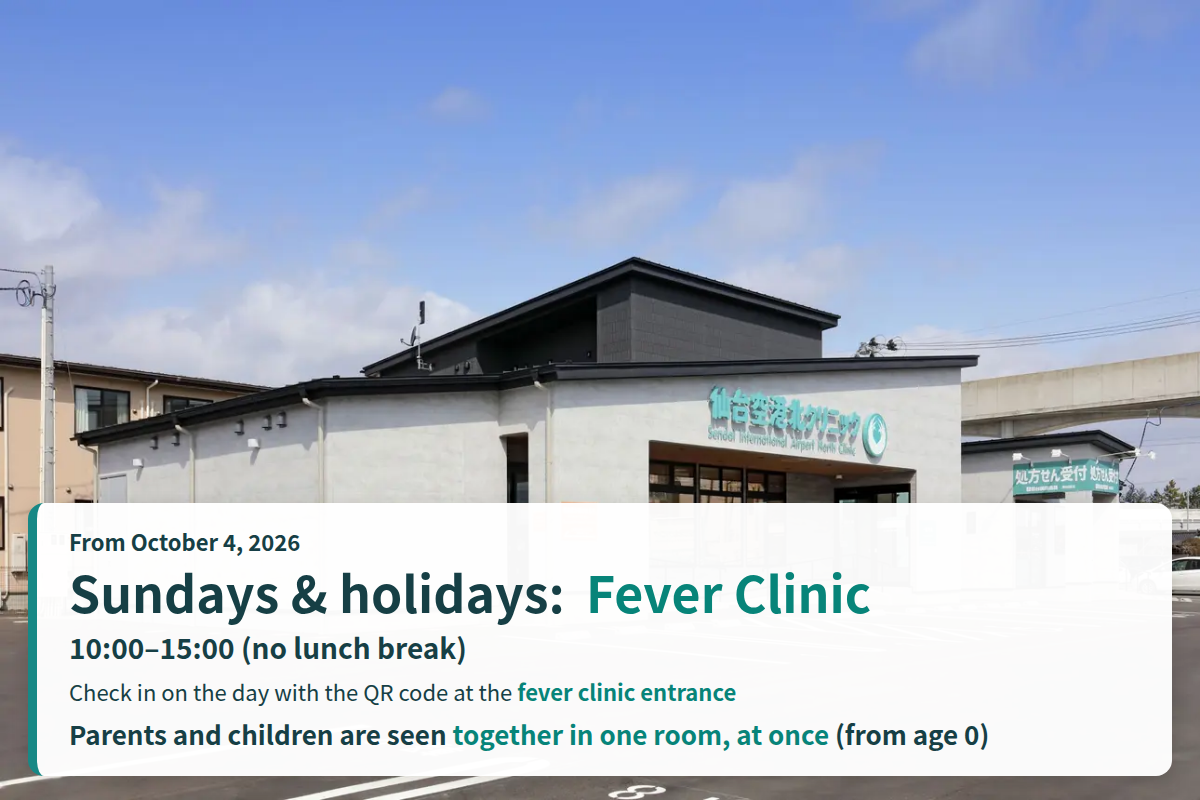
Since October 4, 2026, our fever clinic is also open on Sundays and public holidays
10:00 to 15:00 (no lunch break). You are seen by checking in on the day. We give you the PCR test result on the same day. On Sundays and public holidays we run the fever clinic only, with no general outpatient care or IV drips. Please check the clinic calendar for clinic dates and closed days. Announcement about the Sunday and public holiday fever clinic

Shunichi Gamo, MD, PhD
Director, Sendai International Airport North Clinic
Born and raised locally, he attended Yuriage Elementary School and Yuriage Junior High School in Natori City. After graduating from Tohoku University School of Medicine, he worked at Sendai Open Hospital and Kesennuma City Hospital, and then at Tohoku University Hospital. In April 2021, in the middle of the COVID-19 pandemic, he opened Sendai International Airport North Clinic. Holding to a fever clinic that never turns patients away, he cared for well over 20,000 patients with fever in the two years before COVID-19 was moved to Class 5 under Japan’s infectious disease law.
Society memberships and board certifications
Certified Member and Board Certified Fellow, Japanese Society of Internal Medicine
Board Certified Pulmonologist, Japanese Respiratory Society
Board Certified Allergist, Japanese Society of Allergology
Board Certified Specialist, Japanese Society of Anti-Aging Medicine
PhD in Medicine (Tohoku University)
Conclusion: a peritonsillar abscess is a “worse version of tonsillitis”
The tonsils are clumps of lymph tissue you can see on the left and right at the back of the throat when you open your mouth wide. Tonsillitis is when bacteria settle there and the tonsils swell. A peritonsillar abscess is what happens when it worsens and pus collects in the space just outside the tonsil[1].
With ordinary tonsillitis, both sides of the throat often hurt. With a peritonsillar abscess, a pocket of pus forms on one side, so the pain is typically much stronger on either the left or the right.
Peritonsillar abscess is most common in teenagers and people in their early twenties
A study at a Swedish university hospital looked at every case from 2002 to 2004 in an area with about 180,000 residents[2]. There were 198 peritonsillar abscesses, a rate of 37 per 100,000 people per year.
The highest rate was at ages 14 to 21, at 124 per 100,000 people per year, more than 3 times the overall rate[2]. It is a condition of teenagers and young adults rather than of small children or older people.
 Dr. Gamo
This illness is common in younger people, so please do not think, “I’m young, so I’m fine.”
A study using Japanese insurance claims data examined 12,012 people aged 20 or older who were treated with intravenous antibiotics or surgery[3]. Men made up 73.1%, so among adults it was more common in men[3].
Of these, 11.3% had a recurrence[3]. For people with repeated tonsillitis, the hazard ratio (a ratio comparing how likely recurrence was, with other conditions matched) was 1.79, and the 95% confidence interval (the range the true value probably falls within) was 1.47 to 2.19[3]. Roughly, people with repeated tonsillitis were about 1.8 times as likely to have a recurrence[3].
What are the 5 signs that suggest a peritonsillar abscess?
The signs that suggest a peritonsillar abscess are the following 5, added to a sore throat and fever.
- Throat pain that is much stronger on one side (clearly worse on the left or on the right)
- Difficulty opening the mouth (called trismus): you can no longer open your mouth wide
- A muffled voice: a “hot potato” voice, as if you had something hot in your mouth
- Being unable to swallow saliva, and drooling, with trouble drinking fluids as well
- Pain that reaches the ear on the painful side (referred pain: pain felt in a different place)
If it has reached the point where you can hardly open your mouth or cannot swallow saliva or fluids, see a doctor right away, even at night or on a holiday. Even at an earlier stage, if you notice one-sided pain or a change in your voice, see a doctor the same day.
A study in the UK followed 100 patients over 16 with a sore throat prospectively (a way of studying in which a plan is made in advance and records are kept from the time of the visit)[4]. Forty-six had a peritonsillar abscess, and the other 54 had ordinary tonsillitis.
Five items helped tell the two apart: one-sided sore throat, trismus, male sex, a change in the voice, and a shifted uvula (the small piece of tissue hanging at the back of the throat)[4]. In other words, “pain on one side only,” “can’t open my mouth,” and “my voice is muffled” are important clues you can notice yourself.
Dr. Gamo“Unusually strong pain on one side only” and “difficulty opening the mouth” are important signs that differ from an ordinary sore throat with a cold.
Call 119: acute epiglottitis is recognized by signs in your breathing
Among illnesses that cause a sore throat and fever, one more urgent than a peritonsillar abscess is acute epiglottitis. The epiglottis is a small flap at the back of the throat that covers the windpipe when you swallow.
When it swells, it blocks the passage for air, and you can suffocate, which can be life-threatening[5]. What makes it frightening is that it sits deep in the throat, so even when you open your mouth and look, the throat may not look very red.
Dr. GamoEven if your throat does not look red in the mirror, if breathing is hard, please give that more weight.
A study used Japan’s hospital admission database (DPC data) to examine 6,072 adults admitted with acute epiglottitis in 2011 and 2012[6]. In 9.4%, the illness was severe: they needed airway management (a procedure to secure a path for air with a tube or similar) or died within 2 days of admission[6].
If even one of the following applies, do not go to a fever clinic; call 119 right away. This is the same at night and on holidays.
- You are short of breath, or there is a wheezing or whistling sound when you breathe
- You can breathe only when sitting leaning forward, or you cannot lie down
- Along with shortness of breath, your voice is hoarse or you can hardly speak
- Along with shortness of breath, you cannot swallow saliva and you drool
- You are drowsy or confused, or your lips look purplish
Sore throat and fever: how urgent is it? A guide to when to go
I have sorted the urgency into 3 levels. If you are unsure, choose the more urgent one.
| Urgency | When | Where to go |
|---|---|---|
| Call 119 right away | Short of breath, wheezing, can breathe only when leaning forward, or shortness of breath along with being unable to speak or swallow saliva | Ambulance |
| Go right away, even at night or on a holiday | Can hardly open the mouth, cannot swallow saliva or fluids, the neck is swelling and the pain is spreading, or there is chest pain | Emergency department, or a hospital with an ENT department |
| Go the same day | Sore throat and fever, with pain becoming stronger on one side, or a muffled voice | Fever clinic, ENT clinic |
*Our clinic is closed on Thursdays. On Sundays and public holidays we run the fever clinic only, from 10:00 to 15:00, and cannot give IV drips.
Dr. GamoWhen in doubt, go with the more urgent choice. Remembering just this gives peace of mind.
Treating a peritonsillar abscess takes two things: draining the pus and antibiotics
When a peritonsillar abscess is suspected, an ENT doctor examines the back of the throat and, if needed, checks how far the pus extends with a CT scan (a test that takes cross-section images of the body) or similar. Treatment is a procedure to drain the collected pus, plus antibiotics given by IV drip or taken by mouth[1].
Procedures to drain the pus: needle aspiration and incision
- Needle aspiration: a needle is inserted into the swollen area and the pus is drawn out
- Incision and drainage: a small cut is made in the swollen area and the pus is let out
A systematic review (a method that gathers studies on the same topic and evaluates them together) has compared these two[7]. It pooled 11 studies and 674 people.
Recurrence was more common with needle aspiration, with a risk ratio (a ratio of how likely something is to happen) of 3.74 and a 95% confidence interval of 1.63 to 8.59[7]. On the other hand, needle aspiration tended to be less painful as a procedure.
However, the quality of the underlying studies was rated “very low,” and no conclusion has been reached about which is better[7]. In practice, the ENT doctor chooses the method after looking at where the pus is and how large it is.
Start antibiotics without hesitation when needed, and finish them
A peritonsillar abscess is a bacterial infection, so antibiotics are the mainstay of treatment. When they are needed, start them without hesitation, and take everything you are given until it is finished.
When the swelling is so bad that you cannot swallow saliva, it is common to be admitted to hospital and given antibiotics by IV drip[1]. Please do not stop partway because “the pain has eased,” and do not take leftover antibiotics at home on your own judgment.
Dr. GamoEven as the pain eases, please finish all of the antibiotics you were given.
If left alone, the pus can spread to the neck and chest
A review (a paper that summarizes earlier reports) that collected papers on complications of peritonsillar abscess (another illness that follows the first one) says that most people recover without problems with drainage of the pus and antibiotics[8].
On the other hand, cases were reported in which the pus spread deep into the neck and to the middle of the chest (the mediastinum)[8]. There were 113 cases of descending mediastinitis (a serious infection in which pus from the neck travels down into the chest) and 96 cases of abscesses deep in the neck.
Among the reported cases with complications, 10% of people died[8]. This is the share among cases with serious complications only, not among all peritonsillar abscesses. If your neck is swelling or you have chest pain, see a doctor right away, even at night or on a holiday.
Even after being told you have strep tonsillitis, watch for signs of a peritonsillar abscess
A peritonsillar abscess develops when tonsillitis gets worse[1]. If you saw a doctor for a sore throat and fever and were diagnosed with tonsillitis caused by strep (group A streptococcus, a bacterium that often settles in the throat) or another germ, finish all the antibiotics you were given (our article on strep throat).
If you are taking the medicine but the pain is getting stronger on one side or your mouth is getting harder to open, the infection may be progressing to a peritonsillar abscess. Do not think, “I got medicine, so I’ll wait and see.” See a doctor again the same day.
Dr. GamoEven while taking the medicine, please watch for changes in how strong the pain is and how wide you can open your mouth.
What to tell the doctor when you go for a sore throat and fever
If you make notes on the following, it will be easier to tell the doctor.
- Since when your throat has hurt, and since when you have had a fever and about how high it is (in °C)
- Which side hurts, left or right, and whether the pain reaches the ear
- How far you can open your mouth (how many fingers fit)
- Whether you can swallow saliva and fluids, and whether you are eating
- Any change in your voice, or shortness of breath
- Any medicine you are already taking (antibiotics or fever and pain relievers) and the day you started
- Whether you have repeated tonsillitis, or have had a peritonsillar abscess before
How to use our fever clinic (no IV drips on Sundays and public holidays)
Sore throat and fever are conditions our fever clinic at Sendai Airport North Clinic (Mitazono, Natori City) treats. we see you after a pre-visit questionnaire and same-day check-in.
Our policy is not to turn anyone away from the fever clinic. However, when a peritonsillar abscess is suspected, treatment by an ENT doctor is needed, so we may direct you to a more suitable medical institution.
| Day | Hours |
|---|---|
| Mon, Tue, Wed, Fri, Sat | 9:00-12:00 / 14:00-18:00 |
| Sundays and public holidays (from October 4, 2026) | 10:00-15:00 (no lunch break, fever clinic only) |
| Thursday | Closed |
The Sunday and public holiday fever clinic runs from 10:00 to 15:00 (no lunch break). Please check the clinic calendar for clinic dates and closed days. On Sundays and public holidays we run the fever clinic only, with no general outpatient care.
On Sundays and public holidays we cannot give IV drips. If you seem to need a drip or a procedure, such as when you can hardly open your mouth or cannot swallow saliva or fluids, go from the start to a medical institution that can provide them.
For details, see the announcement about the Sunday and public holiday fever clinic and About the fever clinic pre-visit questionnaire and same-day check-in.

How a visit works
You check in with the QR code (a square pattern read with a smartphone camera) at the fever clinic entrance. When your turn is near, we call you by SMS (a mobile text message) or by phone.
- Before you come, fill in the pre-visit questionnaire (optional; you may also fill it in when you check in at the entrance)
- Scan the QR code at the fever clinic entrance and check in by choosing “I have arrived, so I will check in” (required)
- On weekdays, once you have checked in, please wait in your car
- On Sundays and public holidays, after check-in your insurance card (My Number insurance card, certificate of eligibility, and so on) is checked at the general outpatient entrance. We do not run general outpatient care on those days, so please come in without hesitation. When the check is done, please wait in your car or similar
- When your turn is near, we call you by SMS or by phone. Press the intercom at the fever clinic entrance and give your name
Frequently asked questions
- How do I tell ordinary tonsillitis from a peritonsillar abscess?
-
With tonsillitis both sides of the throat often hurt, whereas with a peritonsillar abscess the pain is stronger on one side. If difficulty opening the mouth, a muffled voice, or pain reaching the ear is added, see a doctor the same day. If you can hardly open your mouth or cannot swallow saliva or fluids, see a doctor right away, even at night or on a holiday.
- When should I call 119?
-
If you are short of breath, there is a wheezing or whistling sound, or you can breathe only when leaning forward, acute epiglottitis is possible. The same applies if shortness of breath comes with being unable to speak or swallow saliva. Call 119 right away, even at night or on a holiday.
- It is a Sunday or public holiday, and I cannot open my mouth or swallow saliva. Where should I go?
-
On Sundays and public holidays our clinic runs the fever clinic only and cannot give IV drips. If you can hardly open your mouth or cannot swallow saliva or fluids, go to a medical institution that can provide a drip or a procedure, such as an emergency department or a hospital with an ENT department.
- I am taking antibiotics, but my sore throat is getting worse.
-
If the pain is getting stronger on one side or your mouth is getting harder to open, the infection may be progressing to a peritonsillar abscess. Do not stop the medicine on your own; keep taking what you were given, and see a doctor again the same day.
- If I have had it once, will I get a peritonsillar abscess again?
-
In a study of 12,012 people aged 20 or older in Japan, 11.3% had a recurrence[3]. People with repeated tonsillitis were more likely to have a recurrence[3]. The Japan Society of Otorhinolaryngology and Head and Neck Surgery says that when it keeps coming back, the tonsils need to be removed by surgery[1]. Please talk with an ENT doctor.
Summary: be alert to one-sided pain, a mouth that won’t open, and being unable to swallow saliva
- A peritonsillar abscess is a condition in which a worsening tonsil infection leaves pus collecting around the tonsil. It is most common in teenagers and people in their early twenties
- The signs are strong pain on one side only, difficulty opening the mouth, a muffled voice, being unable to swallow saliva (drooling), and pain that reaches the ear
- If you are short of breath, wheezing, or can breathe only when leaning forward, suspect acute epiglottitis and call 119 right away
- If you can hardly open your mouth or cannot swallow saliva or fluids, if your neck is swelling, or if you have chest pain, see a doctor right away, even at night or on a holiday
- Treatment is draining the pus plus antibiotics. Start antibiotics without hesitation when needed, and finish what you are given
- Our Sunday and public holiday fever clinic cannot give IV drips. If you seem to need a drip or a procedure, go to a medical institution that can provide it
Even if you think it is “just a sore throat from a cold,” it is a different matter once one-sided pain or difficulty opening the mouth appears. Please do not tough it out and wait; talk to us the same day. Leave the medical care to us.
That’s all.
Disclaimer
This article is intended to provide general medical information and does not replace an examination, diagnosis, or treatment by a doctor. The content is based on medical knowledge at the time of publication, but the right response differs from person to person. If you are worried about your symptoms, please consult a medical institution.
References
- Japan Society of Otorhinolaryngology and Head and Neck Surgery. Common diseases handled by otorhinolaryngology and head and neck surgery: diseases of the mouth and pharynx (peritonsillar abscess) (in Japanese). Japan Society of Otorhinolaryngology and Head and Neck Surgery website. Accessed October 2026. https://www.jibika.or.jp/modules/disease/index.php?content_id=22
- Risberg S, Engfeldt P, Hugosson S. Incidence of peritonsillar abscess and relationship to age and gender: retrospective study. Scand J Infect Dis. 2008;40(10):792-6. doi:10.1080/00365540802195226 PMID: 18609198
- Mizuno K, Takeuchi M, Kishimoto Y, Omori K, Kawakami K. Risk Factors for Recurrence of Peritonsillar Abscess. Laryngoscope. 2023 Aug;133(8):1846-1852. doi:10.1002/lary.30367 PMID: 36054512
- Lau AS, Selwyn DM, Yang D, Swainbank L, Ridley P, Carmichael N, et al. The Liverpool Peritonsillar abscess Score: Development of a predictive score through a prospective multicentre observational study. Clin Otolaryngol. 2019 May;44(3):293-298. doi:10.1111/coa.13290 PMID: 30663235
- Japan Society of Otorhinolaryngology and Head and Neck Surgery. Common diseases handled by otorhinolaryngology and head and neck surgery: diseases of the larynx, trachea and esophagus (acute epiglottitis) (in Japanese). Japan Society of Otorhinolaryngology and Head and Neck Surgery website. Accessed October 2026. https://www.jibika.or.jp/modules/disease/index.php?content_id=23
- Suzuki S, Yasunaga H, Matsui H, Fushimi K, Yamasoba T. Factors associated with severe epiglottitis in adults: Analysis of a Japanese inpatient database. Laryngoscope. 2015 Sep;125(9):2072-8. doi:10.1002/lary.25114 PMID: 25546701
- Chang BA, Thamboo A, Burton MJ, Diamond C, Nunez DA. Needle aspiration versus incision and drainage for the treatment of peritonsillar abscess. Cochrane Database Syst Rev. 2016 Dec;12(12):CD006287. doi:10.1002/14651858.CD006287.pub4 PMID: 28009937
- Klug TE, Greve T, Hentze M. Complications of peritonsillar abscess. Ann Clin Microbiol Antimicrob. 2020 Jul;19(1):32. doi:10.1186/s12941-020-00375-x PMID: 32731900
More articles to read about sore throat and fever
For the Sunday and public holiday fever clinic, see the announcement about the Sunday and public holiday fever clinic; for how to come in, see About the fever clinic pre-visit questionnaire and same-day check-in.