If you are in a hurry
- In 2025, whooping cough (pertussis) had its largest outbreak on record in Japan (84,911 cases by the end of October). It centered on teenagers, and most had already had all 4 vaccine doses. Both adults and children get it
- About 8 in 10 adults with whooping cough have no fever and have coughing fits that keep going. The whooping sound and vomiting after coughing occur in only about 3 in 10
- For babies (especially under 6 months old and before vaccination), it can be life-threatening through pauses in breathing and respiratory failure, and deaths occurred one after another in 2025. If the baby stops breathing or the lips look blue-purple, call 119 (Japan’s emergency number)
Hello. I am Shunichi Gamo, MD, PhD, a board-certified pulmonologist and the director of Sendai Airport North Clinic.
In 2025, whooping cough (pertussis) had its largest outbreak on record across Japan. At our fever clinic, too, we see quite a few people who say, “My fever is already gone, but my cough has not stopped for weeks.” One cause of such a cough is whooping cough. A national research institute has also warned that whooping cough in adults is often mild and easy to overlook even when the cough lasts a long time[1].
To state the conclusion first, if you have only a mild fever but a cough that has lasted 2 weeks or more, and you vomit after coughing or hear a whooping sound when you breathe in, suspect whooping cough; see a doctor early. In particular, a lingering cough in an adult who lives with a baby must not be left alone.
In this article, from the standpoint of a pulmonologist, I roughly explain what happened in the 2025 outbreak, how the cough of whooping cough differs in adults versus babies, tests and how to take antibiotics, the rules on staying home from school, and vaccines.
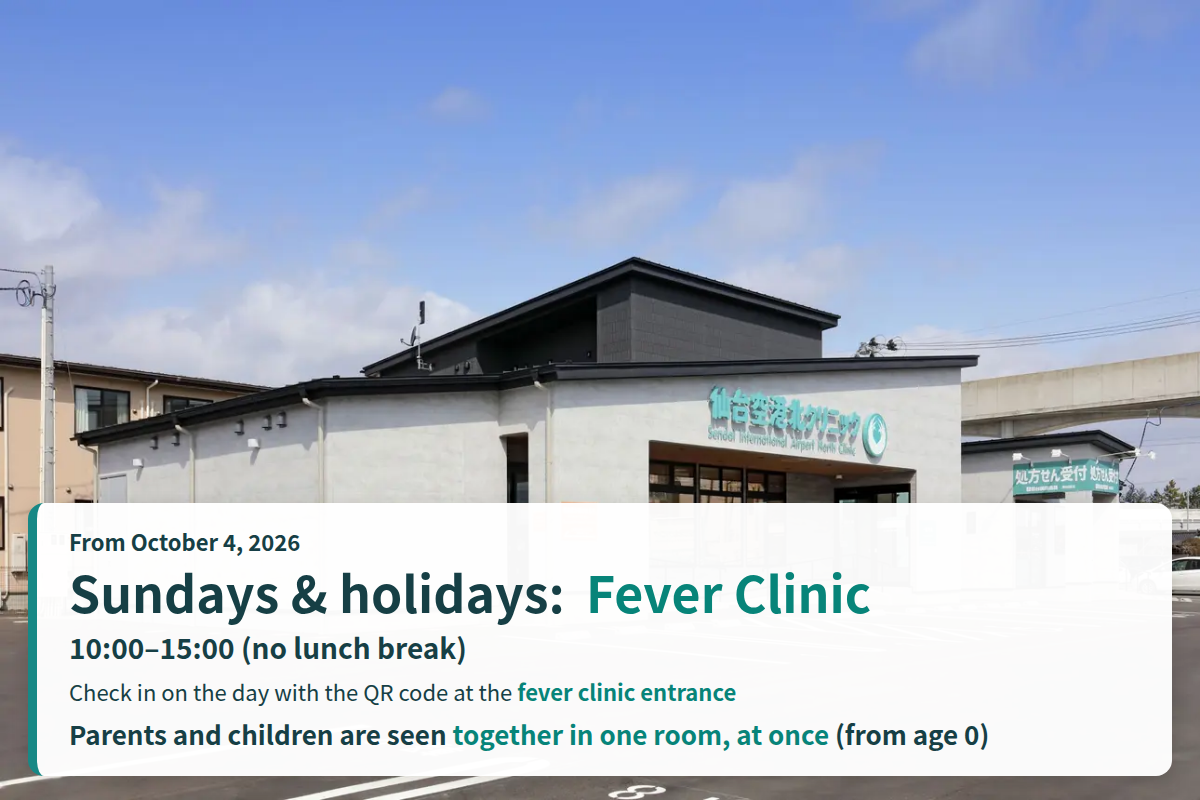
Since October 4, 2026, we also run the fever clinic on Sundays and national holidays
10:00 to 15:00 (no lunch break). We accept patients by same-day check-in. PCR test results are given on the same day. On Sundays and national holidays we run only the fever clinic; we do not offer general outpatient care or IV drips. Please check the clinic calendar for clinic dates and closed days. Announcement about the Sunday and national holiday fever clinic
Shunichi Gamo, MD, PhD
Director, Sendai International Airport North Clinic
Born and raised locally, he attended Yuriage Elementary School and Yuriage Junior High School in Natori City. After graduating from Tohoku University School of Medicine, he worked at Sendai Open Hospital and Kesennuma City Hospital, and then at Tohoku University Hospital. In April 2021, in the middle of the COVID-19 pandemic, he opened Sendai International Airport North Clinic. Holding to a fever clinic that never turns patients away, he cared for well over 20,000 patients with fever in the two years before COVID-19 was moved to Class 5 under Japan’s infectious disease law.
Society memberships and board certifications
Certified Member and Board Certified Fellow, Japanese Society of Internal Medicine
Board Certified Pulmonologist, Japanese Respiratory Society
Board Certified Allergist, Japanese Society of Allergology
Board Certified Specialist, Japanese Society of Anti-Aging Medicine
PhD in Medicine (Tohoku University)
[Conclusion] A long cough with a mild fever may be whooping cough [homes with a baby should act early]
Roughly, it is reasonable to suspect whooping cough if any of the following applies.
- [2 weeks or more]
It started with cold-like symptoms, and although the fever went down (or was never high), the cough alone gradually got worse and has lasted 2 weeks or more - [Coughing fits]
You cough in rapid bursts, often at night, and vomit after coughing - [Whooping sound]
After a coughing fit, you make a whistling “whoop” sound as you breathe in (this is called an inspiratory whoop) - [Outbreak around you]
Someone at school, at home, or at work has a similar long-lasting cough or has been diagnosed with whooping cough
In adults it is often just “hard to bear but I can get on with life,” and that is why it is overlooked. However, for babies under 6 months old, especially babies who have not yet been vaccinated, it is a life-threatening illness. If you live with a baby, please see a doctor early for a lingering cough, not so much for yourself as for the baby.
 Dr. Gamo
Many people say, “I thought it was just a cough.” A cough lasting more than 2 weeks is one useful guide.
In 2025, the largest whooping cough outbreak on record [centered on teenagers]
Whooping cough has been subject to universal reporting (a system in which doctors report every patient to the public health center) since 2018. According to a report by the Japan Institute for Health Security (formerly the National Institute of Infectious Diseases), the annual number of reports in 2024 was 4,096 cases. In 2025, however, weeks 1 to 21 alone (through the end of May) reached 22,351 cases, more than 5 times the whole of the previous year. That is the highest for this period since universal reporting began in 2018[1].
The outbreak did not stop there. In a report from January 2026, notifications for weeks 1 to 44 of 2025 (through the end of October) reached 84,911 cases[2]. That is 5 times the whole of 2019 (16,847 cases), which had been the highest since universal reporting began.
The median age was 12, and teenagers made up 58.7% of all cases. Of the 14,531 cases whose vaccination history was recorded, 13,072 (about 9 in 10) had completed all 4 doses of the routine vaccination[1]. In other words, this is not an illness that you never get again once you have been vaccinated; the outbreak came when immunity had weakened in schoolchildren and teenagers.
Dr. GamoThis is an illness you can catch even after being vaccinated. Please keep it in mind when a cough drags on.
The same report says that in adults it is “often mild, and may be overlooked even when the cough lasts a long time”[1]. Babies, on the other hand, can progress to respiratory arrest from apnea attacks (attacks in which breathing stops) without the characteristic cough, and pneumonia and encephalopathy (brain dysfunction) have also been reported[1]. It is the same germ, but the illness looks completely different by age. That is what makes whooping cough troublesome.
How the cough of whooping cough progresses [a low fever is actually typical]
Roughly, whooping cough runs in 3 stages[1][3].
| Stage | Approximate length | What it looks like |
|---|---|---|
| Catarrhal stage | About 2 weeks | Cannot be told apart from an ordinary cold. Runny nose and a mild cough. No fever, or only a mild one |
| Paroxysmal stage | About 2 to 3 weeks | Severe coughing fits. More often at night. An inspiratory whoop and vomiting after coughing. In infants, pauses in breathing and poor color may stand out more than the cough |
| Recovery stage | About 2 to 3 weeks or more | The fits gradually decrease. The whole course is 2 to 3 months |
As the name “hundred days cough” (the Japanese name) suggests, it takes 2 to 3 months to get better[1]. In fact, you can already pass it on during the first stage, when it looks like a cold. By the time you notice “something is wrong,” you may already have given it to your family.
In adults, “not typical” is what is typical
There is a study of how useful each symptom is for diagnosing whooping cough. Researchers in the United Kingdom and elsewhere pooled 53 studies that compared the symptoms of people with laboratory-confirmed whooping cough and those without it[4]. The methods were a systematic review (a method that gathers and evaluates studies from around the world by a fixed procedure) and a meta-analysis (a method that combines the data of several studies and recalculates).
- Symptoms often present in adults with whooping cough (sensitivity = the proportion of people with whooping cough who have the symptom)
Fit-like (paroxysmal) cough: 93.2% / No fever: 81.8% - Symptoms that point toward whooping cough when present (specificity = the proportion of people without whooping cough who do not have the symptom)
Vomiting after coughing: specificity 77.7% (sensitivity 32.5%) / Inspiratory whoop: specificity 79.5% (sensitivity 29.8%)
Put simply, about 8 in 10 adults with whooping cough have no fever, and most have a fit-like cough. On the other hand, the textbook “whoop” sound and vomiting after coughing occur in only about 3 in 10 adults. But when they do occur, they point quite strongly to whooping cough[4]. So you cannot say “there’s no whooping sound, so it isn’t whooping cough”. A fit-like cough that continues without fever is reason enough to suspect it.
Dr. GamoEven without a fever, a fit-like cough that keeps going is itself an important clue.
In children, the sensitivity of vomiting after coughing is 60.0% and the specificity is 66.0%, so it is less decisive than in adults[4]. A lingering cough in children is also hard to tell apart from mycoplasma, so please also see the article on mycoplasma.
[Call 119 or go to the emergency department] Why whooping cough is dangerous for babies
Babies under 6 months old, especially those who are unvaccinated or have not yet finished 3 doses, are at an age when whooping cough easily becomes severe[5]. Without the characteristic cough, they can stop breathing from apnea attacks or develop pneumonia or encephalopathy[1]. In 2025, a children’s hospital in Tokyo also reported a 1-month-old girl who died after respiratory failure and pulmonary hypertension (a state in which the pressure in the lung blood vessels rises and strains the heart) progressed[6].
In a nationwide survey of pediatric intensive care units (PICUs), 65 children who received intensive care for whooping cough were registered over about one year, from December 2024 to December 2025, and 8 (12%) died[7]. All but one were under 1 year old, and every child whose vaccination history was known was unvaccinated. Deaths from whooping cough from 2006 to 2023 were 0 to 3 a year, so this is a different order of magnitude[7].
If a baby shows any of the following, call 119 or go to an emergency department without hesitation, even at night or on a holiday.
- Breathing stops, or the baby goes limp, during or right after coughing
- The face or lips turn blue-purple or white
- Very fast breathing, breathing with the shoulders, or the chest and the area below the throat sinking in with each breath
- Barely able to take breast milk or formula, or limp with a slow response
- Has had a seizure
Even if it is not that serious, when a baby under 6 months old starts to cough and someone in the family has a lingering cough, take the baby to a pediatrician or other medical institution the same day. Infants may not have the characteristic cough, and waiting because “it’s just a mild cough” is dangerous[1].
It is the family who pass it to the baby
Babies do not go out on their own. The ones who pass it on are the adults and siblings around them. In an Italian study of the parents of 55 babies under 6 months old hospitalized for whooping cough, blood tests suggested that at least one parent was the source of infection for 49.1% of the babies. When the parents’ cough symptoms were taken into account, this rose to 56.4%[8]. Roughly, this study means that about half of whooping cough in babies is caught from a parent.
In the report from the Tokyo children’s hospital mentioned above (5 cases in which a resistant strain was found from November 2024 to March 2025), infection from family members, such as a sibling living in the same home, was suspected, including for the girl who died[6]. In the national tally as well, most cases in 2025 with a known route of infection were household infections from siblings, fathers, or mothers[2]. A parent’s “just a lingering cough” can be fatal to a baby. That is the meaning of this article’s title.
Dr. GamoBabies usually catch it from their family. Family members with a cough, please take care when you are near the baby.
Tests and treatment [start antibiotics early and finish them]
Tests
Tests for whooping cough include nucleic acid amplification tests (PCR and LAMP) that look for the germ’s genes with a swab from the back of the nose, and blood tests for antibodies[1]. There are many other causes of cough, and which test is needed is decided at the exam. At your visit, please tell us the date your cough began, whether you have a fever, whether you vomit after coughing, whether you hear a whistling sound, whether anyone at home or school has the same symptoms, and whether you live with a baby or a pregnant woman.
The core of treatment is a macrolide antibiotic
For whooping cough we use macrolide antibiotics (such as clarithromycin and azithromycin; antibiotics are medicines that kill bacteria)[1][5]. The Japan Pediatric Society says that antibiotics given even in the period when coughing fits are severe (the paroxysmal stage) markedly reduce spread to other people[5]. In other words, it is an important medicine for stopping spread to those around you. If you have symptoms that suggest whooping cough, it is important to start without hesitation when needed and to finish all that you are given.
A Cochrane review (an international systematic review that gathers several studies to test an effect) pooled 13 clinical trials of antibiotics for whooping cough (2,197 people)[9]. Among the treatment trials, short courses such as azithromycin for 3 to 5 days or clarithromycin for 7 days were compared with the long course of erythromycin for 10 to 14 days. The effect of clearing the germ was the same (relative risk 1.02, 95% confidence interval 0.98 to 1.05), and side effects were fewer with the short courses[9]. Relative risk is the ratio of how often an outcome occurs with two treatments; 1.0 means no difference. A 95% confidence interval is the range in which the true value probably lies.
What matters here is to take the antibiotic to the very end, even if you feel better partway through. If the germ remains, you keep passing it on. Conversely, please do not take leftover antibiotics from before on your own judgment. The duration and type will not match, and it only increases resistant bacteria.
“Resistant strains” that macrolides work poorly against are increasing
Since 2024, strains of the whooping cough germ that macrolide antibiotics work poorly against (macrolide-resistant strains) have been found one after another in Japan as well[1][5]. In a study that collected specimens from 54 children aged 0 to 15 with suspected whooping cough at 6 clinics in Japan from March to August 2025, 43 of the 52 strains whose genes could be analyzed (82.7%) carried a gene mutation linked to macrolide resistance. It ranged from 40 to 96% depending on the facility[10].
The Japan Pediatric Society says that because reports of resistant strains are increasing in Japan, it will consider using sulfamethoxazole-trimethoprim (ST combination, a different type of antibiotic) together with a macrolide[5]. However, ST combination has limits, such as not being usable in newborns and pregnant women, and choosing the medicine is the doctor’s job. There are two things I ask of patients.
- If your cough does not lessen even after taking antibiotics, or if a family member newly develops a cough, do not wait on your own judgment; come back to see a doctor
- Even after you start antibiotics, wear a mask while the cough continues and avoid contact with babies and pregnant women as much as possible (the society also says that the response to treatment alone cannot tell you the germ has gone[5])
Note that the role of the antibiotic is to clear the germ and stop spread to others; it is not a medicine that immediately stops a cough that has already begun. The Cochrane review also says that antibiotics have the effect of clearing the whooping cough germ from the back of the nose[9]. “I took the medicine but the cough didn’t stop” does not mean “it isn’t working,” so finish the course, and keep wearing a mask while the cough continues.
Dr. GamoThe cough may continue for a while even after the antibiotics are finished. Please keep wearing a mask to protect those around you.
When can they return to school or nursery? [the rules on staying home]
Whooping cough is a Class 2 infectious disease under the Enforcement Regulations of the School Health and Safety Act, and the period of exclusion from school is set as follows[11].
- Until the characteristic cough disappears, or until 5 days of treatment with an appropriate antibacterial agent has been completed
In other words, it is either “until the fit-like cough disappears” or “until you have finished 5 days of a proper antibiotic.” Waiting for the cough to stop completely takes 2 to 3 months, so in practice the 5 days of antibiotics is the guide. However, the text of the regulation also has a proviso: “this does not apply when the school doctor or another doctor recognizes, depending on the condition, that there is no risk of infection,” so the final decision rests with the doctor[11].
What I would like you to be careful about is the problem of resistant strains. The Japan Pediatric Society says that even when the 5 days of antibiotics are over and the child can go to school, there may be a resistant strain, so cough etiquette such as wearing a mask is needed while the cough continues[5]. Nurseries often follow the school standard, so please check with your nursery on whether a return-to-nursery form is needed. There is no legal rule for adults returning to work, but the school standard is a useful reference. Please follow your workplace’s rules too, and keep wearing a mask while the cough continues.
Dr. GamoEven once your child can go back to school, please remember a mask while the cough continues.
Vaccines [the 5-in-1 vaccine, and a booster before school]
The mainstay of preventing whooping cough is the vaccine. In Japan, the 5-in-1 vaccine (DPT-IPV-Hib) is a routine vaccination, starting at 2 months of age, with 3 doses in the first year and 1 dose after the first birthday, 4 doses in total[5]. The Japan Pediatric Society urges “get vaccinated promptly once your baby turns 2 months old”[5]. If vaccination slips because of a stay at the mother’s family home or illness, the most dangerous period is left unprotected. Please have at least the 2-month vaccination on schedule.
Dr. GamoThe vaccination at 2 months of age is the first step in protecting your baby. Let’s check the schedule in the maternal and child health handbook.
The problem is that there is no booster system after the 4 doses. The effect of the vaccine is estimated to weaken about 4 to 12 years after vaccination[2]. As we saw earlier, the 2025 outbreak centered on teenagers, and many of the reported cases had finished all 4 doses[1]. In the national tally as well, about 60 to 70% of patients aged 1 to 14 had completed 4 doses[2]. The Japan Pediatric Society recommends 2 booster doses, although they are optional (self-paid)[5]. These are: one dose of the DPT vaccine (3-in-1) before school, and at age 11 to 12 the DPT (3-in-1) vaccine in place of the routine DT (2-in-1) vaccine.
In Australia and in Europe and North America, the approach is for mothers in late pregnancy to receive a vaccine that includes whooping cough protection[5]. The idea is to protect the baby to be born with transferred antibodies (antibodies passed from the mother to the baby through the placenta). In Japan it is not a routine vaccination, and the policy differs by country and medical institution. If you are pregnant, please consult your regular obstetrician. The society also recommends vaccination for everyone who is involved with the baby[5].
* If you would like a booster, please consult your regular doctor.
For a lingering cough, come to our fever clinic [Sundays and national holidays too]
“I don’t have a fever, but my cough has gone beyond 2 weeks.”
“Someone in my family has whooping cough.”
“I live with a baby, so I’m worried about my own cough.”
If any of these applies to you, please come to the fever clinic.
Even without a fever, if you have symptoms that raise concern about an infection, such as a lingering cough or infections going around you, you are eligible for the fever clinic. Our policy is not to turn away anyone seeking the fever clinic (depending on your symptoms, we may guide you to a more suitable medical institution). We also see fevers in small children.
| Day | Hours |
|---|---|
| Mon, Tue, Wed, Fri, Sat | 9:00-12:00 / 14:00-18:00 |
| Sundays and national holidays (from October 4, 2026) | 10:00-15:00 (no lunch break, fever clinic only) |
| Thursday | Closed |
The Sunday and national holiday fever clinic runs from 10:00 to 15:00 (no lunch break). Please check the clinic calendar for clinic dates and closed days. On Sundays and national holidays we run only the fever clinic; we do not offer general outpatient care or IV drips. For details, please see the announcement about the Sunday and national holiday fever clinic.
What happens during your visit (no reservation needed)
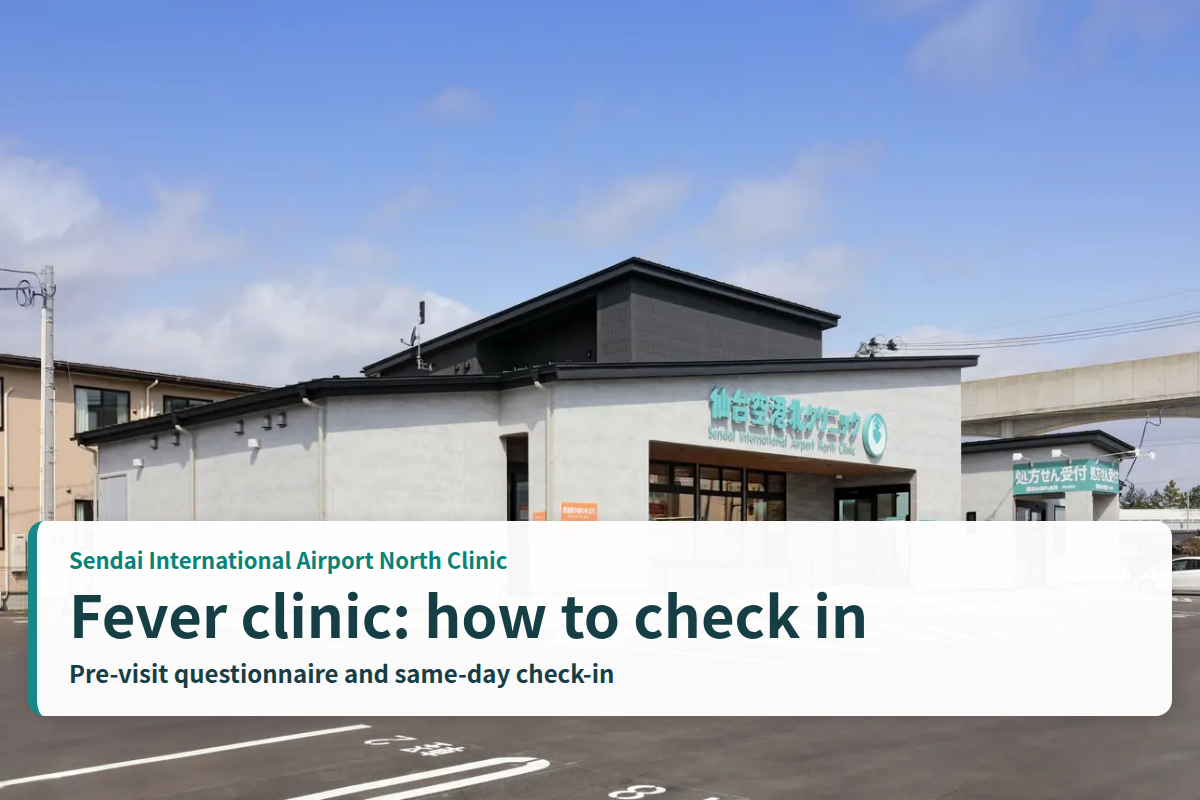
- Before you come, fill in the pre-visit questionnaire (optional; you may also fill it in when you check in at the entrance)
- Scan the QR code at the fever clinic entrance and check in by choosing “I have arrived and want to check in” (required)
- On weekdays, once you have checked in, please wait in your car
- On Sundays and national holidays, after check-in we confirm your health insurance card (My Number insurance card, certificate of eligibility, etc.) at the general outpatient entrance. We do not run general outpatient care on Sundays and national holidays, so please feel free to come in. When the confirmation is done, please wait in your car or elsewhere
- When your turn is near, we will call you by SMS or phone. Press the intercom at the fever clinic entrance and say your name
For the detailed steps, please see About the fever clinic pre-visit questionnaire and same-day check-in.
Patients are generally seen in order of check-in, but the order may change depending on how severe the symptoms are. If a baby seems to be struggling to breathe or looks pale, please use an emergency department or call 119 instead of the fever clinic. Please also note that we cannot give IV drips on Sundays and national holidays. If you are unsure about a child’s condition at night or on a holiday, please also refer to the article on what to do when a child has a fever at night, on Sundays, or on national holidays.
 Dr. Gamo
Whether there is a baby or a pregnant woman at home is very important information. It changes who is protected when your cough is dealt with.
Frequently asked questions (FAQ)
- I have no fever but have had a cough for 3 weeks. Could it be whooping cough?
-
It is possible. About 8 in 10 adults with whooping cough have no fever, and a fit-like cough is typical. If you vomit after coughing or hear a whoop when you breathe in, it looks even more like whooping cough. There are other causes too, such as mycoplasma, asthma, sinusitis, and stomach acid reflux, so please see a doctor once and have a cough that has gone beyond 2 weeks checked.
- I was diagnosed with whooping cough. Until when can I pass it on?
-
You can pass it on from the first stage, when it looks like a cold, and spread to others drops greatly once antibiotics are started. Under the School Health and Safety Act, exclusion from school lasts until the characteristic cough disappears or until 5 days of an appropriate antibiotic have been completed. However, because there may be a resistant strain, the Japan Pediatric Society recommends continuing cough etiquette such as wearing a mask while the cough continues. Please avoid contact with babies and pregnant women as much as possible.
- I finished 5 days of antibiotics but still have a cough. Isn’t it working?
-
Not necessarily. Antibiotics clear the germ and stop spread to others; they are not medicines that immediately stop a cough that has already begun. The cough of whooping cough can continue for several weeks to 2 to 3 months even after the germ is gone, so “I finished the medicine but still have a cough” is not unusual. However, if the coughing fits actually get worse, a family member newly develops a cough, or you have trouble breathing, please come back, since there may be a resistant strain.
- I have a 1-month-old baby, and someone in the family has a lingering cough. What should I do?
-
First, have the family member with the cough see a doctor early to check whether it is whooping cough. Wear a mask and wash your hands when you are with the baby. If the baby starts to cough, take the baby to a pediatrician the same day, even if it is mild. If the baby stops breathing during coughing, the face or lips turn blue-purple, or the baby cannot drink milk, call 119 or go to an emergency department, even at night or on a holiday.
- My child has had all 4 vaccine doses. Is a booster needed?
-
The immunity from the 4 routine doses weakens by around the time children start elementary school. The 2025 outbreak also centered on teenagers, and many reported cases had finished all 4 doses. The Japan Pediatric Society recommends, though optional, one dose of the 3-in-1 vaccine before school, and at age 11 to 12 the 3-in-1 vaccine in place of the 2-in-1. Cost and supply differ by medical institution, so please consult your regular doctor.
- Can I go to the fever clinic even without a fever?
-
Yes. Our fever clinic has no rule about “from what temperature,” and even without a fever you are eligible if you have symptoms that raise concern about an infection, such as a lingering cough. We accept patients by same-day check-in using the QR code at the fever clinic entrance. We also run it on Sundays and national holidays from 10:00 to 15:00 (please check the calendar for open days). On Sundays and national holidays we run only the fever clinic and do not give IV drips.
Summary [even with a mild fever, see a doctor for a cough lasting over 2 weeks]
- In 2025, whooping cough had its largest outbreak on record (84,911 cases by the end of October). It centered on teenagers, and most had already had all 4 doses. Both adults and children get it
- About 8 in 10 adults with whooping cough have no fever and have fit-like coughing that continues. The whooping sound and vomiting after coughing occur in only about 3 in 10
- For babies (especially under 6 months old and before vaccination), it can be life-threatening through pauses in breathing and respiratory failure, and deaths occurred one after another in 2025. If the baby stops breathing or the lips look blue-purple, call 119
- About half of whooping cough in babies comes from a parent. If you are an adult living with a baby, see a doctor early for a lingering cough
- Start an antibiotic (a macrolide) early once whooping cough is suspected, and finish it even if you feel better. Resistant strains are increasing, so wear a mask while the cough continues
- Exclusion from school is “until the characteristic cough disappears, or until 5 days of an appropriate antibiotic have been completed”
- Give the 2-month 5-in-1 vaccine on schedule. The Japan Pediatric Society recommends 3-in-1 boosters before school and at age 11 to 12
Even if whooping cough is only a “stubborn cough” for the person who has it, it becomes a different illness once it is passed to a baby. Please do not leave it alone because the fever is mild; see a doctor early for a cough that has gone beyond 2 weeks. Please leave the medical care to us.
That’s all.
Disclaimer
This article is intended to provide general medical information and does not replace an examination, diagnosis, or treatment by a doctor. The content is based on medical knowledge at the time of publication, but the appropriate response differs for each individual. If you are worried about your symptoms, please consult a medical institution.
References
- Japan Institute for Health Security, National Institute of Infectious Diseases. IDWR 2025 Week 22 <Notable infectious diseases> Pertussis (2025 weeks 1-21, as of May 28, 2025) (in Japanese). Infectious Disease Information site. 2025. https://id-info.jihs.go.jp/surveillance/idwr/featured/2025/22/index.html
- Japan Institute for Health Security, National Institute of Infectious Diseases. Pertussis, as of November 2025 (in Japanese). Infectious Agents Surveillance Report (IASR) Vol.47 p1-2. 2026. https://id-info.jihs.go.jp/surveillance/iasr/pathogens/vol47/551/551t.html
- Ministry of Health, Labour and Welfare. Pertussis (in Japanese). Ministry of Health, Labour and Welfare website. Accessed October 2026. https://www.mhlw.go.jp/stf/seisakunitsuite/bunya/kenkou/kekkaku-kansenshou19/whooping_cough.html
- Moore A, Ashdown HF, Shinkins B, Roberts NW, Grant CC, Lasserson DS, et al. Clinical Characteristics of Pertussis-Associated Cough in Adults and Children: A Diagnostic Systematic Review and Meta-Analysis. Chest. 2017 Aug;152(2):353-367. doi:10.1016/j.chest.2017.04.186 PMID: 28511929
- Japan Pediatric Society, Committee on Immunization and Infectious Disease Control. On the increase in pertussis cases and in the frequency of isolation of macrolide-resistant strains (March 29, 2025) (in Japanese). Japan Pediatric Society. 2025. https://www.jpeds.or.jp/uploads/files/20250402_hyakunitizeki1.pdf
- Nakamura Y, Shibata A, Horikoshi Y, et al. Detection of macrolide-resistant Bordetella pertussis infections at a children’s hospital in Tokyo (in Japanese). Infectious Agents Surveillance Report (IASR) rapid communication. 2025. https://id-info.jihs.go.jp/surveillance/iasr/pathogens/vol46/543/543p01.html
- Kurosawa H, Nagai Y, Shimizu N, et al. Characteristics of severe (fatal) pertussis cases in the improved cross-sectional ICU information search system (improved CRISIS) (in Japanese). Infectious Agents Surveillance Report (IASR) Vol.47 p37-39. 2026. https://id-info.jihs.go.jp/surveillance/iasr/pathogens/vol47/552/552d01.html
- Fedele G, Carollo M, Palazzo R, Stefanelli P, Pandolfi E, Gesualdo F, et al. Parents as source of pertussis transmission in hospitalized young infants. Infection. 2017 Apr;45(2):171-178. doi:10.1007/s15010-016-0943-6 PMID: 27614887
- Altunaiji S, Kukuruzovic R, Curtis N, Massie J. Antibiotics for whooping cough (pertussis). Cochrane Database Syst Rev. 2007 Jul;2007(3):CD004404. doi:10.1002/14651858.CD004404.pub3 PMID: 17636756
- Oishi T, Nakano T. Analysis of Macrolide Resistance in Bordetella pertussis Isolated from Japanese Children in 2025 Using Test Kit and Sequence Method. Biomedicines. 2026 Jan;14(1):167. doi:10.3390/biomedicines14010167 PMID: 41595701
- Ministry of Education, Culture, Sports, Science and Technology. Enforcement Regulations of the School Health and Safety Act (Ministry of Education Ordinance No. 18 of 1958), Article 19 (in Japanese). e-Gov Law Search. Accessed October 2026. https://laws.e-gov.go.jp/law/333M50000080018
Related articles on a lingering cough and fever
For the fever clinic on Sundays and holidays, see the announcement about the fever clinic on Sundays and holidays; for how to visit, see the page on the fever clinic pre-visit questionnaire and same-day check-in.