If you are in a hurry
- When your child has a headache and a fever, first check three things so that you do not miss meningitis: a stiff neck, a rash, and a change in consciousness
- Call 119 if your child’s consciousness seems wrong, a seizure does not stop, or your child does not respond when you call them
- Even if your child is active and drinking, see a doctor the same day if the headache is severe, they vomit again and again, or they have a rash
Hello. I am Shunichi Gamo, MD, PhD, a board-certified pulmonologist and the director of Sendai Airport North Clinic.
When your child says “my head hurts” and has a fever, the biggest worry is probably meningitis (inflammation of the membranes that cover the brain and spinal cord).
“Is this headache really just a cold?”
I understand this worry very well.
To give you the conclusion first: when your child has a headache and a fever, first check three things: a stiff neck, a rash, and a change in consciousness. A stiff neck is one of the findings that makes meningitis more likely[1]. A rash or a change in consciousness can appear later and may not stand out at an early stage[2].
In this article, as a pulmonologist, I explain the symptoms seen in meningitis, where to draw the line for calling 119 (Japan’s emergency number), where to get advice at night and on holidays, how well the Hib and pneumococcal vaccines work, and what we would like you to tell us when you come to see a doctor.
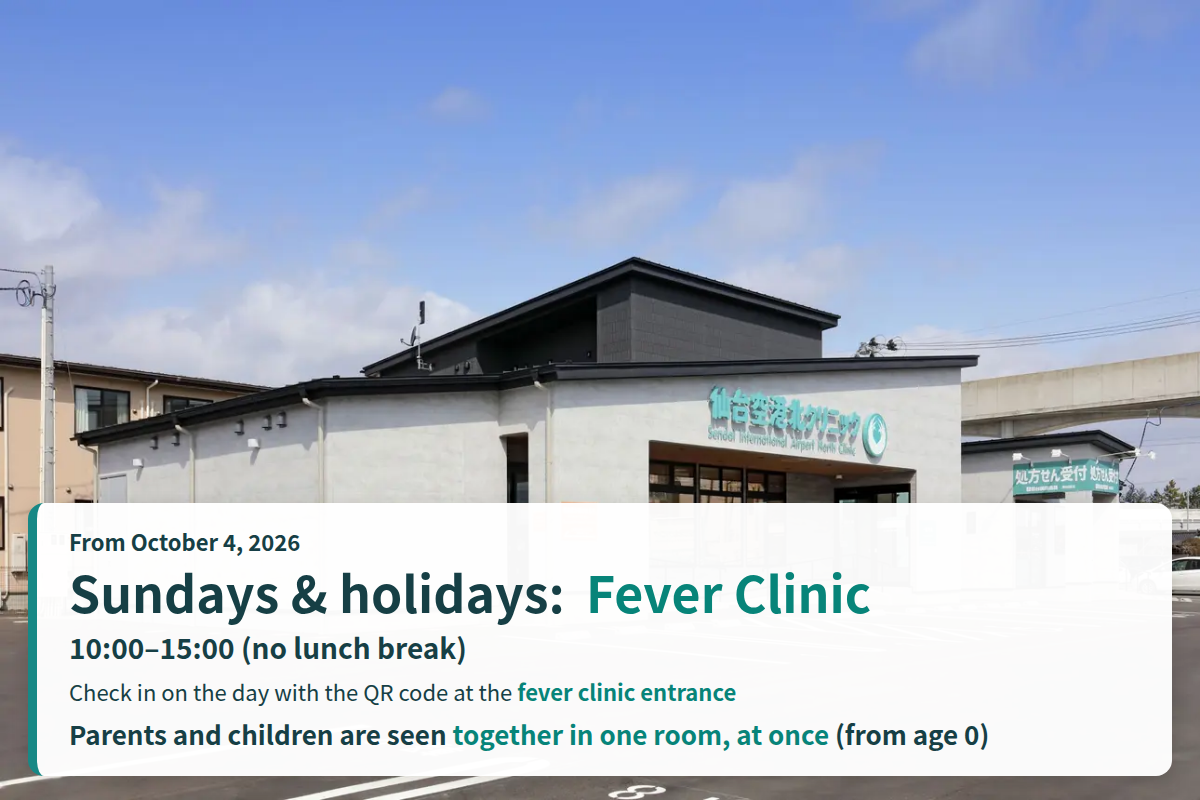
First, a note about our fever clinic on Sundays and national holidays. PCR testing for influenza and COVID (a test that copies the virus’s genetic material in order to detect it) gives results the same day.
From October 4, 2026, we also run the fever clinic on Sundays and national holidays
10:00 to 15:00 (no lunch break). You check in on the day. We give you the PCR result the same day. On Sundays and holidays we see fever patients only, and we do not offer general outpatient care or IV drips. Please check the clinic calendar for clinic dates and closed days. Notice: fever clinic on Sundays and national holidays
Shunichi Gamo, MD, PhD
Director, Sendai International Airport North Clinic
Born and raised locally, he attended Yuriage Elementary School and Yuriage Junior High School in Natori City. After graduating from Tohoku University School of Medicine, he worked at Sendai Open Hospital and Kesennuma City Hospital, and then at Tohoku University Hospital. In April 2021, in the middle of the COVID-19 pandemic, he opened Sendai International Airport North Clinic. Holding to a fever clinic that never turns patients away, he cared for well over 20,000 patients with fever in the two years before COVID-19 was moved to Class 5 under Japan’s infectious disease law.
Society memberships and board certifications
Certified Member and Board Certified Fellow, Japanese Society of Internal Medicine
Board Certified Pulmonologist, Japanese Respiratory Society
Board Certified Allergist, Japanese Society of Allergology
Board Certified Specialist, Japanese Society of Anti-Aging Medicine
PhD in Medicine (Tohoku University)
In short: with a child’s headache and fever, first check the neck, rash and consciousness
First, check three things: a stiff neck, a rash, and a change in consciousness.
The main symptoms of meningitis are fever, headache and vomiting. On top of these come signs of meningeal irritation (a reaction in which the neck and back become stiff), such as a stiff neck[3]. However, in newborns and infants these symptoms are said to often be unclear[3].
Aseptic meningitis caused by viruses also has fever, headache and vomiting as its three main signs, and a stiff neck is seen in most cases[4]. Infants may have fever and fussiness, and older children may have headache, nausea, or photophobia (finding light too bright)[4][5].
| Sign to check | What it looks like | Source |
|---|---|---|
| Stiff neck (nuchal rigidity) | Has trouble touching the chin to the chest and does not want to move the neck | [1][4] |
| Rash | Pinpoint bleeding spots or purpura (bleeding under the skin) | [2][5] |
| Change in consciousness | Answers strangely when you call them, or seems dazed | [2][6] |
| Light seems too bright (photophobia) | Dislikes bright places or the light from the TV | [4][5] |
| Repeated vomiting / cannot drink | Keeps vomiting and cannot keep fluids down | [3][6] |
 Dr. Gamo
You do not need to check all three at once. Even “somehow doesn’t like having the neck touched” is an important clue.
Are a “stiff neck” or a “rash” signs of meningitis?
Both are clues to meningitis, but neither one alone is enough to decide.
A systematic review that combined 10 studies of children with bacterial meningitis found that a stiff neck reported in the history made meningitis more likely. Other clues were a bulging fontanelle (the soft spot on a baby’s head), seizures outside the usual age range for febrile seizures, and feeding less[1]. On the other hand, this study concluded that “no single finding can make the diagnosis.” The absence of signs of meningeal irritation did not rule out meningitis, and neither did the absence of fever[1].
In aseptic meningitis, too, a stiff neck is seen in most cases[4]. In other words, you cannot say it is bacterial just because there is a stiff neck, or viral because there is not. To tell them apart, a test of the cerebrospinal fluid (the fluid around the spine) is needed[4].
As for rash, a study of 448 children admitted to hospital with meningococcal infection found that a bleeding rash, signs of meningeal irritation and impaired consciousness appeared late (a median of 13 to 22 hours after onset). In the first 4 to 6 hours, most symptoms were nonspecific[2]. The signs that were common at an early stage (a median of 8 hours) were leg pain, cold hands and feet, and a change in skin color, seen in 72% of the children[2]. Do not wait for a rash before going to a doctor; it is important to act on the early signs.
Dr. GamoWithout waiting for a rash, please also watch for leg pain, cold hands and feet, and changes in skin color.
Meningococcal meningitis can cause pinpoint bleeding spots and purpura within a few hours of onset[5], but patient reports in Japan have always been few (0 to 2 cases a year from 2001 to 2012)[7], and the study data above are not from Japan. In Japan, viral meningitis and bacterial meningitis caused by Hib, pneumococcus and similar bacteria are the more familiar concerns.
What should I do if my child’s consciousness seems wrong or a seizure does not stop?
Call 119 right there. If a child with a headache is limp, has a seizure, or their consciousness seems wrong, call an ambulance right away[6].
If your child has a very bad headache, vomits again and again, has slurred speech, has paralysis of an arm or leg, or is unsteady and cannot walk normally, do not wait, even at night or on a holiday: go to a medical facility (emergency department) right away[6].
Seizures can also be caused by fever (febrile seizures)[6]. However, if a seizure does not stop, or your child does not regain consciousness after a seizure, call 119. For seizures, please also see our article on febrile seizures. A seizure at onset has been reported as one of the risk factors for meningitis becoming severe[7].
Dr. GamoAnyone would panic when a seizure happens in front of them. If it does not stop, or consciousness does not come back, call 119.
When should I call 119, and where can I get advice at night and on holidays?
If even one of the following applies, call 119 without hesitation. This is the same at night and on holidays.
- Has no energy and is limp
- Has a seizure (convulsion), or it does not stop
- Consciousness seems wrong, or answers strangely
- Does not respond when you call them, or breathing looks very difficult
- Does not clearly regain consciousness after a seizure
With a fever, whether your baby is under 3 months old is also an important point to check[6]. A baby under 3 months should see a doctor early, even if they seem well. For details, see our article on fever in babies under 3 months.
If there are no urgent symptoms and your child is active and drinking, take them to a clinic or hospital during regular opening hours[6]. If the headache is severe, they are vomiting, or they have a rash, do not wait: see a doctor the same day. If you are unsure what to do at night, please also see our article on what to do when your child has a fever at night or on a holiday.
In Miyagi Prefecture, you can talk to a nurse about a sudden fever or injury in your child at night through the children’s night-time advice line (#8000). It is open every day from 19:00 to 08:00 the next morning, it is for parents and others caring for children under about 15, and it gives advice only, not medical treatment[8]. However, if any of the 119 signs above are present, call 119 without calling the advice line first.
Dr. Gamo#8000 advice is available every day from 19:00 to 08:00 the next morning. Keeping the number handy helps you stay calm at night.
Have the Hib and pneumococcal vaccines reduced meningitis?
Yes, greatly. The Hib and pneumococcal vaccines have sharply reduced bacterial meningitis in children.
| Vaccine | Reported effect |
|---|---|
| Hib (Haemophilus influenzae type b) | In Japan, after it became a routine (publicly funded) vaccination, invasive Haemophilus influenzae disease in children under 5 fell by 93%[9]. Haemophilus influenzae meningitis fell from 7.7 to 0.0 per 100,000 children under 5[10] |
| Pneumococcus | Invasive pneumococcal disease fell by about 80%, from about 24 to 26 per 100,000 children under 5 to about 4.8 in 2022[11] |
| Meningococcus | Cases in Japan have always been few: 0 to 2 a year from 2001 to 2012[7] |
In Japan before these vaccines became widespread, about 600 children a year had Hib meningitis; about 2 to 3% died and about 15% were left with lasting effects such as damage to the brain or hearing. About 200 children a year had pneumococcal meningitis; about 6 to 7% died and about 30% were left with lasting effects[5].
Even now, we cannot let our guard down. Infections caused by types of pneumococcus that the vaccine does not cover, and by Haemophilus influenzae other than Hib, still occur[5][10]. In pneumococcal meningitis, it is said that 2% of children die and 10% are left with lasting effects such as hearing loss or developmental delay[11]. Even if your child has been vaccinated, the vaccines cannot completely prevent meningitis.
Today, Hib is mainly given as part of the five-in-one vaccine (diphtheria, whooping cough, tetanus, inactivated polio and Hib). The standard schedule is 3 doses between 2 and 7 months of age plus 1 booster, 4 doses in total, and the pneumococcal vaccine (PCV) is also basically 3 initial doses and 1 booster[10][11]. If your child started late, the number of doses depends on age, so check your Maternal and Child Health Handbook and ask your local government or your family doctor[11].
Dr. GamoYou can check the number and timing of the doses in the maternal and child health handbook.
What should I tell the doctor at the visit?
If you tell us the following, we can reach a diagnosis sooner. Please bring a written note or enter it in the pre-visit questionnaire.
- When the headache started, and when it is at its worst
- How the fever has gone (since when, and the highest temperature)
- How many times your child has vomited, whether they can drink and eat, and how often they pee
- Whether there has been a seizure, and any time their consciousness seemed wrong to you
- If your child took a fever reducer, the time and the type
- Infections going around nearby, any long-term illness, and medicines your child usually takes
If the fever makes your child too uncomfortable to sleep, you can bring it down with acetaminophen (Calonal and others). The dose depends on your child’s age and weight, so follow the instructions of your doctor or pharmacist, or the medicine leaflet. If anything at all seems different from usual, see a doctor the same day.
Dr. GamoIf you used a fever reducer, please also note the time you gave it and which kind it was.
For when to go back to the doctor if your child’s condition changes after being told it is “viral,” see our article on changes that call for another visit.
Frequently asked questions
- It is only a headache and a fever. Can I tell at home whether it is meningitis?
-
It is hard to tell at home, and confirming it requires a test of the cerebrospinal fluid[4]. That is exactly why you should check the neck, rash and consciousness, and see a doctor if anything seems even slightly suspicious. It is also important to know that the absence of a stiff neck does not rule out meningitis[1].
- If the fever goes down, can I assume it is not meningitis?
-
No. It is said that meningitis cannot be ruled out even when there is no fever[1]. If the headache continues after the fever goes down, your child’s consciousness seems wrong, or they vomit again and again, see a doctor right away.
- Is a seizure a sign of meningitis?
-
With a fever, a seizure can also be a febrile seizure[6]. If your child is having a seizure, or does not regain consciousness after a seizure, call 119. For what to do during a seizure, see our article on febrile seizures.
- If my child has been vaccinated, do I not need to worry about meningitis?
-
Meningitis caused by Hib and pneumococcus has fallen greatly[9][10][11]. On the other hand, types of bacteria not covered by the vaccines remain, so the vaccines cannot completely prevent meningitis[5][10]. Keep getting the vaccines, and see a doctor if your child seems different from usual.
- My child became ill in the middle of the night. Where can I get advice?
-
If your child’s consciousness seems wrong, they are having a seizure, or they are limp, call 119 without hesitation. If you are unsure, you can call Miyagi Prefecture’s children’s night-time advice line (#8000) from 19:00 to 08:00 the next morning (for children under about 15; advice only)[8].
Summary: check the neck, rash and consciousness, and see a doctor if in doubt
- When your child has a headache and a fever, first check three things so that you do not miss meningitis: a stiff neck, a rash, and a change in consciousness
- Call 119 if your child’s consciousness seems wrong, a seizure does not stop, or your child does not respond when you call them
- Even if your child is active and drinking, see a doctor the same day if the headache is severe, they vomit again and again, or they have a rash
- A stiff neck or a rash can appear late, so see a doctor based on the early signs
- At the visit, tell the doctor when the headache started, how many times your child vomited, whether there was a seizure, and what medicines they took
The first people to notice that your child “seems somehow off” are the family members who are always with them. Please tell us exactly what you noticed. Leave the medical care to us.
That’s all.
Disclaimer
This article is intended to provide general medical information and does not replace an examination, diagnosis, or treatment by a doctor. The content is based on medical knowledge at the time of publication, but the right course of action differs for each person. If you are worried about symptoms, please consult a medical facility.
References
- Curtis S, Stobart K, Vandermeer B, Simel DL, Klassen T. Clinical features suggestive of meningitis in children: a systematic review of prospective data. Pediatrics. 2010 Nov;126(5):952-60. doi:10.1542/peds.2010-0277 PMID: 20974781
- Thompson MJ, Ninis N, Perera R, Mayon-White R, Phillips C, Bailey L, et al. Clinical recognition of meningococcal disease in children and adolescents. Lancet. 2006 Feb;367(9508):397-403. doi:10.1016/S0140-6736(06)67932-4 PMID: 16458763
- Ministry of Health, Labour and Welfare. Bacterial meningitis (excluding cases identified as caused by meningococcus, pneumococcus or Haemophilus influenzae). Ministry of Health, Labour and Welfare website (in Japanese). Accessed October 2026. https://www.mhlw.go.jp/bunya/kenkou/kekkaku-kansenshou11/01-05-36.html
- Japan Institute for Health Security, Infectious Disease Information Site. Aseptic meningitis (detailed version). id-info.jihs.go.jp (in Japanese). Accessed October 2026. https://id-info.jihs.go.jp/infectious-diseases/viral-meningitis/detail/index.html
- Japan Pediatric Society, Committee on Immunization and Infectious Disease Control. Guide to infectious diseases to be prevented in schools, kindergartens, certified centers for early childhood education and care, and nursery schools (revised April 2025). Japan Pediatric Society (in Japanese). Accessed October 2026. https://www.jpeds.or.jp/uploads/files/20250430_yobo_kansensho.pdf
- Japan Pediatric Society. Children’s emergency guide (ONLINE-QQ): headache / fever (38°C or higher). kodomo-qq.jp (in Japanese). Accessed October 2026. https://kodomo-qq.jp/index.php?pname=zutsu
- Shinjoh M, Iwata S, Yagihashi T, Sato Y, Akita H, Takahashi T, et al. Recent trends in pediatric bacterial meningitis in Japan–a country where Haemophilus influenzae type b and Streptococcus pneumoniae conjugated vaccines have just been introduced. J Infect Chemother. 2014 Aug;20(8):477-83. doi:10.1016/j.jiac.2014.04.007 PMID: 24855913
- Miyagi Prefecture. Miyagi Prefecture children’s night-time advice line program (#8000). Miyagi Prefecture website (in Japanese). Accessed October 2026. https://www.pref.miyagi.jp/soshiki/iryou/shouni04.html
- Suga S, Ishiwada N, Sasaki Y, Akeda H, Nishi J, Okada K, et al. A nationwide population-based surveillance of invasive Haemophilus influenzae diseases in children after the introduction of the Haemophilus influenzae type b vaccine in Japan. Vaccine. 2018 Sep;36(38):5678-84. doi:10.1016/j.vaccine.2018.08.029 PMID: 30122645
- Ministry of Health, Labour and Welfare. Five-in-one vaccine (including Hib disease). Ministry of Health, Labour and Welfare website (in Japanese). Accessed October 2026. https://www.mhlw.go.jp/stf/seisakunitsuite/bunya/kenkou_iryou/kenkou/kekkaku-kansenshou/yobou-sesshu/vaccine/dpt-ipv-hib/index.html
- Ministry of Health, Labour and Welfare. Pneumococcal vaccine for children. Ministry of Health, Labour and Welfare website (in Japanese). Accessed October 2026. https://www.mhlw.go.jp/stf/seisakunitsuite/bunya/kenkou_iryou/kenkou/kekkaku-kansenshou/yobou-sesshu/vaccine/pneumococcus-child/index.html
▶ Overview of this topic: Fever clinic on Sundays and national holidays (from October 4, 2026, 10:00 to 15:00)
More articles to read when you have a fever
If your child’s condition changes after a fever, see our article on changes that call for another visit; for seizures, see our article on febrile seizures.