If you are in a hurry
- A cough after a cold settles within 10 days in about half of children and within 25 days in about 90%. Watch your child’s mood, fluids and breathing, and ask about a visit if it drags on[1]
- Call 119 if the lips turn purple, breathing stops, breathing is very difficult, or your child responds weakly when you call them
- Honey only after age 1. Do not give it to babies under 1 year old[2][3]
Hello. I am Shunichi Gamo, MD, PhD, a board-certified pulmonologist and the director of Sendai Airport North Clinic.
Many parents worry, “Is this all right?” when their child’s cough just won’t stop. Hearing coughing fits in the middle of the night makes it even more worrying.
“How long is this cough going to last?”
To give you the conclusion first: a cough caused by a cold settles within 10 days in about half of children and within 25 days in about 90%[1]. How many days it takes differs from child to child, so it is important to watch the breathing and mood, and to ask about a visit if it drags on.
In this article, as a pulmonologist, I explain how long a child’s cough lasts, when to see a doctor, signs that mean you should hurry, care you can give at home, how to use honey, and where to get advice at night.
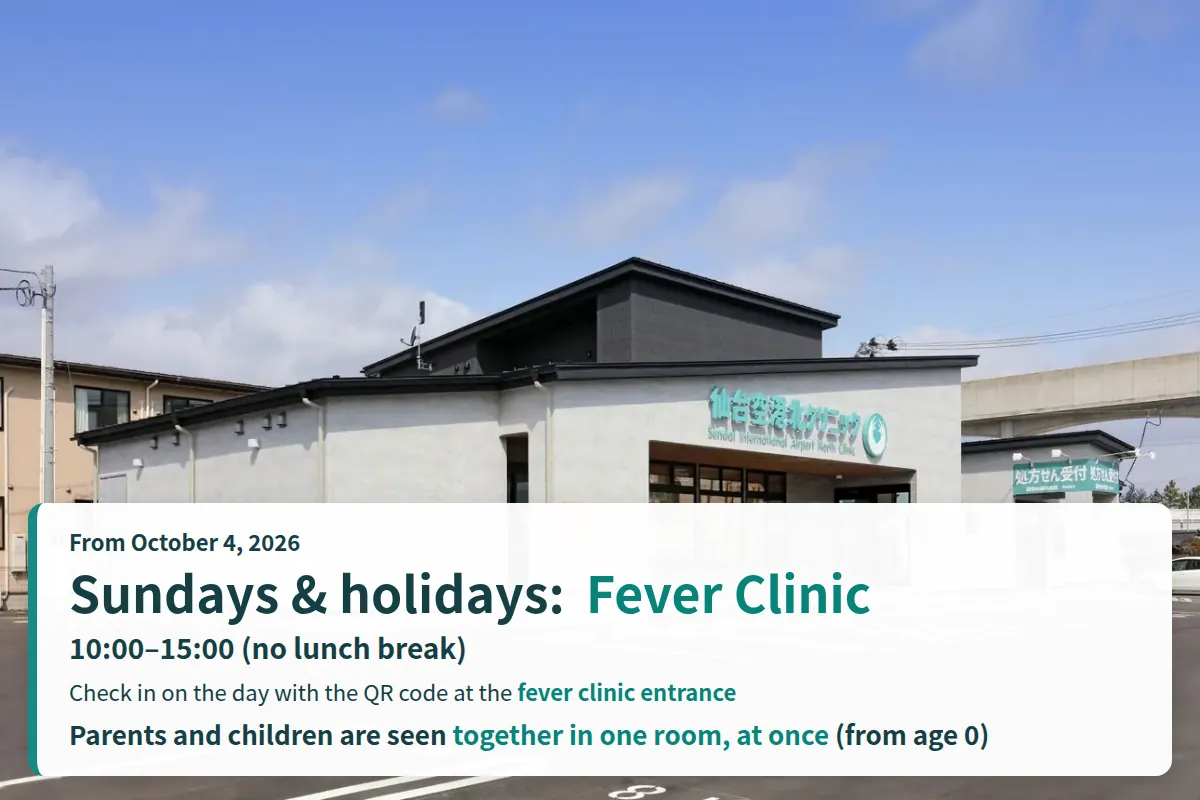
First, a note about our fever clinic on Sundays and national holidays. PCR testing for influenza and COVID (a test that copies the virus’s genetic material in order to detect it) gives results the same day.
From October 4, 2026, we also run the fever clinic on Sundays and national holidays
10:00 to 15:00 (no lunch break). You check in on the day. We give you the PCR result the same day. On Sundays and holidays we see fever patients only, and we do not offer general outpatient care or IV drips. Please check the clinic calendar for clinic dates and closed days. Notice: fever clinic on Sundays and national holidays
Shunichi Gamo, MD, PhD
Director, Sendai International Airport North Clinic
Born and raised locally, he attended Yuriage Elementary School and Yuriage Junior High School in Natori City. After graduating from Tohoku University School of Medicine, he worked at Sendai Open Hospital and Kesennuma City Hospital, and then at Tohoku University Hospital. In April 2021, in the middle of the COVID-19 pandemic, he opened Sendai International Airport North Clinic. Holding to a fever clinic that never turns patients away, he cared for well over 20,000 patients with fever in the two years before COVID-19 was moved to Class 5 under Japan’s infectious disease law.
Society memberships and board certifications
Certified Member and Board Certified Fellow, Japanese Society of Internal Medicine
Board Certified Pulmonologist, Japanese Respiratory Society
Board Certified Allergist, Japanese Society of Allergology
Board Certified Specialist, Japanese Society of Anti-Aging Medicine
PhD in Medicine (Tohoku University)
In short: how long does a child’s cough last?
A cough after a cold lasts longer than many families think. A review (a paper that collects and organizes previous studies) of studies on the course of acute cough in children found that a cold-related cough had settled within 10 days in about half of children and within 25 days in about 90%[1].
 Dr. Gamo
A cough that drags on is worrying. A cough from a cold really does last longer than you might think.
Knowing that a cold-related cough can continue past 2 weeks may make you feel a little easier.
| Symptom | Approximate time until it settles in 90% of children[1] |
|---|---|
| Cough from a cold (acute cough) | About 25 days |
| Bronchiolitis | About 21 days |
| Common cold overall | About 15 days |
| Sore throat | 2 to 7 days |
| Earache | 7 to 8 days |
| Croup | About 2 days |
However, this is only a guide to “about how long it usually takes to get better.” If breathing looks difficult, your child is in a bad mood, or cannot drink, see a doctor regardless of the number of days.
Should I see a doctor if the cough lasts 2 weeks?
Even if a cold-related cough has lasted 2 weeks, that alone does not mean something is wrong. As the review above shows, it is not unusual for a cold-related cough to take about 10 to 25 days to settle[1]. So the 2-week mark is not a line that defines illness, but our clinic’s recommendation: “please let us see your child once.”
If the cough is not getting better after 2 weeks, or is actually getting worse, I recommend talking to your family doctor once.
Dr. GamoNot just the number of days: please look at the direction, whether the cough is getting lighter or stronger.
International guidelines treat a cough lasting 4 weeks or more as a “chronic cough”[4]. In particular, when a wet cough with phlegm lasts 4 weeks or more, a disease that improves with antibiotics (protracted bacterial bronchitis) may be behind it[4].
There are also infections, such as whooping cough, in which the cough itself lasts a long time[5]. I explain the pattern of whooping cough in detail in a later section.
- Not getting better after 2 weeks, or actually getting worse
- Getting worse and worse at night, so your child cannot sleep
- A wet cough with phlegm continues[4]
- Repeated fits of short coughs in a row, ending with a whooping breath in[5]
- Coughing fits make your child vomit[5]
What signs with a cough mean I should hurry to a doctor?
If your child’s consciousness seems wrong, breathing has stopped, or the lips are purple, get emergency help right away, regardless of how high the fever is. Infants in particular can suddenly get worse without the typical cough[5].
Information on whooping cough states that the younger the child, the less typical the symptoms, and that in early infancy there may be no typical cough, with spells of stopped breathing (apnea) progressing to cyanosis (the lips or face turning purple), seizures and breathing stopping[5].
- Responds weakly when you call them, or is limp and not fully conscious
- Breathing has stopped, is gasping, or breathing is so difficult that your child cannot talk or drink
- Lips or face are purple (cyanosis: a sign of not enough oxygen)
- Having a seizure
The four signs above are generally reasons to call 119 (Japan’s emergency number), not only with a cough. Call an ambulance without hesitation.
A harsh, high-pitched sound when breathing in is called inspiratory stridor[6]. It is a sign that the throat or windpipe is swollen and narrowed[6]. It is often seen in croup caused by cold viruses (common from about 6 months to 3 years of age), but it can also have an urgent cause such as epiglottitis, so it needs early assessment[6].
- A deep cough like a dog’s bark, or a hoarse voice[7]
- Wheezing or a whistling sound when breathing[7]
- Breathing faster than usual, or seems short of breath[7]
- Does not want to drink[7]
- A fever of 38.0°C or higher[7]
- Limp (but still responds when you call them)[7]
If even one of the signs above is present, go to a holiday and night emergency clinic or similar facility[7]. During the day, it is reassuring to see a doctor early, before evening comes[7].
If your child suddenly starts coughing and cannot stop while they had food or a toy in their mouth, something may have gone into the windpipe. Be especially careful with peanuts and other beans and nuts[7].
Dr. GamoWith a sudden coughing fit, what your child had in their mouth just before is also an important clue.
Is there any care I can give at home?
First: give fluids, ease the runny nose, and avoid irritants. A position paper from a specialist society also lists fluids, washing the nose with saline (salt water for rinsing the nose), and avoiding irritants as the first-line care for a cough[8].
Miyagi Prefecture’s children’s emergency guidebook also lists humidifying the room and giving drinks that are gentle on the throat a little at a time, many times[7]. A cough is often worse at night than during the day, so it is said to be good to see a doctor early in the evening if it is daytime[7].
When your child has a cough like a dog’s bark, it is important to keep them from crying as much as possible. Hold them and help them calm down[7].
| What you can do at home | Key points |
|---|---|
| Fluids | Drinks that are gentle on the throat, a little at a time[7] |
| Humidity | Humidify the room if it is dry[7] |
| Nose care | Rinse the nose with saline[8] |
| Avoid irritants | Avoid things that irritate[8] |
| Avoid crying | With a cough like a dog’s bark, hold your child to calm them[7] |
Some over-the-counter cough medicines have not been shown to work well enough in children, and some have been pointed out as possibly harmful[9]. Do not use them on your own judgment; if the cough is distressing, talk to a doctor.
Dr. GamoBefore over-the-counter medicine, start with fluids and humidity. If your child still seems uncomfortable, it is also important to check for other causes.
Does honey help a cough?
For children over 1 year old, honey is an option to ease a night-time cough. A review of 6 trials with 899 children showed that honey may reduce how often a child coughs compared with doing nothing or with a placebo (a dummy medicine with no effect)[2].
However, the effect is clear only up to about 3 days, and the certainty of the evidence is moderate to low[2]. There were also reports of stomach symptoms[2].
The most important thing is age. Do not give honey, or drinks and sweets containing honey, to babies under 1 year old[3]. It can cause a disease called infant botulism[3].
The botulism bacterium is resistant to heat and is not killed by ordinary heating or cooking[3]. For people aged 1 and over, honey is not considered a high-risk food[3].
Infant botulism can cause symptoms such as constipation, weaker feeding, loss of energy, a change in the cry, and poorer head control[3]. In most cases it is cured with appropriate treatment, but in rare cases babies die[3].
Dr. GamoHoney only after the 1st birthday. Until then, please avoid sweets with honey in them too.
Is there also a cough called whooping cough?
Whooping cough (pertussis) is an infection marked by characteristic spasm-like coughing fits (paroxysmal cough)[5]. It starts like a cold, and the coughing gradually becomes more frequent and more violent[5].
Its feature is a run of short coughs followed by a whistle-like sound when breathing in (the whoop)[5]. These repeated fits are called reprise, and they are often accompanied by vomiting[5]. There is no fever, or only a slight one[5].
Dr. GamoThe whistle-like whoop after a run of short coughs is a clue for telling it apart.
The younger the child, the less typical the symptoms; in early infancy there may be no typical cough, and spells of stopped breathing (apnea) can progress to cyanosis, seizures and breathing stopping[5]. At 1 year old or younger, and especially at 6 months or younger, the risk to life is said to be high[5].
The whole illness is long, about 2 to 3 months, and even in the recovery phase coughing fits occur now and then[5]. If whooping cough is suspected, see a doctor early. For details, see our article on whooping cough.
Where can I get advice at night or on holidays?
If your child’s cough suddenly gets worse at night and you are unsure whether to see a doctor, you can call Miyagi Prefecture’s children’s night-time advice line (#8000)[10].
- Hours: every day, from 7 p.m. to 8 a.m. the next morning[10]
- Who can call: parents and others caring for children under about 15[10]
- What they do: a nurse advises on whether to see a doctor and on first aid[10]
- Note: the call gives advice only; no medical treatment is provided[10]
The number is #8000. From a landline without touch-tone dialing, call 022-212-9390[10].
Dr. GamoKeeping the #8000 number where you can see it right away can ease the loneliness of the night a little.
However, if there are dangerous signs such as consciousness seeming wrong, being unable to breathe, or purple lips, do not wait for advice: call 119.
Frequently asked questions
- The cough has lasted 2 weeks. Should we see a doctor?
-
It has been reported that a cold-related cough settles within 10 days in about half of children and within 25 days in about 90%, so at 2 weeks it may still be on its way to getting better[1]. However, if it is not getting better after 2 weeks, is getting worse and worse at night, or a cough with phlegm continues, our clinic recommends a visit. If breathing is very difficult, the lips are purple, breathing stops, or your child responds weakly when you call them, call 119.
- From what age can I give honey?
-
After age 1. Under age 1 there is a risk of infant botulism, so do not give honey or foods containing honey[3]. From age 1, short-term use is an option to ease a night-time cough[2].
- Can I give my child over-the-counter cough medicine?
-
Over-the-counter cough medicines have not been shown to work well enough in children, and some have been pointed out as possibly harmful[9]. Talk to a doctor before using them on your own judgment. When medicine is needed, the doctor chooses it to match the symptoms.
- The cough is so bad at night that my child cannot sleep. Should we go to the emergency department?
-
Call 119 if there is very difficult breathing (cannot talk or drink), purple lips, stopped breathing, a seizure, or consciousness seems wrong. Otherwise, if there is wheezing or whistling breathing, your child seems short of breath, or cannot drink and is limp, go to a holiday and night emergency clinic or similar facility at night and on holidays[7][10]. If you are unsure, you can call #8000 for advice[10].
- What kind of cough is whooping cough?
-
It is a cough with repeated fits of short coughs in a row, followed by a whooping sound when breathing in[5]. There is hardly any fever[5]. In infants there may be no typical cough, and it can progress from apnea, so when people around a baby are coughing, care is needed not to pass it to the baby[5].
- Whom should I call at night or on holidays?
-
Miyagi Prefecture’s children’s night-time advice line (#8000) takes calls every day from 7 p.m. to 8 a.m. the next morning[10]. A nurse advises on whether to see a doctor and on first aid, but no medical treatment is provided[10].
Summary: with a lingering cough, watch the breathing and mood, and ask us
- A cough after a cold settles within 10 days in about half of children and within 25 days in about 90%. Watch your child’s mood, fluids and breathing, and ask about a visit if it drags on[1]
- Call 119 if the lips turn purple, breathing stops, breathing is very difficult, or your child responds weakly when you call them
- Honey only after age 1. Do not give it to babies under 1 year old[2][3]
- If the cough is not getting better after 2 weeks, see a doctor once and talk it over[1]
- For advice at night, call #8000[10]; for dangerous signs, call 119
When your child’s cough goes on and on, I know the family is truly worried. Please tell us how your child is at home, in your own words. Leave the medical care to us.
That’s all.
Disclaimer
This article is intended to provide general medical information and does not replace an examination, diagnosis, or treatment by a doctor. The content is based on medical knowledge at the time of publication, but the right course of action differs for each person. If you are worried about symptoms, please consult a medical facility.
References
- Thompson M, Vodicka TA, Blair PS, Buckley DI, Heneghan C, Hay AD, et al. Duration of symptoms of respiratory tract infections in children: systematic review. BMJ. 2013 Dec;347:f7027. doi:10.1136/bmj.f7027 PMID: 24335668
- Oduwole O, Udoh EE, Oyo-Ita A, Meremikwu MM. Honey for acute cough in children. Cochrane Database Syst Rev. 2018 Apr;4(4):CD007094. doi:10.1002/14651858.CD007094.pub5 PMID: 29633783
- Ministry of Health, Labour and Welfare. Give honey only after age 1. Ministry of Health, Labour and Welfare website (in Japanese). Accessed October 2026. https://www.mhlw.go.jp/stf/seisakunitsuite/bunya/0000161461.html
- Chang AB, Oppenheimer JJ, Weinberger MM, Rubin BK, Grant CC, Weir K, et al. Management of Children With Chronic Wet Cough and Protracted Bacterial Bronchitis: CHEST Guideline and Expert Panel Report. Chest. 2017 Apr;151(4):884-90. doi:10.1016/j.chest.2017.01.025 PMID: 28143696
- Japan Institute for Health Security, Infectious Disease Information Site. Pertussis (detailed version). Infectious Disease Information Site (in Japanese). Accessed October 2026. https://id-info.jihs.go.jp/infectious-diseases/pertussis/detail/index.html
- Smith DK, McDermott AJ, Sullivan JF. Croup: Diagnosis and Management. Am Fam Physician. 2018 May 1;97(9):575-80. PMID: 29763253
- Miyagi Prefecture. Miyagi children’s emergency guidebook: cough (wheezing). Miyagi Prefecture website (in Japanese). Accessed October 2026. https://www.pref.miyagi.jp/documents/11413/279886.pdf
- Manti S, Licari A, Del Giudice MM, Tosca MA, Ciprandi G, Marseglia G. Pragmatic management of acute cough in children and adolescents: an updated position paper by the Italian Society of Pediatric Allergy and Immunology (SIAIP). Allergol Immunopathol (Madr). 2026 May;54(3):31-41. doi:10.15586/aei.v54i3.1671 PMID: 42115792
- Smith SM, Schroeder K, Fahey T. Over-the-counter (OTC) medications for acute cough in children and adults in community settings. Cochrane Database Syst Rev. 2014 Nov;(11):CD001831. doi:10.1002/14651858.CD001831.pub5 PMID: 25420096
- Miyagi Prefecture. Miyagi Prefecture children’s night-time advice line program (#8000). Miyagi Prefecture website (in Japanese). Accessed October 2026. https://www.pref.miyagi.jp/soshiki/iryou/shouni04.html
▶ Overview of this topic: Child’s Fever at Night or on a Holiday: Wait or Go Now?
More articles to read when your child has a cough
For whooping cough, see our article on whooping cough; for a mycoplasma cough, see our article on mycoplasma testing; and for a baby’s breathing and feeding, see our article on RSV.