If you are in a hurry
- Epidemic keratoconjunctivitis (called “hayarime” in Japan) is a highly contagious conjunctivitis caused by adenovirus, and the basics of prevention are handwashing and not sharing towels
- If there is strong eye pain, sensitivity to light, or sudden blurred vision, see an eye doctor, even at night or on a holiday (call 119 (Japan’s emergency number) if your child does not answer when you call out, has a seizure, or seems to struggle to breathe)
- At school it is a Category 3 infectious disease, and children must stay home until a doctor confirms there is “no risk of infection”
Hello. I am Shunichi Gamo, MD, PhD, a board-certified pulmonologist and the director of Sendai Airport North Clinic.
In the morning, your child’s eyes are red and swollen, and so much discharge has built up that the eyelids are stuck shut. Seeing this, you may worry, “Could it be hayarime?” Hearing that it is going around at kindergarten or school probably makes you even more anxious.
To give you the answer first: hayarime (epidemic keratoconjunctivitis) is a highly contagious conjunctivitis caused by adenovirus, and the basics of prevention are handwashing and not sharing towels[1][2]. At school it is a Category 3 infectious disease, and children must stay home until a doctor confirms there is “no risk of infection”[3].
In this article, I explain, from the standpoint of a pulmonologist, how hayarime differs from other conjunctivitis, how it spreads, how the symptoms progress, the rules for returning to school and nursery, and when to see an eye doctor.
First, a note about our fever clinic on Sundays and national holidays. PCR testing for influenza and COVID (a test that copies the virus’s genetic material in order to detect it) gives results the same day.
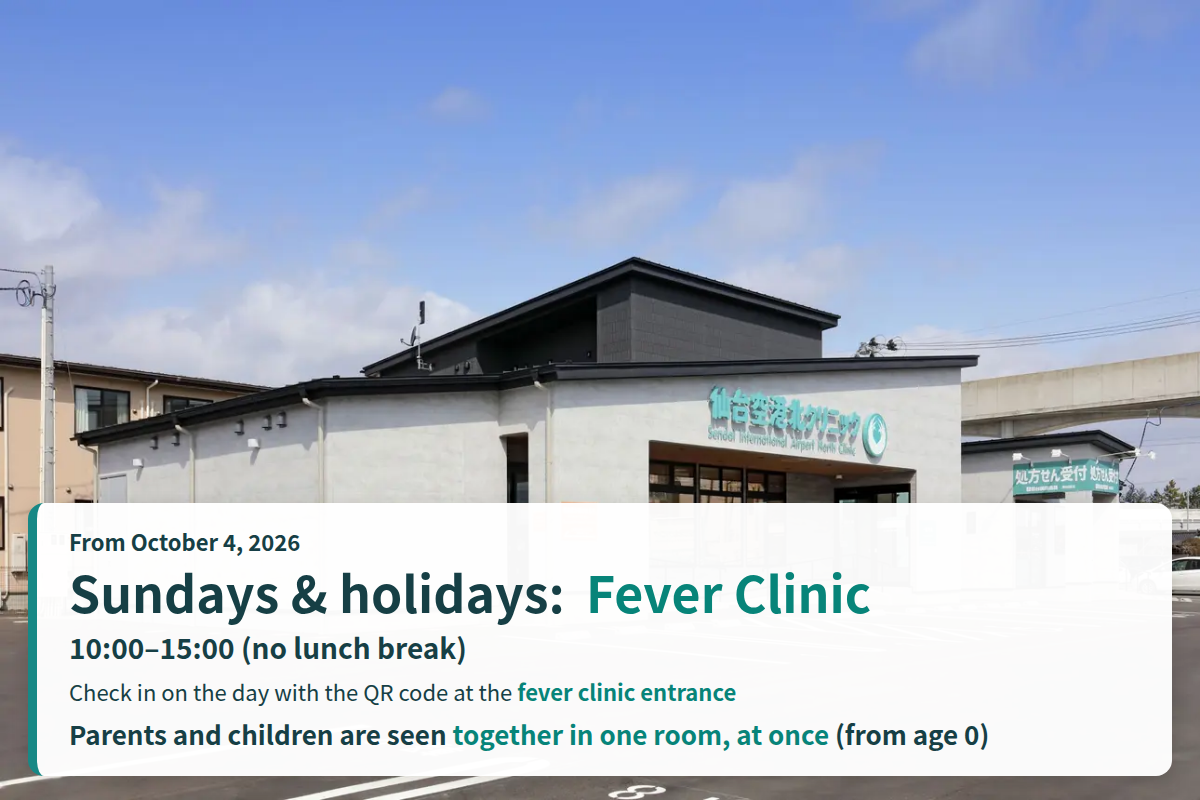
From October 4, 2026, we also run the fever clinic on Sundays and national holidays
10:00 to 15:00 (no lunch break). You check in on the day. We give you the PCR result the same day. On Sundays and holidays we see fever patients only, and we do not offer general outpatient care or IV drips. Please check the clinic calendar for clinic dates and closed days. Notice: fever clinic on Sundays and national holidays

Shunichi Gamo, MD, PhD
Director, Sendai International Airport North Clinic
Born and raised locally, he attended Yuriage Elementary School and Yuriage Junior High School in Natori City. After graduating from Tohoku University School of Medicine, he worked at Sendai Open Hospital and Kesennuma City Hospital, and then at Tohoku University Hospital. In April 2021, in the middle of the COVID-19 pandemic, he opened Sendai International Airport North Clinic. Holding to a fever clinic that never turns patients away, he cared for well over 20,000 patients with fever in the two years before COVID-19 was moved to Class 5 under Japan’s infectious disease law.
Society memberships and board certifications
Certified Member and Board Certified Fellow, Japanese Society of Internal Medicine
Board Certified Pulmonologist, Japanese Respiratory Society
Board Certified Allergist, Japanese Society of Allergology
Board Certified Specialist, Japanese Society of Anti-Aging Medicine
PhD in Medicine (Tohoku University)
What kind of eye disease is hayarime (epidemic keratoconjunctivitis)?
Hayarime is a highly contagious conjunctivitis caused when a virus called adenovirus infects the eye. According to the Japanese Ophthalmological Society, there are three contagious types of viral conjunctivitis called “hayarime”: epidemic keratoconjunctivitis, pharyngoconjunctival fever and acute hemorrhagic conjunctivitis[1].
 Dr. Gamo
The conjunctivitis called hayarime is not just 1 kind; there are actually 3.
Of these, epidemic keratoconjunctivitis is conjunctivitis caused when adenovirus infects the eye[2]. One day the white of the eye suddenly turns bright red, a large amount of discharge appears, and the eyelids swell[1].
Looking at conjunctivitis as a whole, viruses are reported to cause about 80% of acute conjunctivitis, and adenovirus accounts for 65 to 90% of viral conjunctivitis[4].
How is adenovirus conjunctivitis different from other conjunctivitis?
The color and texture of the discharge can give some idea. Bacterial conjunctivitis often causes yellow, sticky discharge, and allergic conjunctivitis often causes whitish, stringy discharge[5].
However, you usually cannot tell the cause of conjunctivitis just by looking[5]. Illnesses that resemble hayarime include allergic conjunctivitis, corneal infections, herpes keratoconjunctivitis, corneal erosion and corneal opacity, so a diagnosis by an eye doctor is needed[1].
| Type of conjunctivitis | Discharge and symptoms |
|---|---|
| Epidemic keratoconjunctivitis (hayarime) | The white of the eye suddenly turns bright red, a lot of discharge, swollen eyelids, swollen lymph nodes in front of the ear[1] |
| Pharyngoconjunctival fever (“pool fever”) | Conjunctivitis plus a sore throat and a fever of around 39°C lasting several days[1] |
| Acute hemorrhagic conjunctivitis | One type of viral conjunctivitis (hayarime)[1] |
| Bacterial conjunctivitis | Yellow, sticky discharge[5] |
| Allergic conjunctivitis | Whitish, stringy discharge[5] |
Infection with adenovirus types 3, 4 and 7 causes not only conjunctivitis but also pharyngoconjunctival fever, with a sore throat and fever. A fever of around 39°C lasts for several days[1]. Under the School Health and Safety Act, pharyngoconjunctival fever is Category 2, and its rule for returning to school is different from that for epidemic keratoconjunctivitis[3]. I explain it in detail in Adenovirus: High Fever for 3 to 5 Days in Children, Strep and Rapid Test.
Dr. GamoBright red eyes, heavy discharge and sore swollen nodes by the ear point to hayarime. The eye doctor decides; if unsure, go early.
How contagious is hayarime? What to watch for with handwashing and towels
Hayarime is extremely contagious and spreads through contact. It spreads through pool water, hands and fingers, towels and so on[6].
The main route of infection is contact through hands and fingers contaminated with the virus, or through shared items such as towels[2].
Alcohol disinfectant does not work well against adenovirus, so handwashing with soap under running water is important[7].
Dr. GamoPlease do not rely on alcohol alone; wash thoroughly with soap under running water.
The Japan Ophthalmologists Association also recommends washing the virus off the hands and fingers well with soap and running water. It also advises wiping away eye discharge and tears with something disposable such as tissue paper rather than a handkerchief or towel, and throwing it away right away[5].
Keep items that touch the eyes, such as towels and eye drops, for one person only, and disinfect equipment and other items contaminated with the patient’s secretions[2].
The virus is shed most in the first few days of the illness, but after that it may continue to be shed in the stool for several weeks, or in some cases for several months[6].
That is why it is important to keep up handwashing even after your child goes back to school or nursery[6][7].
How do the symptoms of hayarime progress?
The conjunctivitis symptoms peak about a week after the illness starts, then gradually ease, and it heals in 2 to 3 weeks[5].
It starts in one eye, and 4 or 5 days later the same symptoms appear in the other eye[5].
Dr. GamoIt may start in one eye and then appear in the other eye 4 or 5 days later.
Both eyes are easily infected, but a typical feature is that the symptoms are stronger in the eye affected first. If the inflammation reaches the cornea, it becomes less clear, and the clouding can last for several years[8].
In a typical case, it starts with a feeling of something in one eye, becomes keratoconjunctivitis in both eyes within hours to days, and light feels too bright (photophobia). Because of clouding of the cornea, reduced vision can last for several months[9].
Clouding of the cornea after keratitis may leave lasting problems with vision[6].
When can my child go back to school? The Category 3 rules on staying home
Epidemic keratoconjunctivitis and acute hemorrhagic conjunctivitis are Category 3 infectious diseases under the School Health and Safety Act[2][3].
For Category 3, the law sets the period of suspension from attendance as “until a school physician or other doctor confirms, based on the child’s condition, that there is no risk of infection”[3].
Both the Japan Society of School Health and the Japan Pediatric Society state “suspension from attendance until a doctor confirms there is no risk of infection”[6][7].
When an infectious disease is found at school, the principal has the school physician make a diagnosis and orders suspension from attendance[3].
| School | Nursery school (day care) | |
|---|---|---|
| Status | Category 3 infectious disease (epidemic keratoconjunctivitis and acute hemorrhagic conjunctivitis)[3] | Attendance guide in the nursery-school guidelines[10] |
| Rule for returning | Until a school physician or other doctor confirms, based on the child’s condition, that there is no risk of infection[3] | “The symptoms of conjunctivitis have disappeared”[10] |
| Who decides | A doctor such as the school physician makes the diagnosis, and the principal orders suspension[3] | Classed as an infection for which a doctor may be expected to fill in a written opinion[10] |
No number of days is set. There is no rule such as “your child can go back to school X days after it starts”, so have an eye doctor confirm that it has healed and write a medical certificate before your child goes back[5].
Dr. GamoRather than setting a number of days off, the sure way is to have an eye doctor confirm that it has healed.
When can my child go back to nursery school?
The guide for nursery schools (day care) is set separately from the school law. The Children and Families Agency’s Guidelines for infection control in nursery schools give the guide for an infected young child to return as “the symptoms of conjunctivitis have disappeared”[10].
This is only a guide for nursery schools. The guidelines class it as an infection for which a doctor may be expected to fill in a written opinion[10]. Actual practice differs between nursery schools, so follow your nursery school’s instructions.
Dr. GamoRules differ from one nursery to another, so checking early with your child’s nursery gives peace of mind.
Because it is so contagious, the guidelines strictly forbid sharing towels and the like. They also call for disinfecting places many people touch, such as door handles and switches, disinfecting toys because adenovirus also survives drying well, and thorough chlorine disinfection of pools[10].
- Schools and nursery schools word their rules for returning differently[3][10]
- Follow the instructions of your child’s school or nursery school
- In both cases, the basis is “a doctor’s confirmation”[5][3][10]
When should my child see an eye doctor?
See an eye doctor if there is so much discharge that the swollen eyelids will not open, or if there is strong eye pain, sensitivity to light, hazy vision or difficulty seeing.
When the inflammation is strong, it can come with corneal erosion, in which the surface of the cornea (the clear front of the eye) is scraped, and this can be very painful[1]. Small cloudy spots (corneal opacity) may appear on the cornea 1 to 2 weeks after the illness starts, and they can make light seem too bright or vision hazy[1].
- The eye is very painful because of corneal erosion, in which the surface of the cornea is scraped[1]
- The cornea is cloudy, with sensitivity to light, hazy vision or difficulty seeing[1]
- If damage to the cornea remains, it may leave lasting problems with vision[6]
- Clouding of the cornea can reduce vision for several months[9]
- In newborns and young children, it can cause pseudomembranous conjunctivitis or corneal perforation[2]
Particular care is needed in newborns and young children[2]. If you feel your child’s vision has dropped, have an eye doctor check it early as well. Vision can take time to recover.
Dr. GamoIf blurred vision or eye pain appears, it may be a sign that the inflammation has reached the cornea.
Also see an eye doctor to have them confirm that it has healed and write a medical certificate[5].
When the main symptoms are in the eyes, please go to an eye doctor. If there is also a fever or a sore throat, it may be pharyngoconjunctival fever (adenovirus). If your child has a fever, please contact a fever clinic.
Even with eye symptoms, if your child does not answer when you call out, is having a seizure, or seems to struggle to breathe, call 119 right away instead of going to an eye doctor.
What should we be careful about at home?
At home, keep the following in mind.
- Wash hands well with soap and running water (alcohol disinfectant does not work well)[7]
- Keep towels and eye drops separate from the rest of the family, for your child’s use only[2]
- Wipe eye discharge and tears with something disposable such as tissue paper, and throw it away right away[5]
- Keep towels and other things that touch the face separate from the family, and disinfect tableware and towels by boiling. Have your child take a bath last[5]
- At the pool, always shower before and after, and use goggles[6][7]
- Even after going back to school or nursery, the virus may be shed in the stool for about a month, so keep up handwashing[6][7]
At the eye doctor, eye drops to reduce inflammation and eye drops to prevent an added bacterial infection are given[1][5]. If the cornea becomes cloudy, steroid eye drops may be used to clear the clouding[1][8]. It is important to get a diagnosis from an eye doctor early and use the eye drops needed.
Dr. GamoWipe eye discharge with disposable tissues, not a towel. It sounds simple, but it is the best way to protect your family.
Frequently asked questions
- If my child may have hayarime, is it all right to wait and see at home?
-
If the white of the eye turns bright red, there is a lot of discharge, or the eyelids are swollen, get a diagnosis from an eye doctor. At the eye doctor, eye drops to reduce inflammation and eye drops to prevent an added bacterial infection are given[1][5].
- Can hayarime spread to the family?
-
It is extremely contagious and spreads through hands, fingers, towels and so on[6]. It is important to wash hands with soap and running water, avoid sharing towels, and use disposable tissues for eye discharge[7][5].
- When can my child go back to school?
-
Epidemic keratoconjunctivitis is a Category 3 infectious disease, and the law requires suspension from attendance “until a school physician or other doctor confirms, based on the child’s condition, that there is no risk of infection”[3]. No number of days is set; it is up to the doctor. Have the doctor confirm that it has healed and get a medical certificate before your child goes back[5].
- When can my child go back to nursery school?
-
The nursery-school guidelines give the guide for returning as “the symptoms of conjunctivitis have disappeared”[10]. It is classed as an infection for which a doctor may be expected to fill in a written opinion, so in practice, follow your nursery school’s instructions.
- What should I do if the eye is very painful or my child has trouble seeing?
-
When the inflammation reaches the cornea, the eye can become very painful, and sensitivity to light, hazy vision or difficulty seeing can appear[1]. See an eye doctor early, including when you feel your child’s vision has dropped.
- Is there anything to watch for after my child goes back to school or nursery?
-
The virus may be shed in the stool for about a month, so keep up handwashing after your child goes back[6][7]. Keep towels and eye drops for your child’s use only[2].
Summary: For hayarime, handwashing and towels matter, and a doctor decides when your child returns
- Epidemic keratoconjunctivitis (called “hayarime” in Japan) is a highly contagious conjunctivitis caused by adenovirus, and the basics of prevention are handwashing and not sharing towels
- If there is strong eye pain, sensitivity to light, or sudden blurred vision, see an eye doctor, even at night or on a holiday (call 119 if your child does not answer when you call out, has a seizure, or seems to struggle to breathe)
- At school it is a Category 3 infectious disease, and children must stay home until a doctor confirms there is “no risk of infection”
- If there is a lot of discharge or the eyelids are swollen, get a diagnosis from an eye doctor early
- At home, wash hands with soap and running water, keep towels and eye drops for one person only, and use disposable tissues for eye discharge
- Have a doctor confirm that it has healed and get a medical certificate before going back to school or nursery
Hayarime looks dramatic, but it is an infection where what you can do at home is clear. The most important things are getting an early diagnosis from an eye doctor and being thorough about handwashing and towels. And for school or nursery, wait for a doctor’s confirmation. If you are worried about your child’s eyes, please seek advice early. Leave the medical care to us.
That’s all.
Disclaimer
This article is intended to provide general medical information and does not replace an examination, diagnosis, or treatment by a doctor. The content is based on medical knowledge at the time of publication, but the right course of action differs for each person. If you are worried about symptoms, please consult a medical facility.
References
- Japanese Ophthalmological Society. Viral conjunctivitis. Japanese Ophthalmological Society website (in Japanese). Accessed October 2026. https://www.nichigan.or.jp/public/disease/name.html?pdid=14
- Japan Institute for Health Security (JIHS). Epidemic keratoconjunctivitis. Infectious Disease Information website (in Japanese). Accessed October 2026. https://id-info.jihs.go.jp/infectious-diseases/epidemic-keratoconjunctivitis/index.html
- Ministry of Education. Ordinance for Enforcement of the School Health and Safety Act (Ministry of Education Ordinance No. 18 of 1958). e-Gov Law Search (in Japanese). Accessed October 2026. https://laws.e-gov.go.jp/law/333M50000080018
- Liu SH, Hawkins BS, Ng SM, Ren M, Leslie L, Han G, et al. Topical pharmacologic interventions versus placebo for epidemic keratoconjunctivitis. Cochrane Database Syst Rev. 2022 Mar;3(3):CD013520. doi:10.1002/14651858.CD013520.pub2 PMID: 35238405
- Takamura E. Viral conjunctivitis. Japan Ophthalmologists Association, Health information about the eyes (in Japanese). Accessed October 2026. https://www.gankaikai.or.jp/health/27/index.html
- Japan Society of School Health. Guide to infectious diseases to be prevented in schools (FY2023 revision). Japan Society of School Health website (in Japanese). Accessed October 2026. https://www.gakkohoken.jp/book/ebook/ebook_R050080/data/670/src/670.pdf
- Japan Pediatric Society, Committee on Immunization and Infectious Disease Control. Guide to infectious diseases to be prevented in schools, kindergartens, certified centers for early childhood education and care, and nursery schools, April 2025 revision. Japan Pediatric Society website (in Japanese). Accessed October 2026. https://www.jpeds.or.jp/uploads/files/20250430_yobo_kansensho.pdf
- Japan Institute for Health Security (JIHS). Epidemic keratoconjunctivitis (detailed version). Infectious Disease Information website (in Japanese). Accessed October 2026. https://id-info.jihs.go.jp/infectious-diseases/epidemic-keratoconjunctivitis/detail/index.html
- Meyer-Rüsenberg B, Loderstädt U, Richard G, Kaulfers PM, Gesser C. Epidemic keratoconjunctivitis: the current situation and recommendations for prevention and treatment. Dtsch Arztebl Int. 2011 Jul;108(27):475-80. doi:10.3238/arztebl.2011.0475 PMID: 21814523
- Children and Families Agency. Guidelines for infection control in nursery schools (2018 revision). Children and Families Agency website (in Japanese). Accessed October 2026. https://www.cfa.go.jp/assets/contents/node/basic_page/field_ref_resources/e4b817c9-5282-4ccc-b0d5-ce15d7b5018c/c60bb9fc/20230720_policies_hoiku_25.pdf
Related articles
For pharyngoconjunctival fever (“pool fever”), see Adenovirus: High Fever for 3 to 5 Days in Children, Strep and Rapid Test, and for tips on keeping an infection from spreading at home, see How to keep flu and COVID from spreading to your family at home.