
If you are in a hurry
- If chest pain, palpitations, or shortness of breath continue after a viral infection, it may be myocarditis, so see a doctor the same day
- If your child is unconscious, is having a seizure, is severely short of breath, or has fainted with chest pain, call 119 (Japan’s emergency number)
- In babies, not drinking milk, being limp, fast or heavy breathing, and looking pale are also signs to see a doctor
Hello. I am Shunichi Gamo, MD, PhD, a board-certified pulmonologist and the director of Sendai Airport North Clinic.
After a cold, has your child ever said “my chest hurts” or “my heart is pounding”? Even when a child looks well, a heart problem may be hiding.
“The cold is gone, but my child somehow seems to have chest discomfort, and I am worried.”
This kind of worry in a family is a very important sign. To give you the conclusion first: if chest pain, palpitations, or shortness of breath continue after a viral infection, it may be myocarditis (inflammation of the heart muscle), so please see a doctor the same day.
In this article, I explain, from the standpoint of a pulmonologist, the symptoms of myocarditis in children, the signs that mean you should call 119, how to think about the reported rates after COVID infection and after vaccination, and limits on exercise after a diagnosis of myocarditis.
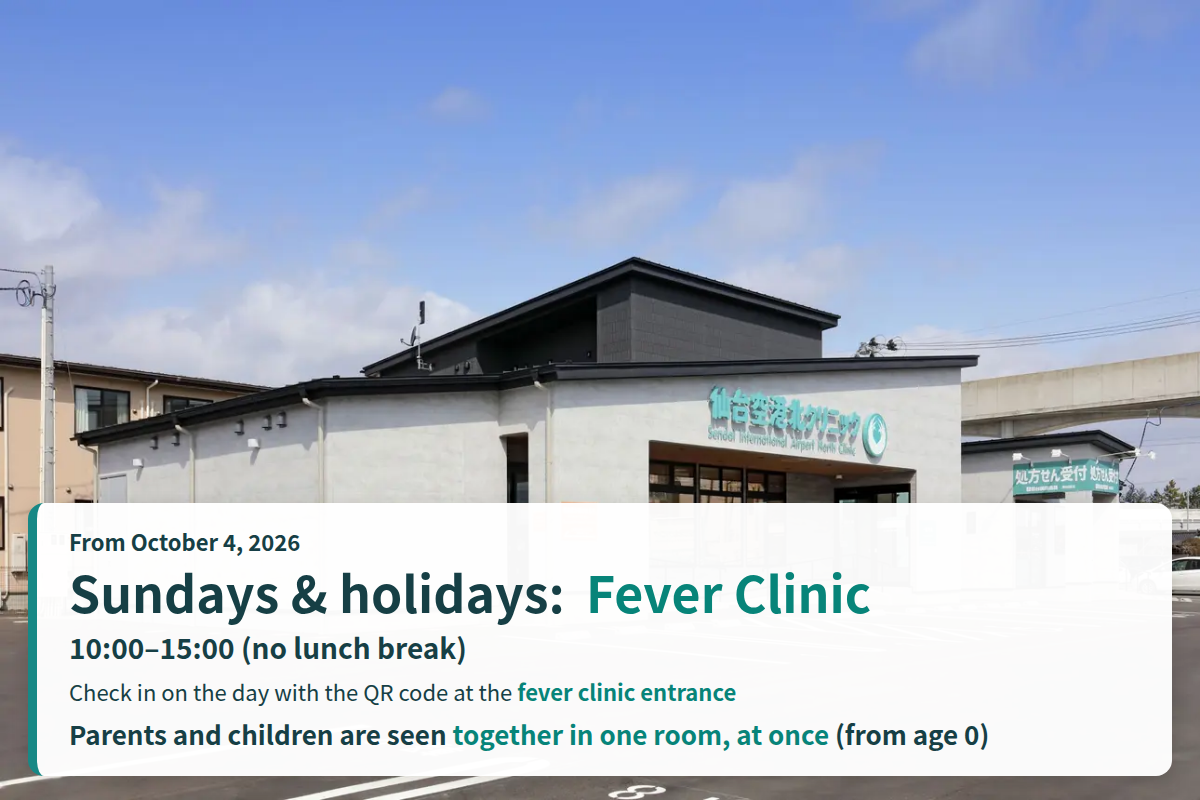
First, a note about our fever clinic on Sundays and national holidays. PCR testing for influenza and COVID (a test that copies the virus’s genetic material in order to detect it) gives results the same day.
From October 4, 2026, we also run the fever clinic on Sundays and national holidays
10:00 to 15:00 (no lunch break). You check in on the day. We give you the PCR result the same day. On Sundays and holidays we see fever patients only, and we do not offer general outpatient care or IV drips. Please check the clinic calendar for clinic dates and closed days. Notice: fever clinic on Sundays and national holidays
Shunichi Gamo, MD, PhD
Director, Sendai International Airport North Clinic
Born and raised locally, he attended Yuriage Elementary School and Yuriage Junior High School in Natori City. After graduating from Tohoku University School of Medicine, he worked at Sendai Open Hospital and Kesennuma City Hospital, and then at Tohoku University Hospital. In April 2021, in the middle of the COVID-19 pandemic, he opened Sendai International Airport North Clinic. Holding to a fever clinic that never turns patients away, he cared for well over 20,000 patients with fever in the two years before COVID-19 was moved to Class 5 under Japan’s infectious disease law.
Society memberships and board certifications
Certified Member and Board Certified Fellow, Japanese Society of Internal Medicine
Board Certified Pulmonologist, Japanese Respiratory Society
Board Certified Allergist, Japanese Society of Allergology
Board Certified Specialist, Japanese Society of Anti-Aging Medicine
PhD in Medicine (Tohoku University)
In short: Chest pain and palpitations after a viral infection may be a sign of myocarditis
When chest pain, palpitations, or shortness of breath continue after a viral infection, we consider the possibility of myocarditis. Myocarditis is mainly caused by viral infections, and many viruses we meet in daily life can cause it[1].
 Dr. Gamo
Chest pain or palpitations that continue after a cold are changes we do not want you to overlook.
Myocarditis often starts with mild, cold-like symptoms. The guidelines of the Japanese Circulation Society state that chest pain, together with fast breathing, difficulty breathing, and shortness of breath, are especially important symptoms[1].
- Chest symptoms
Chest pain, palpitations (a pounding heart), shortness of breath - Body symptoms
Tiredness, poor appetite, shortness of breath when moving - Danger signs
Fainting (losing consciousness), looking pale, being limp and listless
Children often cannot put feeling unwell into words, so behavior that is different from usual is a clue[1]. In the next section, we look in detail at the symptoms by age.
What symptoms appear with myocarditis in children?
A feature of myocarditis in children is that the symptoms vary very widely, from mild cold-like symptoms to chest pain, low blood pressure, fainting, seizures, and cardiogenic shock[1].
The symptoms of myocarditis in children and their frequency, as listed in the Japanese Circulation Society guidelines, are as follows[1].
| Symptom | Frequency (%) |
|---|---|
| Fatigue (tiredness) | 25 to 70 |
| Shortness of breath | 33 to 69 |
| Fever | 31 to 58 |
| Nausea, vomiting, abdominal pain | 28 to 48 |
| Chest pain | 24 to 42 |
| Difficulty breathing | 22 to 25 |
| Palpitations | 16 |
| Diarrhea | 8 to 33 |
In a study of 42 children with myocarditis at a single hospital in Spain (2008 to 2017), chest pain was the most common heart symptom at 40%, followed by shortness of breath at 35%, digestive symptoms such as vomiting and abdominal pain at 33%, and fever at 31%[2]. On examination at the visit, a fast pulse (57%) and fast breathing (52%) were common[2].
In a review of 29 children with severe myocarditis admitted to a pediatric intensive care unit in Japan, fever and digestive symptoms were the first symptoms in about 80%, and at the emergency visit, symptoms of the central nervous system (seizures or changes in consciousness) were the most common, at 41%, according to the report[3].
This is why “we thought it was a stomach bug, but it was actually myocarditis” can happen[3][4].
Dr. GamoIf shortness of breath or chest pain comes on after nausea or belly pain, please take that change seriously.
What signs appear in babies and newborns?
In babies and newborns, the symptoms are not clear and show up as differences from usual. Myocarditis in newborns presents with non-specific symptoms such as fever, low body temperature, irritability, poor feeding (not drinking milk), vomiting, and respiratory distress (fast, labored breathing), and cases starting with an irregular heartbeat, cardiogenic shock, or sudden death have also been reported[1].
At an age when a child cannot tell you in words, see a doctor the same day if you notice any of the following.
- Not drinking milk, or drinking less than before
- Limp and listless, fussy and crying differently from usual
- Fast or heavy breathing, seems to be struggling, looking pale
- Sweating a lot, cold hands and feet, puffiness (swelling)
Dr. GamoBabies cannot say “I feel awful”. If something feels different from usual, that alone is an important sign.
After a cold or a stomach bug, a child can suddenly get worse within hours
In myocarditis, cold or stomach symptoms often come first, and heart symptoms follow. According to material from the Ministry of Health, Labour and Welfare, acute myocarditis is often preceded by cold-like symptoms or poor appetite, nausea, vomiting, and diarrhea, and over the next few hours to few days, signs of heart failure (in 70%), chest pain (44%), and an irregular heartbeat (25%) may appear[4].
The Japanese Circulation Society’s information for patients also states that when myocarditis is diagnosed, the heart’s pumping function can drop rapidly within hours, even if the first symptoms were mild and cold-like[1].
It is also an illness that is hard to find at the first visit. About 80% of children with a confirmed diagnosis of myocarditis were diagnosed only after two or more visits[1]. There is also a report that most fulminant cases had been wrongly diagnosed as another, mild illness for several weeks before they suddenly got worse[2].
So even if your child has been seen once and told “it is probably a cold”, it is important to see a doctor again if chest pain, palpitations, or shortness of breath continue, get worse, or newly appear. For guidance on when to come back, please also see Fever Came Back After Being Told It’s Viral?.
Dr. GamoEven after being seen once, there is no need at all to hold back from asking again when symptoms continue.
At the same time, it is also true that most cases are mild and recover. According to the Japanese Circulation Society’s information for patients, most patients recover with no symptoms or mild symptoms, but some patients fall into a serious, life-threatening condition[1]. In a nationwide survey in Japan, 91.0% of patients with acute myocarditis and 48.0% of those with the fulminant type were discharged alive[1].
Signs to seek care urgently: 119, the emergency department, or the same day
If even one of the following applies, call 119 without hesitation. The same applies at night and on holidays. This is a general request for safety.
- Your child does not answer when you call, is unconscious, or is drowsy and confused
- Your child is having a seizure
- Your child is severely short of breath, is breathing with the shoulders, or has purplish lips
- Your child lost consciousness (fainted) with chest pain
- Your child is pale, with cold hands and feet, and is limp
Even without the signs above, in the following cases do not wait until morning; go to an emergency department, even at night or on a holiday.
- Chest pain continues or keeps coming back
- Palpitations (a pounding heart) continue, or the pulse is clearly fast
- Shortness of breath, or breathing faster than usual
- Fainting, unsteadiness, or being unable to stand
- In a baby: not drinking milk, limp, fast or heavy breathing, looking pale
If you “cannot tell whether it is serious enough to call 119”, you can call the children’s emergency advice line for your area (#8000). However, if there are clearly dangerous signs, call 119 directly without calling the advice line first.
Dr. Gamo#8000 is the line to call when you are unsure whether to call 119. Please keep the number handy.
Even without dangerous signs, if chest pain or palpitations continue, or your child lacks energy after a cold, see a medical facility the same day. At night and on holidays, please use an emergency department. While there are symptoms, have your child stop exercise for now and see a doctor. For what to do when a seizure occurs, please also see Febrile Seizure in a Child: What to Do for 5 Minutes, and When to Call 119.
Think about myocarditis after COVID infection and after vaccination separately
Myocarditis “after COVID infection” and “after COVID vaccination” are considered as separate things, each with its own denominator (how many cases out of how many people or how many doses). We do not mix the numbers or compare them by dividing one by the other. The reports so far can be summarized as follows.
| After COVID infection | After mRNA vaccination | |
|---|---|---|
| Data from Japan | Among hospitalized males aged 15 to 39, reports of suspected myocarditis or pericarditis were 834 per million (as of May 31, 2021)[5] | Very rare and mostly mild; more common in males in their teens and 20s, with chest pain or shortness of breath about 4 days after vaccination[5] |
| Data from the US | 450 per million in males aged 12 to 17[5] | 475 cases reported among vaccinated people aged 30 or under (frequency 0.0005%)[4] |
| Pooled analysis in adolescents (meta-analysis) | 1583.9 cases per million infected people (myocarditis or pericarditis)[6] | 37.6 cases per million vaccine doses (myocarditis or pericarditis, Pfizer)[6] |
The numbers in this table differ in the ages studied, the type of vaccine, the country, the year, and the denominator (hospitalized patients, infections, or vaccinations). They cannot be placed side by side and compared directly. Overall, however, myocarditis has been reported to be more common after infection than after vaccination[5].
In a study in England of people aged 13 and over (data from December 2020 to December 2021), the overall risk of myocarditis was higher after a positive COVID test than after vaccination. However, the risk after the second dose of the Moderna vaccine was an exception and was high, with an incidence rate ratio (a ratio of risks) of 11.76. For each dose of the Pfizer vaccine it was 1.52 to 1.72, and after a positive COVID test it was 11.14 when the positive test came before vaccination and 5.97 when it came after vaccination[7]. These are ratios of risk, not proportions such as “1 in so many people”.
After vaccination, a tendency toward higher reporting rates in males in their teens and 20s has been confirmed[5]. On the other hand, it is very rare and mostly mild[4][5]. The numbers given here are mainly from reports around 2021 to 2022, and both the types of vaccine and the way they are used have changed since then.
If, after your child has been vaccinated, your child complains of chest pain or a pounding heart, seems short of breath, or has swelling, or if your child continues to seem different from usual, for example with poor appetite or low energy, see a medical facility promptly and tell them about the vaccination[8]. It is important not to hesitate to see a doctor.
Dr. GamoThe date your child was vaccinated is also important information we would like you to tell the doctor.
If myocarditis is diagnosed, when can exercise start again?
Limits on exercise after a diagnosis of myocarditis are decided by the doctor in charge of treatment. Please do not restart exercise on your own judgment. The Japanese Circulation Society guidelines state that careful guidance on limiting exercise over a long period is important, and that competitive sports should be resumed only after at least several months have passed[1]. The information for patients also states that hard exercise should be avoided for at least 6 months after onset[1].
Also, even if heart function appears to have returned to normal, in children changes in the heart muscle can progress slowly, and there is said to be a risk of sudden death[1]. That is exactly why longer exercise limits and regular follow-up are important. Always follow your doctor’s instructions on when to restart exercise and how hard.
Dr. GamoIt is tempting to let your child exercise once they seem well, but please decide when to restart with their doctor.
What to tell the doctor at the visit
Children may not be able to explain their symptoms well. If the family member who comes along tells the doctor the following, the diagnosis can be made sooner. Please bring it written down as a note.
- When the cold or stomach symptoms started and when they settled
- When the chest pain, palpitations, or shortness of breath started, and when they appear
- Events such as fainting, a seizure, or looking pale
- How much milk or food, and fluids, your child has had, and how often your child has passed urine
- If a fever reducer was given, the time and the type (use it as the doctor instructed)
- Long-term conditions, medicines your child usually takes, and when vaccinations were given
In particular, “since when” and “in what situations the symptoms appear” are things only the family knows. Please be sure to tell us.
Dr. GamoMaking a note of what your child was doing when the chest pain came on makes it easier to explain.
Frequently asked questions
- My child says the chest hurts after getting over a cold. Can we wait and see?
-
Chest pain after a viral infection may be myocarditis. Please see a doctor the same day. If your child fainted with chest pain, is severely short of breath, or is not fully conscious, call 119.
- The palpitations stopped in a moment. Does my child need to see a doctor?
-
If it happened only once and stopped quickly, see a doctor the same day to discuss it. If palpitations continue, keep coming back, or come with shortness of breath or chest pain, go to an emergency department, even at night or on a holiday. If your child fainted with chest pain, call 119. If your child fainted even without chest pain, go to an emergency department, even at night or on a holiday.
- Are there signs that suggest myocarditis in a baby?
-
In newborns, symptoms such as fever, low body temperature, irritability, not drinking milk, vomiting, and fast or heavy breathing are seen[1]. Babies cannot tell you in words, so if anything is different from usual, such as looking pale or being limp, see a doctor the same day.
- I am worried about myocarditis after a COVID vaccine.
-
Myocarditis after vaccination is very rare and mostly mild[5]. If, within about 4 days after vaccination, chest pain, a pounding heart, seeming short of breath, swelling, or poor appetite or low energy continue, see a medical facility promptly and tell them about the vaccination[8]. Please do not hesitate to see a doctor.
- If myocarditis is diagnosed, when can my child exercise again?
-
The doctor in charge of treatment decides when exercise can restart. It is recommended that competitive sports wait until at least several months have passed, and that hard exercise be avoided for at least 6 months after onset[1]. Do not restart on your own judgment; follow your doctor’s instructions.
- Can my child be seen at the fever clinic on a Sunday or national holiday?
-
Yes. We also run the fever clinic on Sundays and national holidays from 10:00 to 15:00 (no lunch break). You check in on the day using the QR code at the fever clinic entrance. On Sundays and holidays we do not offer general outpatient care or IV drips (please check the clinic calendar for closed days).
Summary: See a doctor the same day for chest pain and palpitations after a viral infection
- If chest pain, palpitations, or shortness of breath continue after a viral infection, it may be myocarditis, so see a doctor the same day
- If your child is unconscious, is having a seizure, is severely short of breath, or has fainted with chest pain, call 119
- In babies, not drinking milk, being limp, fast or heavy breathing, and looking pale are also signs to see a doctor
- Myocarditis is hard to find at the first visit, and about 80% of cases are diagnosed only after two or more visits. If symptoms continue or get worse, see a doctor again[1]
- Rates after COVID infection and after vaccination have different denominators, so think about them separately[5][6][7]
- After a diagnosis of myocarditis, follow your doctor’s instructions on restarting exercise[1]
Myocarditis is a rare illness, but if chest pain or palpitations continue, please see a doctor the same day. Even if nothing is found at the first visit, it is important to come back if the symptoms continue. Leave the medical care to us.
That’s all.
Disclaimer
This article is intended to provide general medical information and does not replace an examination, diagnosis, or treatment by a doctor. The content is based on medical knowledge at the time of publication, but the right course of action differs for each person. If you are worried about symptoms, please consult a medical facility.
References
- Japanese Circulation Society / Japanese Society of Pediatric Cardiology and Cardiac Surgery, et al. Joint Working Group. Guidelines for the Diagnosis and Treatment of Myocarditis (JCS 2023). Japanese Circulation Society website (in Japanese). Accessed October 2026. https://www.j-circ.or.jp/cms/wp-content/uploads/2023/03/JCS2023_nagai.pdf
- Rodriguez-Gonzalez M, Sanchez-Codez MI, Lubian-Gutierrez M, Castellano-Martinez A. Clinical presentation and early predictors for poor outcomes in pediatric myocarditis: A retrospective study. World J Clin Cases. 2019 Mar;7(5):548-561. doi:10.12998/wjcc.v7.i5.548 PMID: 30863755
- Nosaka N, Muguruma T, Fujiwara T, Enomoto Y, Toida C, Morishima T. Effects of the elective introduction of extracorporeal membrane oxygenation on outcomes in pediatric myocarditis cases. Acute Med Surg. 2015 Apr;2(2):92-97. doi:10.1002/ams2.76 PMID: 29123700
- Ministry of Health, Labour and Welfare. Clinical picture of myocarditis and pericarditis associated with viral infection. Ministry of Health, Labour and Welfare website (in Japanese). Accessed October 2026. https://www.mhlw.go.jp/content/10601000/000796566.pdf
- Ministry of Health, Labour and Welfare. COVID-19 vaccine Q&A (vaccine safety and adverse reactions). Ministry of Health, Labour and Welfare website (in Japanese). Accessed October 2026. https://www.mhlw.go.jp/stf/seisakunitsuite/bunya/vaccine_qa.html
- Choi Y, Lee JS, Choe YJ, Lee H, Yoon Y, Shin SH, et al. Myocarditis and Pericarditis are Temporally Associated with BNT162b2 COVID-19 Vaccine in Adolescents: A Systematic Review and Meta-analysis. Pediatr Cardiol. 2025 Dec;46(8):2193-2206. doi:10.1007/s00246-024-03618-2 PMID: 39404761
- Patone M, Mei XW, Handunnetthi L, Dixon S, Zaccardi F, Shankar-Hari M, et al. Risk of Myocarditis After Sequential Doses of COVID-19 Vaccine and SARS-CoV-2 Infection by Age and Sex. Circulation. 2022 Sep;146(10):743-754. doi:10.1161/CIRCULATIONAHA.122.059970 PMID: 35993236
- Ministry of Health, Labour and Welfare. COVID-19 vaccine Q&A (as of March 2024): Is there anything parents should be careful about before vaccinating infants and young children (6 months to 5 years)? Ministry of Health, Labour and Welfare website (in Japanese). Accessed October 2026. https://www.mhlw.go.jp/stf/seisakunitsuite/bunya/vaccine_qa_archive.html
▶ Overview of this topic: Fever clinic on Sundays and national holidays (from October 4, 2026, 10:00 to 15:00)
More articles to read when you have a fever
For fever after vaccination, see Fever after a vaccine: wait it out or see a doctor? Child and adult, and for decisions at night and on holidays, see Child’s Fever at Night or on a Holiday: Wait or Go Now?.