
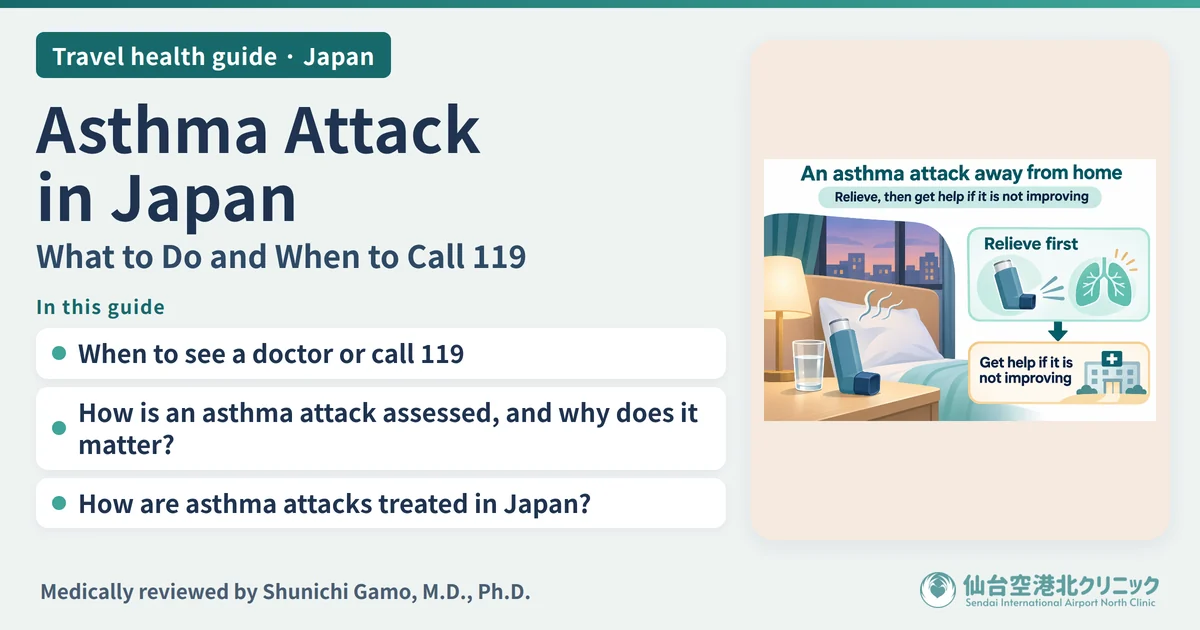
Quick answer
- Sit upright, stay calm, and use your reliever inhaler exactly as your own asthma action plan or doctor says, with a spacer if you have one.
- If breathing does not improve after the reliever, the relief does not last, or you cannot speak in full sentences, call 119 (ambulance) in Japan. Do not travel to a clinic on your own.
- Danger signs include blue or grey lips, confusion, or exhaustion. These mean 119 now.
- Japanese clinics and emergency departments treat attacks with inhaled bronchodilators, steroids and oxygen. Your reliever inhaler needs a prescription in Japan, so keep it on you.
- Ask for an English medical certificate and receipts for travel insurance.
Is this an asthma attack, or something else?
Asthma is a long-term lung condition in which the airways (the tubes that carry air in and out of the lungs) become inflamed and narrow. An asthma attack is when these symptoms suddenly get much worse [23]. Typical signs are wheezing (a whistling sound when breathing out), chest tightness, coughing (often at night), shortness of breath, and needing your reliever inhaler more often than usual [23][25].
Common travel triggers in Japan include colds and other respiratory viruses. Viral infections, especially rhinovirus, are the most common trigger of asthma attacks [16][17]. Other triggers include cold air, smoke (smoke exposure may occur in some venues), pollen, and dust or days with high air pollution [23][25].
Some painkillers called NSAIDs (non-steroidal anti-inflammatory drugs, such as aspirin and ibuprofen) can trigger attacks in people who are sensitive to them [20].
Other conditions can look like an asthma attack and need different care:
- Anaphylaxis: a severe allergic reaction. Breathing trouble together with hives (itchy raised skin patches), swelling, or vomiting after a food or insect sting is an emergency. Use an adrenaline auto-injector if one has been prescribed for you, and call 119.
- Pneumonia: an infection of the lungs.
- A blood clot in the lungs after a long flight: sudden chest pain, sometimes with a swollen, painful leg.
- A collapsed lung: air leaking around the lung, causing sudden breathlessness and chest pain.
- Heart problems, and panic or hyperventilation (breathing too fast), which can also feel similar.
Symptoms alone do not give you a diagnosis. Wheezing does not always mean asthma; a doctor needs to check.
What should I do first during an attack?
- Stop and sit upright. Loosen tight clothing. Sitting up helps your breathing [25].
- Take your reliever inhaler (the fast-acting inhaler that opens the airways). Good technique matters: shake a pressurised aerosol inhaler, breathe out, then take a slow deep breath through a spacer (a plastic tube that holds the mist so more medicine reaches the lungs). For dry-powder inhalers, take a fast, deep breath instead. Hold your breath about 10 seconds if you can.
- Follow the dose steps in your written asthma action plan. If you do not have a plan, the UK National Health Service (NHS) advises the following for a blue reliever inhaler. Take 1 puff every 30 to 60 seconds until you feel better, up to a maximum of 10 puffs. Shake the inhaler between puffs and use a spacer if you have one. For a combination AIR or MART inhaler (used for both preventing and treating symptoms), take 1 puff every 1 to 3 minutes, up to a maximum of 6 puffs. If your own plan gives a different maximum, follow your plan [25].
- If your doctor has told you to use budesonide-formoterol (Symbicort) as your reliever, follow that plan. This “anti-inflammatory reliever” approach is supported by research [12][13], but others must not switch on their own.
- Move away from the trigger, such as smoke or cold air.
- Tell your travel companion or hotel staff what is happening.
Do not rely on home remedies, caffeine, or over-the-counter medicines in Japan as treatment for an attack.
When to see a doctor or call 119
Call 119 (Japan’s emergency number; say “kyukyu” for an ambulance) if any of these happen:
- the reliever does not help, or the effect wears off quickly;
- you are too breathless to speak, eat, or lie flat;
- your lips or face turn blue or grey;
- you feel drowsy or confused;
- you are exhausted;
- a child is using the neck and rib muscles to breathe, or cannot feed.
Do not drive yourself to hospital during a severe attack [25]. Some emergency services may offer interpreter support, and it helps to know your hotel address. The Japan National Tourism Organization (JNTO) offers a multilingual Japan Visitor Hotline for travellers.
A same-day clinic visit (not an emergency) makes sense if: you need the reliever more than usual, you have night-time symptoms, symptoms come with a cold or fever, or you have used your last spare inhaler [25].
The ambulance itself is operated by the fire department; hospital care is charged separately. If you are unsure whether it is an emergency, calling 119 is the safe action.
How is an asthma attack assessed, and why does it matter?
Assessment is mainly clinical, meaning the doctor examines you: they ask about your history, listen to your chest, count your breathing rate, and measure your oxygen level with a pulse oximeter (a small clip-on sensor). A peak flow meter (a handheld device that measures how fast you can blow air out) may be used if possible [4][25]. A chest X-ray or a blood gas test (a blood test measuring oxygen and carbon dioxide) may be used to rule out pneumonia or a collapsed lung, or in severe attacks [4].
Why this matters: the severity decides the treatment [1][4]. It also separates asthma from look-alike conditions such as anaphylaxis, pneumonia, or a blood clot. If a respiratory infection seems to be the trigger, testing can identify it. A multiplex PCR (a test that looks for the genetic material of many germs at once) uses one nasal swab and can identify a viral or bacterial trigger. That can lead to an antiviral or antibiotic for the infection, or to isolation advice. Antibiotics do not treat the asthma attack itself, only a bacterial infection.
A PCR test does not diagnose asthma, does not measure how severe the attack is, and does not replace emergency care. Spirometry (a breathing test) and FeNO (a breath test for airway inflammation) are mostly used for long-term assessment, not during an attack.
How are asthma attacks treated in Japan?
First-line treatment is inhaled short-acting bronchodilators (medicines that quickly open the airways) plus systemic corticosteroids (steroids that reduce inflammation throughout the body) [1][3][4].
| Medicine (generic name) | Common Japanese brand | How it is given |
|---|---|---|
| Salbutamol (called albuterol in the US) | Sultanol (inhaler), Venetlin (nebuliser solution) | Inhaler with spacer, or nebuliser (a machine that turns medicine into a mist) |
| Procaterol | Meptin | Inhaler or nebuliser; widely used in Japan |
| Prednisolone | — | Oral (tablets) |
| Methylprednisolone or hydrocortisone | — | Intravenous (into a vein) in more severe attacks |
| Oxygen | — | Through a mask, when oxygen levels are low [25] |
In some cases doctors also use ipratropium (an inhaled airway-opening medicine of a different type); adding it to a beta2-agonist can reduce hospital admission in children [3]. Other options include intravenous magnesium sulfate, which can reduce hospital admission and length of stay in children who do not respond to first-line treatment [3][9][10]. Intravenous aminophylline is another option, though it can cause nausea and vomiting [3][4]. An adrenaline injection may be given for very severe attacks or anaphylaxis.
Medicines you may leave with: a reliever inhaler, a short course of oral steroids, and sometimes a controller inhaler. A controller can be an inhaled steroid or an ICS-LABA combination (an inhaled steroid combined with a long-acting airway-opening medicine), for example Symbicort or Adoair [12][13]. High-dose inhaled steroids added to systemic steroids may reduce hospital admission in moderate-to-severe attacks [2].
Prescription vs drugstore: reliever and steroid inhalers need a doctor’s prescription in Japan and are not sold over the counter. Generally, Japanese pharmacies require a prescription issued by a Japanese doctor. Tell the doctor if painkillers have triggered your asthma before, and avoid NSAID pain relievers unless a doctor approves [20][21].
Travel tips: flights, daily outings, companions, children and insurance
- Flights: carry relievers and spacers in your hand luggage, never in checked bags. Keep one in a pocket or seat-back bag. Inhalers are generally allowed through security screening, but check your airline’s rules [27]. After a recent attack, ask a doctor whether you are fit to fly; airlines may require a medical form.
- Daily outings: carry the reliever every day, plus a spare and your written action plan [25].
- Bringing medicines into Japan: check the Ministry of Health, Labour and Welfare (MHLW) personal-import guidance before you travel; some medicines have quantity rules.
- Companions: show them your inhaler, the danger signs above, and how to call 119.
- Children: use a spacer, with a mask for young children; a spacer works at least as well as a nebuliser and children may recover faster with it [5][6][7][8]. Children tire quickly during an attack, so watch closely.
- Insurance: keep all receipts. Ask for an English medical certificate with the diagnosis, and contact your insurer’s assistance line early.
Frequently asked questions
Can I buy an asthma inhaler at a Japanese drugstore?
No. Reliever and steroid inhalers are prescription-only in Japan. You need to see a doctor first.
My inhaler is called albuterol or Ventolin; is that the same as salbutamol?
Yes, the medicine is the same; albuterol is the US name for salbutamol, and Ventolin is a common brand name [26]. The device and strength can differ between countries.
Will a Japanese doctor accept my home prescription?
Bring it as information, but a Japanese doctor must write a new prescription. Generally, Japanese pharmacies require a prescription issued by a Japanese doctor.
Is calling an ambulance in Japan expensive?
The ambulance service is run by the fire department. Hospital treatment itself is charged, so check your travel insurance and keep receipts.
Can I fly home after an attack?
Ask a doctor. It depends on how well you have recovered; airlines may ask for a medical form.
Can I take Japanese cold or pain medicine?
Ask a pharmacist and mention your asthma. Some painkillers (NSAIDs such as aspirin and ibuprofen) can trigger attacks in sensitive people [20][21].
If you are near Sendai Airport
For a severe attack, call 119; do not travel to a clinic. For non-emergency care when asthma symptoms come with fever or a cold, Sendai International Airport North Clinic (仙台空港北クリニック), 8-1-8 Mitazono, Natori, Miyagi, is about 10 minutes by car from Sendai International Airport. The director, Shunichi Gamo, M.D., Ph.D., is board certified in internal medicine, pulmonology (Japanese Respiratory Society) and allergology (Japanese Society of Allergology). The fever clinic has its own entrance with same-day QR check-in available in English; you can walk in without any advance arrangement. Fever clinic hours: Mon, Tue, Wed, Fri, Sat 10:00–12:00 and 14:30–18:00. On Sundays and Japanese national holidays it is open 10:00–15:00 (check the calendar on the clinic page); closed Thursdays. Children from age 0 are seen, and family members with fever can be seen together in the same room by the same doctor at one visit. For visitors without Japanese insurance, the fee is a flat USD 700, charged in yen at the day’s rate (card or cash). It includes an English consultation and the BioFire SpotFire R Panel PCR (one nasal swab, about 15 minutes, 11 viruses and 4 bacteria; Group A strep is not included). It also includes a same-day English certificate with ICD-10 codes, and a prescription if needed. Medicines are paid separately at the pharmacy next door. Residents with Japanese insurance are seen under Japanese national health insurance.

References
- Zelicof Paul A, et al. Emergency department management of pediatric acute asthma: an evidence-based review. Pediatr Emerg Med Pract 2023.
- Kearns N, et al. Inhaled Corticosteroids in Acute Asthma: A Systemic Review and Meta-Analysis. J Allergy Clin Immunol Pract 2020.
- Craig SS, et al. Interventions for escalation of therapy for acute exacerbations of asthma in children: an overview of Cochrane Reviews. Cochrane Database Syst Rev 2020.
- Pardue Jones B, et al. Pediatric acute asthma exacerbations: Evaluation and management from emergency department to intensive care unit. J Asthma 2016.
- Cates CJ, et al. Holding chambers (spacers) versus nebulisers for beta-agonist treatment of acute asthma. Cochrane Database Syst Rev 2013.
- Cates CJ, et al. Holding chambers versus nebulisers for beta-agonist treatment of acute asthma. Cochrane Database Syst Rev 2002.
- Cates CJ, et al. Holding chambers (spacers) versus nebulisers for beta-agonist treatment of acute asthma. Cochrane Database Syst Rev 2006.
- Cates CJ, Rowe BH. Holding chambers versus nebulisers for beta-agonist treatment of acute asthma. Cochrane Database Syst Rev 2000.
- Shan Z, et al. Intravenous and nebulized magnesium sulfate for treating acute asthma in adults and children: a systematic review and meta-analysis. Respir Med 2013.
- Griffiths B, Kew KM. Intravenous magnesium sulfate for treating children with acute asthma in the emergency department. Cochrane Database Syst Rev 2016.
- Knightly R, et al. Inhaled magnesium sulfate in the treatment of acute asthma. Cochrane Database Syst Rev 2017.
- Bateman ED, et al. As-Needed Budesonide-Formoterol versus Maintenance Budesonide in Mild Asthma. N Engl J Med 2018.
- Hardy J, et al. Budesonide-formoterol reliever therapy versus maintenance budesonide plus terbutaline reliever therapy in adults with mild to moderate asthma (PRACTICAL). Lancet 2019.
- Fox GJ, et al. Implementation of a stepped anti-inflammatory reliever therapy intervention with budesonide-formoterol versus usual care. EClinicalMedicine 2025.
- Hlophe ST, et al. Anti-inflammatory reliever therapy for asthma using inhaled budesonide/formoterol as-needed in South African children (AIR-SA 001). BMJ Open Respir Res 2025.
- Castillo JR, et al. Asthma Exacerbations: Pathogenesis, Prevention, and Treatment. J Allergy Clin Immunol Pract 2017.
- Jackson DJ, Gern JE. Rhinovirus Infections and Their Roles in Asthma: Etiology and Exacerbations. J Allergy Clin Immunol Pract 2022.
- Hayashi Y, et al. Rhinovirus Infection and Virus-Induced Asthma. Viruses 2022.
- Garcia-Garcia ML, et al. Pediatric Asthma and Viral Infection. Arch Bronconeumol 2016.
- Minaldi E, Cahill K. Recent Updates in Understanding NSAID Hypersensitivity. Curr Allergy Asthma Rep 2023.
- Stevens WW, et al. The role of aspirin desensitization followed by oral aspirin therapy in managing patients with aspirin-exacerbated respiratory disease. J Allergy Clin Immunol 2021.
- Walgama ES, Hwang PH. Aspirin-Exacerbated Respiratory Disease. Otolaryngol Clin North Am 2017.
- World Health Organization. Asthma (fact sheet).
- CDC. Japan – Traveler View.
- NHS. Asthma attack: how to treat.
- NHS. Salbutamol inhaler.
- TSA. Inhalers.
- JNTO. Safety tips for travelers.
- Pharmaceuticals and Medical Devices Agency (PMDA).