If you are in a hurry
- The complication of mumps to watch most closely is hearing loss. If you notice trouble hearing, see a doctor early and have a hearing test
- If your child does not respond when called, has a seizure, or has severe difficulty breathing, call 119 (Japan’s emergency number)
- Schools exclude a child until the set number of days has passed since the parotid and other glands began to swell and the child’s overall condition has improved
Hello. I am Shunichi Gamo, MD, PhD, a board-certified pulmonologist and the director of Sendai Airport North Clinic.
When the cheeks swell and a fever appears, you think, “Could it be mumps?” What I often hear then, from children and from their parents, is
“I heard that mumps can leave you unable to hear later, and I’m worried.”
That worry is understandable. Mumps is not an illness that only makes the face swell.
Let me give you the conclusion first. Of the complications of mumps, the one we most want you not to miss is hearing loss. It usually affects one ear, and it can occur even in people whose parotid glands (the salivary glands below the ears) are not swollen. If you think “hmm?” about your hearing, see a doctor early and get a hearing test.
In this article, I explain, as a respiratory specialist, the symptoms of mumps and how long it can be passed on, the rules for staying out of school, hearing loss, orchitis, meningitis and pancreatitis, the vaccine, and when to be seen or call 119.
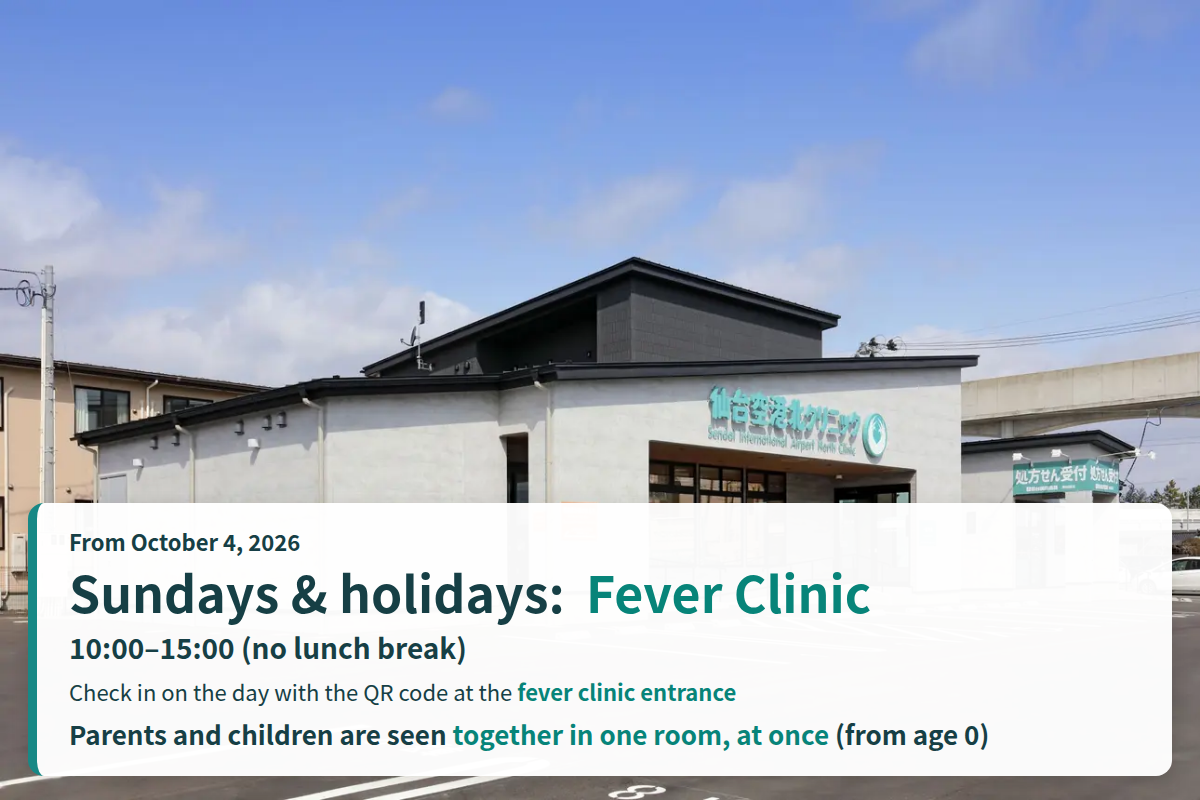
First, a note about our fever clinic on Sundays and national holidays. PCR testing for influenza and COVID (a test that copies the virus’s genetic material in order to detect it) gives results the same day.
From October 4, 2026, we also run the fever clinic on Sundays and national holidays
10:00 to 15:00 (no lunch break). You check in on the day. We give you the PCR result the same day. On Sundays and holidays we see fever patients only, and we do not offer general outpatient care or IV drips. Please check the clinic calendar for clinic dates and closed days. Notice: fever clinic on Sundays and national holidays
Shunichi Gamo, MD, PhD
Director, Sendai International Airport North Clinic
Born and raised locally, he attended Yuriage Elementary School and Yuriage Junior High School in Natori City. After graduating from Tohoku University School of Medicine, he worked at Sendai Open Hospital and Kesennuma City Hospital, and then at Tohoku University Hospital. In April 2021, in the middle of the COVID-19 pandemic, he opened Sendai International Airport North Clinic. Holding to a fever clinic that never turns patients away, he cared for well over 20,000 patients with fever in the two years before COVID-19 was moved to Class 5 under Japan’s infectious disease law.
Society memberships and board certifications
Certified Member and Board Certified Fellow, Japanese Society of Internal Medicine
Board Certified Pulmonologist, Japanese Respiratory Society
Board Certified Allergist, Japanese Society of Allergology
Board Certified Specialist, Japanese Society of Anti-Aging Medicine
PhD in Medicine (Tohoku University)
What is mumps? Symptoms, incubation period, and how long it can be passed on
Mumps (epidemic parotitis) is an infection caused by the mumps virus, and its main symptoms are swelling of the salivary glands and fever[1]. It spreads through droplets such as those from sneezes (droplet transmission) and by touching something with virus on your hands (contact transmission)[1].
According to the Japan Institute for Health Security (JIHS), the incubation period (the time from infection to symptoms) is about 14 to 21 days, averaging around 18 days[1]. Swelling and pain of the salivary glands, fever, and pain on swallowing appear, and it usually improves in 1 to 2 weeks[1].
The following is known about the period when it can be passed on. The JIHS detailed version says it is quite contagious[2]. It states that the virus can be isolated from saliva from about 7 days before symptoms appear until around day 9 after they appear[2].
Silent infection (infection without symptoms) is also said to account for 30 to 35% of cases[2]. The report of the Ministry of Health, Labour and Welfare working team also states that even silent infections shed virus in saliva and become a source of infection[3]. In other words, mumps can be passed on before the swelling appears, and by people who have no swelling at all.
The same report says the fever usually lasts 1 to 6 days, the parotid swelling peaks in 1 to 3 days, and it shrinks over 3 to 7 days[3]. Headache, tiredness, loss of appetite, and neck pain can also occur[3].
Note that swelling below the ear can also be caused by illnesses other than mumps[4]. Do not assume “it’s swollen, so it’s mumps”; it is important to have it confirmed by an examination.
 Dr. Gamo
When the area below the ear swells, it is easy to think of mumps, but there can be other causes too.
How long must a child stay out of school or nursery? The exclusion rules
Schools exclude a child until 5 days have passed since the parotid and other glands began to swell and the child’s overall condition has become good. The rule is in Article 19 of the Enforcement Regulations of the School Health and Safety Act[5].
Mumps is classed as a “Class 2 infectious disease” in the same regulations, and the exclusion period is set as follows[5].
Until 5 days have passed since swelling of the parotid, submandibular, or sublingual gland appeared, and the overall condition has become good.
| What to check | Details |
|---|---|
| Condition 1 | 5 days have passed since swelling of the parotid, submandibular, or sublingual gland appeared[5] |
| Condition 2 | The overall condition has become good[5] |
| Exception | This does not apply when the school physician or another doctor judges, based on the child’s condition, that there is no risk of infection[5] |
Both of the two conditions are required. If the fever or pain remains and your child is limp even after 5 days, your child still stays home.
Dr. GamoPlease look not only at the number of days but also at whether your child’s energy has come back.
For nursery schools and kindergartens, please follow the instructions of the one your child attends. You can ask the doctor at the visit about the date to return to nursery school or school. For how exclusion periods are counted, our article on exclusion from school for influenza and our article on how to count the day of onset may also help.
What complications can mumps cause?
The main complications are meningitis, orchitis (inflammation of the testicle), hearing loss, and pancreatitis[1][2]. The table below summarizes a rough idea of how often they occur.
| Complication | Rough frequency | What makes you notice |
|---|---|---|
| Aseptic meningitis | Estimated at about 10% of clearly symptomatic cases[2] | Headache, repeated vomiting, stiff neck |
| Orchitis | About 20 to 30% of males after puberty[2] | Swelling and pain of the scrotum, fever |
| Hearing loss | 0.01 to 0.5%, with a wide range between reports[3] | Trouble hearing, ringing in the ears, dizziness |
| Pancreatitis | A rare but serious complication[2] | Belly pain, vomiting |
How often hearing loss occurs varies between reports. In the next section, I introduce the results of surveys in Japan.
Dr. GamoA list of complication names can be unsettling. Knowing what to notice is an important way to be prepared.
What kind of hearing loss does mumps cause?
Hearing loss from mumps most often affects one ear and tends to be severe. There are several surveys from Japan, and all show the same tendency.
Nationwide survey by the Oto-Rhino-Laryngological Society of Japan (2015 to 2016)
A committee of the Oto-Rhino-Laryngological Society of Japan (now the Japan Society of Otorhinolaryngology and Head and Neck Surgery) surveyed 5,565 ear, nose, and throat facilities across the country[6]. There were responses from 3,906 facilities (a response rate of 70%), and at least 359 people had been diagnosed with hearing loss from mumps over the 2 years of 2015 to 2016[6].
Among 335 people with detailed information, 320 (95.5%) had hearing loss in one ear and 15 (4.5%) in both ears[6]. Looking at the final hearing, 263 of 290 people (91%) with hearing loss in one ear were left with severe or profound hearing loss[6]. Among those with hearing loss in both ears, 12 of 15 (80%) were left with severe or profound hearing loss even in the better-hearing ear[6].
| What this survey found | Numbers |
|---|---|
| People diagnosed with hearing loss (at least) | 359 people[6] |
| Hearing loss in one ear | 320 people (95.5%)[6] |
| Hearing loss in both ears | 15 people (4.5%)[6] |
| People who also had parotid or other swelling | 73.5% (26.5% had no clear swelling)[6] |
| Peaks in age at onset | Preschool to school age, and the child-rearing generation in their 30s[6] |
What matters is that 26.5% had no clear swelling and that it was also common among parents in their 30s[6]. Parents who are caring for a sick child should pay attention to their own hearing, too.
Hearing can also change later
In this survey, among 203 people whose hearing could be followed from the first visit to the end, 55 (27%) got worse during the course[6]. In contrast, 11 people (5.0%) improved[6]. Cases that took nearly a month to be diagnosed were also reported[6].
The paper summarizing the survey says that even if there is no hearing problem now when someone has mumps, it is necessary to keep observing and to alert the family[6]. In the survey, sudden severe hearing loss that occurred from 4 days before the swelling of the parotid or other glands to within 18 days after it was counted as a definite case[6]. Even after the swelling goes down, keep paying attention to hearing for a while.
Dr. GamoMore important than “will it get better?” is “have you checked the hearing?” Even after the swelling has gone down, keep an eye on any change in hearing.
Other studies in Japan show the same tendency
In nationwide surveys by a Ministry of Health, Labour and Welfare research group in 1987, 1993, and 2001, the estimated number of people with hearing loss from mumps each year was 300, 400, and 650[7]. Most had severe or profound sensorineural hearing loss (hearing loss from the nerve deep in the ear that senses sound), and it was reported that they usually did not recover[7].
In a report on 67 people diagnosed at 19 hospitals from 1987 to 2016, 63 had it in one ear[8]. In 65 ears the hearing loss was severe, and only one ear recovered completely[8]. Most of the people who developed hearing loss had not been vaccinated[8].
There is also a study that used insurance claims data. Among 68,112 mumps patients, 102 had hearing loss, which was 1 in every 668 patients[9]. In this study, hearing loss per 10,000 patients was estimated at 73.6 for ages 16 to 64 and 8.8 for ages 0 to 15, an 8.4-fold difference[9]. Adults need to be careful, not only children.
Small children cannot tell you themselves
Infants and toddlers may not complain even when they cannot hear well in one ear, and the people around them may not notice[6]. The nationwide survey also describes a case in which it took about 40 days to find hearing loss in one ear of a 4-year-old[6].
- Your child sometimes does not turn around when called from one side
- Your child wants the phone or TV louder than usual
- Your child says “my ear feels strange” or “there is a buzzing, ringing sound”
- Your child is unsteady or vomits from dizziness (this can be mistaken for the nausea of a cold[6])
Hearing tests are done at an ear, nose, and throat clinic. When we see mumps at our clinic too, if your child’s hearing is a concern, you can ask us about a referral to an ear, nose, and throat clinic that can do the test.
When should I suspect orchitis, meningitis, or pancreatitis?
For orchitis, it is males after puberty; for meningitis, headache and vomiting; and for pancreatitis, belly pain that prompts a visit. Let us look at each in turn.
Orchitis: in males after puberty
Orchitis is a complication in which the testicle swells and hurts. According to the JIHS, it occurs in about 20 to 30% of males after puberty[2]. A study from Spain describes orchitis from mumps as the most serious complication in young males after puberty[10].
In this study, of 67 people who developed orchitis, 89.5% had one side affected and 10.4% both sides[10]. The interval from parotid swelling to orchitis was 4.9 days[10]. It was reported that many had sperm abnormalities during the follow-up period[10].
On the other hand, the report of the Ministry of Health, Labour and Welfare working team says that even if the testicle becomes smaller and sperm count falls, it is rare for this to cause infertility[3]. If you are worried, you can ask for advice, including from a urologist. If the scrotum is swollen and painful, please be seen early.
Aseptic meningitis: headache and vomiting
Meningitis is inflammation of the membranes that cover the brain and spinal cord. It is the most common complication of mumps and is estimated to occur in about 10% of clearly symptomatic cases[2]. An overseas review also describes meningitis and encephalitis as common complications[4].
A severe headache with repeated nausea or vomiting may be a sign of meningitis. The JIHS detailed version says that in cases with meningitis, rest is kept up, and an IV drip is given if there is dehydration (a state in which the body lacks water)[2].
Pancreatitis: belly pain and vomiting
Pancreatitis is inflammation of the pancreas, which lies behind the stomach. It is rare but is considered one of the serious complications[2]. If pain in the upper belly or vomiting continues, do not assume it is a stomach bug; tell the doctor about the mumps and be seen.
Dr. GamoEven with belly pain, telling the doctor that your child has mumps is an important clue.
Can the vaccine prevent it? It is optional in Japan, and the Society recommends two doses
The mumps vaccine is optional in Japan (a vaccination that people who want it receive at their own expense). The Japan Pediatric Society recommends a first dose early after the first birthday and a second dose in the year before starting elementary school[11].
The Society’s guidance notes that these timings are the same as for the routine measles-rubella combined (MR) vaccine[12]. The Society considers that the risk of complications from catching the disease naturally greatly outweighs the risk of side effects of the vaccine[11].
Dr. GamoIt is easy to remember if you think of the timing as the same as the MR vaccine.
Aseptic meningitis as a vaccine side effect was reported in 6 cases in a nationwide survey (44,708 cases), or 13.4 per 100,000 doses[11]. In June 2026, the Society asked the national government to make the mumps vaccine part of the routine vaccination program[11].
If you do not know your vaccination record, or if you are an adult who has never had mumps and are wondering about vaccination, please ask your regular doctor. For vaccine side effects and fever, please also see our article on fever after vaccination.

When should I be seen? 119, an emergency department, or an early visit
Call 119 right away
If even one of the following is present, call 119 without hesitating. This is the same at night and on holidays.
- Your child does not respond when called, or is limp and will not open their eyes
- A seizure has occurred
- There is severe difficulty breathing, or the lips look purplish
Go to an emergency department, even at night or on a holiday
In the following situations, do not wait until morning; go to an emergency department. If your child is in so much distress that you cannot move them, call 119.
- A severe headache, repeated vomiting, or reluctance to bend the neck
- Your child is dazed or says things that do not make sense
- Severe belly pain continues, and your child vomits and cannot drink
- The scrotum suddenly swells and hurts badly
- Your child is passing hardly any urine or is limp
If you are unsure, for children under 15 you can ask Miyagi Prefecture’s children’s night-time advice line (#8000). It runs every day from 19:00 to 8:00 the next morning, and nurses advise on whether to be seen[13]. From a landline that is not a push-button line, call 022-212-9390[13].
People aged 15 and over can use the adult emergency telephone consultation line (#7119), available 24 hours a day, 365 days a year. From a phone that cannot dial #7119, call 022-706-7119[14]. However, if you think it is an emergency or serious, call 119 without hesitating[14].
Dr. GamoFor children, #8000; for people aged 15 and over, #7119. Keeping the numbers handy means you will not panic when the time comes.
Be seen the same day (the next morning if it is night)
- The parotid glands or the area under the jaw are swollen and there is a fever (have it examined to see whether it is mumps)
- Trouble hearing, ringing in the ears, or dizziness (go to an ear, nose, and throat clinic that can do a hearing test)
- A male after puberty has a swollen or painful scrotum
- A strange feeling in hearing has appeared after the swelling went down
- Belly pain or vomiting has appeared during the course of mumps
If your child’s condition changes during the night, go back to the “119” and “emergency department” guides above at that point and judge again. For the approach at night and on holidays, please also see our article on children’s fevers at night and on holidays.
What happens when I am seen?
First, at the examination, we check where the swelling is, how it has progressed, and the chance of other illnesses. Then we give treatment to ease the distressing symptoms. Treatment of mumps centers on symptomatic treatment that eases the symptoms[1].
For fever and pain, a fever and pain reliever (acetaminophen, such as Calonal) can be used[2]. The Ministry of Health, Labour and Welfare report also states that symptomatic treatment such as fever and pain relievers and cooling the affected area is often given[3]. Please use medicine as the doctor directs, with the amount matched to age and weight.
If hearing is a concern, we will guide you to an ear, nose, and throat clinic that can do a hearing test. If there are symptoms suggesting a complication, we will also guide you to a more suitable medical facility as needed. Please bring notes on the day the swelling began, the day the fever started, and the vaccination record.
Dr. GamoJust writing the day the swelling started and the day the fever started on a calendar is enough.
For how to be seen at the fever clinic, see our article on when to visit a fever clinic, and for what is asked in the questionnaire, see our article on the fever clinic questionnaire.
Frequently asked questions
- The area below my ear is swollen and I have a fever. Should I see a doctor?
-
Yes, I recommend being seen early. Swelling below the ear can also occur with illnesses other than mumps, so it is important to have it confirmed by an examination[4]. At the visit, we explain treatment to ease the symptoms and how to watch for complications. If your child does not respond when called or has a seizure, call 119.
- My child says they cannot hear well in one ear. Which department should we go to?
-
Please go to an ear, nose, and throat clinic that can do a hearing test as soon as possible. Hearing loss from mumps most often affects one ear, and cases that took time to diagnose have been reported[6]. If your child has been seen for mumps, tell them so.
- Can hearing loss appear after the swelling has gone down?
-
Yes, it can. In the nationwide survey, hearing loss that occurred from 4 days before the swelling to within 18 days after it was counted as a definite case[6]. Even after the swelling goes down, keep paying attention to hearing for a while, and see an ear, nose, and throat clinic if anything feels off.
- What should an adult man watch for if he gets mumps?
-
Orchitis is said to occur in about 20 to 30% of males after puberty[2]. If the scrotum is swollen or painful, be seen early. If the pain comes on suddenly and is severe, go to an emergency department even at night. Adults also need to be careful about hearing loss[9].
- How many days should my child stay out of school?
-
The exclusion period is “until 5 days have passed since swelling of the parotid, submandibular, or sublingual gland appeared, and the overall condition has become good”[5]. Please ask the doctor at the visit about the specific date to return.
- How many doses of the vaccine are best, and when?
-
It is optional in Japan, and the Japan Pediatric Society recommends a first dose early after the first birthday and a second dose in the year before starting elementary school[11]. If you do not know the vaccination record, check the maternal and child health handbook and ask your regular doctor.
Summary: if something feels off in your hearing, get a hearing test early
- The complication of mumps to watch most closely is hearing loss. If you notice trouble hearing, see a doctor early and have a hearing test
- If your child does not respond when called, has a seizure, or has severe difficulty breathing, call 119
- Schools exclude a child until the set number of days has passed since the parotid and other glands began to swell and the child’s overall condition has improved
- Hearing loss can occur in people without swelling and in adults. Even after the swelling goes down, keep paying attention to hearing for a while
- For scrotal pain in males after puberty, severe headache with vomiting, or belly pain, be seen early
- The vaccine is optional. The Japan Pediatric Society recommends two doses: early after the first birthday and in the year before starting elementary school
With the complications of mumps, the earlier you notice, the more can be done. Please pass on to us, just as it is, the thought that “my hearing might be a bit off.” Leave the medical care to us.
That’s all.
Disclaimer
This article is intended to provide general medical information and does not replace an examination, diagnosis, or treatment by a doctor. The content is based on medical knowledge at the time of publication, but the right course of action differs for each person. If you are worried about symptoms, please consult a medical facility.
References
- Japan Institute for Health Security. Epidemic parotitis (mumps). Infectious Diseases Information site (in Japanese). Accessed October 2026. https://id-info.jihs.go.jp/infectious-diseases/mumps/index.html
- Japan Institute for Health Security. Epidemic parotitis (mumps), detailed version. Infectious Diseases Information site (in Japanese). Accessed October 2026. https://id-info.jihs.go.jp/infectious-diseases/mumps/detail/index.html
- Ministry of Health, Labour and Welfare, Immunization Subcommittee, Subcommittee on Vaccine Evaluation, Mumps Vaccine Working Team. Report of the Mumps Vaccine Working Team (supplementary fact sheet). Ministry of Health, Labour and Welfare website (in Japanese). Accessed October 2026. https://www.mhlw.go.jp/stf/shingi/2r98520000014wdd-att/2r98520000016rqu.pdf
- Hviid A, Rubin S, Mühlemann K. Mumps. Lancet. 2008 Mar 15;371(9616):932-44. doi:10.1016/S0140-6736(08)60419-5 PMID: 18342688
- Enforcement Regulations of the School Health and Safety Act (Ministry of Education Order No. 18 of 1958), Article 19. e-Gov Law Search (in Japanese). Accessed October 2026. https://laws.e-gov.go.jp/law/333M50000080018
- Morimoto N, Masuda S, Aso S, Kashio A, Kanda Y, Nakazawa M, et al. Nationwide survey of mumps-associated hearing loss cases that developed during the 2015 to 2016 mumps epidemic (in Japanese). Nippon Jibiinkoka Gakkai Kaiho. 2018;121(9):1173-80. doi:10.3950/jibiinkoka.121.1173
- Kawashima Y, Ihara K, Nakamura M, Nakashima T, Fukuda S, Kitamura K. Epidemiological study of mumps deafness in Japan. Auris Nasus Larynx. 2005 Jun;32(2):125-8. doi:10.1016/j.anl.2005.01.009 PMID: 15917168
- Morita S, Fujiwara K, Fukuda A, Fukuda S, Nishio SY, Kitoh R, et al. The clinical features and prognosis of mumps-associated hearing loss: a retrospective, multi-institutional investigation in Japan. Acta Otolaryngol. 2017;137(sup565):S44-7. doi:10.1080/00016489.2017.1290826 PMID: 28338374
- Takagi A, Ohfuji S, Nakano T, Kumihashi H, Kano M, Tanaka T. Incidence of mumps deafness in Japan, 2005-2017: analysis of Japanese insurance claims database. J Epidemiol. 2022 Jan 5;32(1):21-6. doi:10.2188/jea.JE20200233 PMID: 33100297
- Ternavasio-de la Vega HG, Boronat M, Ojeda A, García-Delgado Y, Ángel-Moreno A, Carranza-Rodríguez C, et al. Mumps orchitis in the post-vaccine era (1967-2009): a single-center series of 67 patients and review of clinical outcome and trends. Medicine (Baltimore). 2010 Mar;89(2):96-116. doi:10.1097/MD.0b013e3181d63191 PMID: 20517181
- Japan Pediatric Society. Request for Early Routine Vaccination with Mumps-Containing Vaccines and Use of Already Approved Vaccines (June 4, 2026). Japan Pediatric Society website (in Japanese). Accessed October 2026. https://www.jpeds.or.jp/uploads/2026-06/20260611_MMR.pdf
- Japan Pediatric Society, Committee on Immunization and Infectious Disease Control. Request Regarding the Number of Mumps Vaccine Doses (May 21, 2021). Japan Pediatric Society website (in Japanese). Accessed October 2026. https://www.jpeds.or.jp/society-activities/pediatric-medical-care/vaccination/vaccinations-infectiousdiseases/20370.html
- Miyagi Prefecture. Miyagi Prefecture Children’s Night-time Advice Line Program (#8000). Miyagi Prefecture website (in Japanese). Accessed October 2026. https://www.pref.miyagi.jp/soshiki/iryou/shouni04.html
- Miyagi Prefecture. Adult Emergency Telephone Consultation (#7119). Miyagi Prefecture website (in Japanese). Accessed October 2026. https://www.pref.miyagi.jp/soshiki/iryou/kyuukyuutel.html
▶ Overview of this topic: Fever clinic on Sundays and national holidays (from October 4, 2026, 10:00 to 15:00)
More articles to read when you have a fever
For our Sunday and holiday fever clinic, see Notice: fever clinic on Sundays and national holidays.