If you are in a hurry
- Do not give honey, or drinks, sweets or baby food containing honey, to a baby under 1 year old
- If, after several days of constipation, your baby feeds weakly, has a weak cry, or is floppy all over, see a doctor urgently. If breathing looks difficult, your baby is limp, or has a seizure, call 119
- Heating does not destroy the botulism spores in honey, but after age 1 honey is no longer a high-risk food
Hello. I am Shunichi Gamo, MD, PhD, a board-certified pulmonologist and the director of Sendai Airport North Clinic.
You mixed just a little honey into your baby’s food for flavor. A grandparent gave some to the baby, saying “we’ve always eaten it.” After an experience like this,
“Do not give honey to babies under 1 year old”
many of you may have remembered these words and become worried. To give you the conclusion first: do not give honey, or drinks, sweets or baby food containing honey, to a baby under 1 year old. This is because spores of the botulism bacterium (a state in which the bacterium is shut inside a hard shell), which can be present in honey, can multiply in a baby’s still-immature gut, make toxin, and cause infant botulism[1].
First, a note about our fever clinic on Sundays and national holidays. PCR testing for influenza and COVID (a test that copies the virus’s genetic material in order to detect it) gives results the same day.
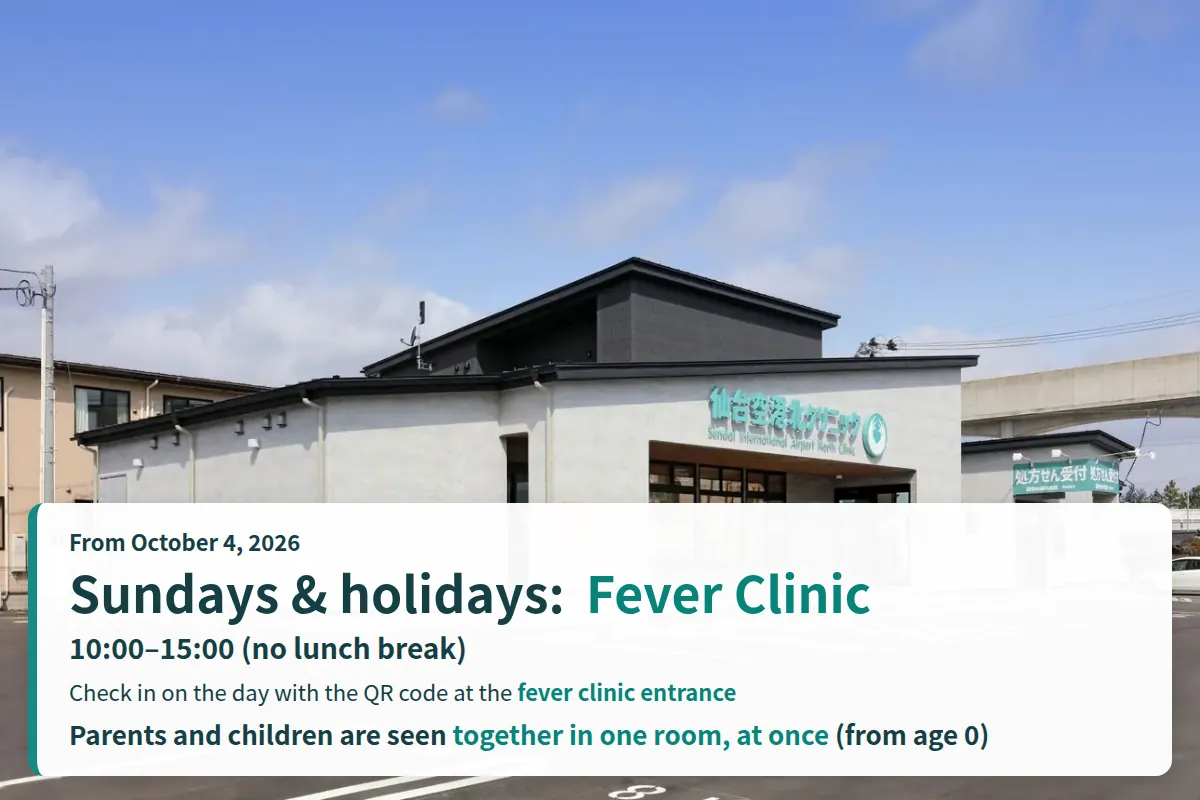
From October 4, 2026, we also run the fever clinic on Sundays and national holidays
10:00 to 15:00 (no lunch break). You check in on the day. We give you the PCR result the same day. On Sundays and holidays we see fever patients only, and we do not offer general outpatient care or IV drips. Please check the clinic calendar for clinic dates and closed days. Notice: fever clinic on Sundays and national holidays

Shunichi Gamo, MD, PhD
Director, Sendai International Airport North Clinic
Born and raised locally, he attended Yuriage Elementary School and Yuriage Junior High School in Natori City. After graduating from Tohoku University School of Medicine, he worked at Sendai Open Hospital and Kesennuma City Hospital, and then at Tohoku University Hospital. In April 2021, in the middle of the COVID-19 pandemic, he opened Sendai International Airport North Clinic. Holding to a fever clinic that never turns patients away, he cared for well over 20,000 patients with fever in the two years before COVID-19 was moved to Class 5 under Japan’s infectious disease law.
Society memberships and board certifications
Certified Member and Board Certified Fellow, Japanese Society of Internal Medicine
Board Certified Pulmonologist, Japanese Respiratory Society
Board Certified Allergist, Japanese Society of Allergology
Board Certified Specialist, Japanese Society of Anti-Aging Medicine
PhD in Medicine (Tohoku University)
Why must babies under 1 year old not be given honey?
Because a baby under 1 year old does not yet have a settled gut environment, botulism spores that can be present in honey may germinate and multiply in the gut, make toxin, and cause infant botulism[1].
The Ministry of Health, Labour and Welfare explains that the botulism bacterium is widespread in places such as soil, and that in an adult’s gut it loses out to other gut bacteria and usually causes nothing, whereas in a baby the bacteria multiply and release toxin[1]. The Consumer Affairs Agency gives the same reason: “In infants under 1 year of age, the gut environment differs from that of adults, and the botulism bacterium is thought to settle and multiply in the intestine more easily”[2].
The Tokyo Metropolitan Government Bureau of Public Health also explains: “Because infants under 1 year old have an immature gut environment, if honey contains the botulism bacterium, the bacteria can multiply in the gut and cause ‘infant botulism’”[3].
 Dr. Gamo
The bacteria do not grow inside the honey jar. The problem is that the spores germinate and the bacteria multiply inside a baby’s still-immature gut[4].
Does heating or cooking kill the botulism bacteria in honey?
No, it does not. The botulism bacterium forms heat-resistant spores, so they are not killed by ordinary heating or cooking, and heated honey must not be given to babies under 1 year old either[1].
The Ministry of Health, Labour and Welfare explains that botulism spores are said to withstand heat up to 120°C for 4 minutes, so they are not killed by ordinary heating or cooking[1]. An official notice from the Ministry of Health, Labour and Welfare also states that killing the spores requires heat sterilization at 120°C for at least 4 minutes or the equivalent, and that at around 100°C they cannot be killed even with long heating[5].
| Heating condition | Botulism spores |
|---|---|
| Ordinary heating or cooking | Not killed[1] |
| 100°C for a long time | Cannot be sterilized[5] |
| 120°C for 4 minutes or more | Killed[1][5] |
The Consumer Affairs Agency also states that in the spore state they can survive even heating at 100°C for several minutes[2]. The Tokyo Metropolitan Government Bureau of Public Health also warns that the botulism bacterium is resistant to heat and is not killed by ordinary heating alone[3].
Dr. GamoEven cooked honey cannot be called safe. Please do not give it until your child turns 1.
What kinds of foods contain honey?
Not only honey itself but also drinks, sweets and baby food containing honey must not be given to babies under 1 year old[1].
The Ministry of Health, Labour and Welfare says, “Do not give honey or foods containing honey, such as drinks and sweets, to babies under 1 year old”[1]. In addition, honey and foods containing honey must carry the label “Do not give to infants under 1 year old”[1][2].
- Honey itself[1]
- Drinks containing honey (such as juice)[1]
- Sweets and other foods containing honey[1][3]
- Baby food made by mixing honey into juice or other drinks[5]
In a case in Adachi Ward, Tokyo, in 2017 in which a baby died, store-bought juice mixed with honey had been given as baby food for about 1 month[5]. At that time, the product carried a label saying it should not be given to infants under 1 year old[5]. Accidents happen even when there is a label, so the whole family should check the ingredients of seasonings and drinks.
Dr. GamoMaking a habit of glancing at the label of drinks and snacks to check for honey gives peace of mind.
What are the symptoms of infant botulism?
After several days of constipation, signs appear such as weaker feeding (less strength to drink breast milk or formula), loss of energy, a change in the cry, and poorer head control[1][4].
Dr. GamoHead control becoming weaker than before is also an important sign.
The Ministry of Health, Labour and Welfare lists symptoms such as constipation, weaker feeding, loss of energy, a change in the cry, and poorer head control[1]. The Consumer Affairs Agency describes constipation lasting several days, general muscle weakness, a limp state, weaker feeding, a quieter cry, a face that becomes especially expressionless, and an inability to hold up the head because the neck muscles are slack[2].
| Stage | Symptoms that appear |
|---|---|
| At first | Constipation for several days (usually 3 days or more)[4], weaker feeding, low energy[1] |
| As it progresses | Weak cry, drooping eyelids, poor head control, expressionless face[2][4] |
| As it progresses further | Floppy all over, paralysis on both sides equally, and the breathing muscles may become paralysed so that a ventilator is needed[4] |
Infant botulism is often first noticed as constipation, which usually lasts 3 days or more[4]. It starts with cranial nerve paralysis, such as ptosis (drooping eyelids) and a weaker gag reflex, and then symmetric, slack paralysis and low muscle tone spread to the neck, trunk, arms and legs, so the baby becomes floppy (floppy baby)[4]. There is no fever and no seizures[4]. However, if there is a seizure, another illness may be the cause, so call 119 (Japan’s emergency number). A related committee of the Japan Pediatric Society also describes the typical feature as nerve symptoms following constipation, in which muscle strength falls and the baby becomes limp, feeds weakly and has a quieter cry[6].
Signs to see a doctor urgently: when should I hurry to a doctor or call 119?
If, after several days of constipation, signs such as weak feeding, a weak cry, floppiness all over, drooping eyelids, or a head that is not held up appear, see a doctor urgently. If breathing looks difficult, call 119 without hesitation. This is the same at night and on holidays.
If the muscles needed for breathing become paralysed, treatment with a ventilator may be necessary[4]. In the 2017 case of death too, the baby developed seizures and respiratory failure and was taken to hospital by ambulance[5]. Watch your baby’s breathing most carefully of all.
- Breathing looks difficult, breaths are weak, or breathing seems about to stop
- Limp all over and responds weakly when you call them
- Looks pale and cannot feed at all
- Has a seizure
If any of these apply, call 119 without hesitation. If you are unsure whether to call 119, you can get advice from Miyagi Prefecture’s children’s emergency advice line (#8000). However, if breathing clearly looks difficult, call 119 without calling the advice line first.
Dr. GamoNight or holiday, if breathing looks hard, call 119 without hesitation. Please remember this.
If breathing does not look difficult but you notice changes like the following, see a doctor the same day. At night, do not wait until the next morning; go to an emergency department.
- Constipation is lasting longer than usual (usually 3 days or more)[4]
- Feeding has become weaker, or your baby is drinking less[1][2]
- The cry is weak, or your baby has low energy[1]
- Drooping eyelids, poorer head control, or an expressionless face[2][4]
- Floppy all over[4]
Can infant botulism be cured? How is it treated?
Yes. In most cases, infant botulism is cured with appropriate treatment. If supportive care (treatment that addresses the symptoms that appear rather than the cause itself), such as breathing support, goes well, the outlook is good[1][4].
The Ministry of Health, Labour and Welfare states that in most cases it is cured with appropriate treatment, but in rare cases babies die[1]. According to JIHS (the infectious disease information site of the Japan Institute for Health Security), which gathers detailed information, in Japan babies are given supportive care and the dried equine botulinum antitoxin is not used. If there are no complications from breathing support or other care, the outlook is good, and in the US the death rate has been reported to be less than 1%[4].
In the US, a human globulin product containing type A and type B antitoxin (BIG-IV) is sometimes used[4]. A 2026 review states that the death rate is less than 1% when babies receive intensive care and treatment with human-derived immune globulin[7].
Dr. GamoMost babies recover if infant botulism is noticed early and breathing and nutrition are supported. Watch for constipation, a weak cry and weaker feeding.
How many cases have been reported in Japan?
In Japan, infant botulism was first reported in 1986, and 42 cases had been reported by 2020[4].
According to JIHS, all 42 cases were under 1 year old, with a median age of 6 months, but 3 cases occurred at 10 months and 4 cases at 11 months[4]. Cases in which honey was thought to be the cause total 13: 12 cases from 1986 to 1989 plus 1 case in 2017. In the 29 cases seen from 1990 to 2020, there was no clear history of eating honey[4].
According to a related committee of the Japan Pediatric Society, infant botulism was first confirmed in Chiba Prefecture in 1986, and in October 1987 the then Ministry of Health and Welfare issued a “notice not to give honey to infants under 1 year old”[6]. In 2017, in Adachi Ward, Tokyo, a 5-month-old boy who had been given juice mixed with honey as baby food died of infant botulism[5]. According to JIHS, the 2017 case is the only death among the 42 confirmed cases[4].
Dr. GamoNot many cases are reported, but it can be life-threatening. Please do not give honey until age 1.
Another page of the Ministry of Health, Labour and Welfare states that there have been 3 cases reported by public health centers as food poisoning since 1986, and 16 cases reported by doctors as infant botulism since 1999 (the counting methods and periods differ)[1]. A study that compiled reports from 1976 to 2006 found that 26 countries had reported cases of infant botulism, with the most in the US, followed by Argentina, Australia, Canada, Italy and Japan[8]. Another review concludes that although cases are rare, honey is the only food that has been consistently identified, and that authorities in many countries recommend avoiding honey before 12 months of age[7].
Can my child eat honey after turning 1?
Yes. After age 1, baby food and other foods help the gut environment become settled, so there is no need to avoid honey[2].
The Ministry of Health, Labour and Welfare states, “For people aged 1 year and over, honey is not a high-risk food”[1]. The Consumer Affairs Agency also states that from age 1, baby food and other foods help the gut environment become settled, so there is no need to avoid honey; honey is a nutritious food, but it should be given only after age 1[2]. After the 1st birthday, it is fine to let your child enjoy honey little by little.
Dr. GamoOnce your child is past the 1st birthday, honey can be enjoyed as a nourishing food.
Frequently asked questions
- My baby ate a little honey. What should I do?
-
Symptoms do not necessarily appear right away, but infant botulism is often first noticed as constipation, so watch your baby’s stools and energy for a while afterwards[4]. If you see changes such as constipation for several days, weaker feeding, a quieter cry, floppiness all over, or drooping eyelids, see a doctor early. If breathing looks difficult, call 119.
- Is heated honey all right?
-
No, heating does not make it safe. Botulism spores are resistant to heat; heating at 120°C for 4 minutes is said to be necessary, and ordinary heating or cooking does not kill them[1]. At around 100°C, they cannot be killed even with long heating[5]. Do not give heated honey to babies under 1 year old either.
- Can a baby get infant botulism without eating honey?
-
Yes. In Japan, in the 29 cases seen from 1990 to 2020, there was no clear history of eating honey. A diagnosis of infant botulism cannot be ruled out just because the baby has not eaten honey[4]. Besides honey, well water has been reported as a cause[1][6].
- I am worried that the grandparents might give my baby honey.
-
The Tokyo Metropolitan Government Bureau of Public Health urges that not only the parents who mainly care for the baby but also grandparents and other family members living together be told that honey must not be given to infants[3]. Please also tell them to be careful with drinks and sweets that contain honey.
- Once my child turns 1, can they eat honey?
-
Yes. After age 1, baby food and other foods help the gut environment become settled, so there is no need to avoid honey[2]. The Ministry of Health, Labour and Welfare also states that honey is not a high-risk food for people aged 1 year and over[1].
- Can we see a doctor on Sundays and national holidays?
-
Yes. We run the fever clinic on Sundays and national holidays too, from 10:00 to 15:00 (no lunch break). You check in on the day. Please check the calendar for open days. On Sundays and holidays we do not offer general outpatient care or IV drips. If breathing looks difficult, first call 119 before coming to the clinic.
Summary: no honey before age 1, and heating does not destroy the spores
- Do not give honey, or drinks, sweets or baby food containing honey, to a baby under 1 year old
- If several days of constipation are followed by weak feeding, a weak cry, or floppiness all over, take your baby to a doctor urgently. Difficulty breathing, limpness, or a seizure means it is time to call 119
- Heating does not destroy the botulism spores in honey; on the other hand, once your child is past age 1, honey is no longer a high-risk food
- In most cases infant botulism is cured with appropriate treatment, and with supportive care such as breathing support the outlook is good[1][4]
- In Japan it was first reported in 1986, with 42 cases by 2020. In 2017 a 5-month-old boy died in Tokyo[4][5]
- At the visit, tell the doctor whether your baby ate honey, how many days the constipation has lasted, and any changes in feeding, crying or muscle tone
Infant botulism is a rare disease, but it can be caused by a familiar food: honey. If it is noticed early and leads to treatment that supports breathing and other functions, most babies recover. The people who can notice that your baby “is different from usual” are the family members who are always with them. Please tell us exactly what you noticed. Leave the medical care to us.
That’s all.
Disclaimer
This article is intended to provide general medical information and does not replace an examination, diagnosis, or treatment by a doctor. The content is based on medical knowledge at the time of publication, but the right course of action differs for each person. If you are worried about symptoms, please consult a medical facility.
References
- Ministry of Health, Labour and Welfare. Give honey only after age 1. Ministry of Health, Labour and Welfare website (in Japanese). Accessed October 2026. https://www.mhlw.go.jp/stf/seisakunitsuite/bunya/0000161461.html
- Consumer Affairs Agency. Infant botulism caused by honey. Consumer Affairs Agency website (in Japanese). Accessed October 2026. https://www.caa.go.jp/policies/policy/consumer_safety/food_safety/food_safety_portal/microorganism_virus/contents_001/
- Tokyo Metropolitan Government Bureau of Public Health. Why must honey not be given to infants under 1 year old? (Food safety FAQ). Tokyo Metropolitan Government Bureau of Public Health website (in Japanese). Accessed October 2026. https://www.hokeniryo.metro.tokyo.lg.jp/anzen/anzen/food_faq/chudoku/chudoku24
- Japan Institute for Health Security. Botulism (detailed version). Infectious Disease Information Site (JIHS) (in Japanese). Accessed October 2026. https://id-info.jihs.go.jp/infectious-diseases/botulism/detail/index.html
- Inspection and Safety Division, Department of Environmental Health and Food Safety, Pharmaceutical Safety and Environmental Health Bureau, Ministry of Health, Labour and Welfare. On a death from infant botulism caused by honey (administrative notice, April 7, 2017). Ministry of Health, Labour and Welfare website (in Japanese). Accessed October 2026. https://www.mhlw.go.jp/file/06-Seisakujouhou-11130500-Shokuhinanzenbu/0000161263.pdf
- Nutrition Committee, Japanese Society of Child Health. Recommendation for members: on the onset of infant botulism caused by honey. Japan Pediatric Society website (in Japanese). Accessed October 2026. https://www.jpeds.or.jp/society-activities/column/proposals-assertions/50093.html
- Aricò MO, Caselli D, Stefanizzi P, Tafuri S, Aricò M. Infant botulism and honey exposure: global epidemiology, prevention policies, and communication strategies. Acta Paediatr. 2026 Jul;115(7):1429-33. doi:10.1111/apa.70538 PMID: 41964486
- Koepke R, Sobel J, Arnon SS. Global occurrence of infant botulism, 1976-2006. Pediatrics. 2008 Jul;122(1):e73-82. doi:10.1542/peds.2007-1827 PMID: 18595978
▶ Overview of this topic: Child’s Fever at Night or on a Holiday: Wait or Go Now?
Related articles
If your baby has a fever and is feeding less, see Fever and poor feeding in babies: what should you check for with RSV infection?; for a fever in a baby under 3 months, see Fever in a Baby Under 3 Months: Always See a Doctor at 38°C.