If you are in a hurry
- Impetigo is a bacterial skin infection. When it is needed, use antibiotics (ointment or oral medicine) exactly as your doctor tells you, start them early, and finish the full course
- Call 119 (Japan’s emergency number) if your child does not seem fully conscious, is having a seizure, is struggling to breathe, or is limp
- If the sores spread, the redness spreads, or a fever develops, see a doctor the same day
Hello. I am Shunichi Gamo, MD, PhD, a board-certified pulmonologist and the director of Sendai Airport North Clinic.
In summer, children get insect bites and heat rash more often. At times like these, families often ask us:
“Could this be impetigo?”
That is a question we hear a lot. Impetigo is a skin infection that can spread in no time, so it is natural for parents to worry.
To give you the answer first: impetigo is a bacterial skin infection, and when needed, antibiotics (ointment or oral medicine) should be started early and finished, exactly as your doctor says[1]. For impetigo that covers only a small area, antibiotic ointment is considered as effective as oral antibiotics[2].
In this article, I explain in plain words the types of impetigo, how it spreads, the use of antibiotics, washing and covering sores at home, school, nursery and pool rules, and signs that need a quick visit.
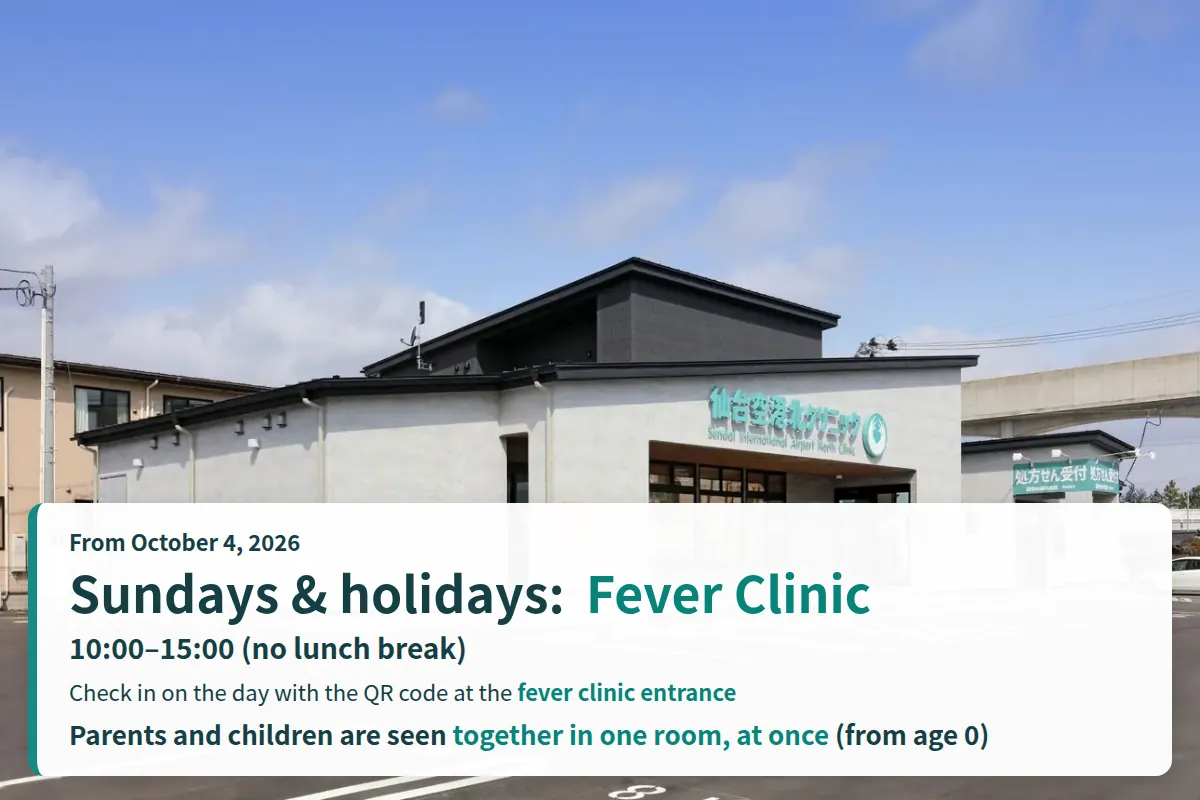
First, a note about our fever clinic on Sundays and national holidays. PCR testing for influenza and COVID (a test that copies the virus’s genetic material in order to detect it) gives results the same day.
From October 4, 2026, we also run the fever clinic on Sundays and national holidays
10:00 to 15:00 (no lunch break). You check in on the day. We give you the PCR result the same day. On Sundays and holidays we see fever patients only, and we do not offer general outpatient care or IV drips. Please check the clinic calendar for clinic dates and closed days. Notice: fever clinic on Sundays and national holidays
Shunichi Gamo, MD, PhD
Director, Sendai International Airport North Clinic
Born and raised locally, he attended Yuriage Elementary School and Yuriage Junior High School in Natori City. After graduating from Tohoku University School of Medicine, he worked at Sendai Open Hospital and Kesennuma City Hospital, and then at Tohoku University Hospital. In April 2021, in the middle of the COVID-19 pandemic, he opened Sendai International Airport North Clinic. Holding to a fever clinic that never turns patients away, he cared for well over 20,000 patients with fever in the two years before COVID-19 was moved to Class 5 under Japan’s infectious disease law.
Society memberships and board certifications
Certified Member and Board Certified Fellow, Japanese Society of Internal Medicine
Board Certified Pulmonologist, Japanese Respiratory Society
Board Certified Allergist, Japanese Society of Allergology
Board Certified Specialist, Japanese Society of Anti-Aging Medicine
PhD in Medicine (Tohoku University)
In short: What should you check first if you are worried about impetigo?
If you are worried that your child has impetigo, first check these three points.
- Treat
Impetigo is a bacterial skin infection. When it is needed, use antibiotics (ointment or oral medicine) exactly as your doctor tells you, start them early, and finish the full course - Call 119
Call 119 if your child does not seem fully conscious, is having a seizure, is struggling to breathe, or is limp - See a doctor
If the sores spread, the redness spreads, or a fever develops, see a doctor the same day
For the third point, seeing a doctor, I explain where to draw the line in the section “When should you see a doctor quickly?” below.
 Dr. Gamo
Please check often that the sores and redness are not spreading.
What kind of illness is impetigo?
“Tobihi” is the everyday Japanese name for this illness; its formal name in dermatology is impetigo contagiosa, and it is a bacterial infection of the skin[1].
The main bacteria that cause it are Staphylococcus aureus and group A streptococcus (strep)[1][3]. It spreads by contact, and it starts when bacteria get into scratched heat rash, insect bites or eczema, or into a wound from a fall[1]. Bacteria normally live just inside the nostrils, so in children who often touch their nose, it can start around the nose[1].
The incubation period is 2 to 10 days, and it can be longer[3][4]. It is common in summer and in babies and young children[3][4].
Dr. GamoThe Japanese name “tobihi” means “flying sparks”: the sores jump from place to place and multiply in no time. Early treatment stops the spread.
What types of impetigo are there?
Impetigo is broadly divided into two types: bullous impetigo and crusted impetigo[1].
| Type | Main bacteria | Appearance and features |
|---|---|---|
| Bullous impetigo | Mainly Staphylococcus aureus | Blisters form, burst, and the skin peels. Common in babies and children, and from early summer to midsummer[1] |
| Crusted impetigo | Mainly group A streptococcus (strep) | The skin becomes red and swollen, with thick crusts (scabs). The inflammation is strong and painful. Not strongly linked to the season, and more common in adults than in children[1] |
Most impetigo is the bullous type[1]. The bullous type occurs when a toxin made by Staphylococcus aureus (exfoliative toxin) attacks the skin[1].
The crusted type often occurs together with atopic dermatitis and comes on quickly[1]. It may also come with whole-body symptoms such as fever, swollen lymph nodes and a sore throat[1].
Dr. GamoTo some extent, the look tells us the type, but the medicine depends on the bacteria. Matching the medicine to the bacteria is what matters.
How does impetigo spread? Why is it more common in summer?
Impetigo spreads by contact, through touching the affected skin[3].
- The fluid inside blisters, the fluid that oozes from raw areas, and even the scabs can still spread the infection[1][3]
- If your child scratches and then touches another place, new sores appear on nearby or distant skin a few days to 10 days later[5]
- Scratched heat rash, insect bites and atopic dermatitis become easy entry points for bacteria[5]
- It is common in summer, but it also occurs in other seasons[5]. The bullous type is especially common from early summer to midsummer[1]
When the itching is strong, an antihistamine taken by mouth may be used to reduce scratching and keep the sores from spreading[1].
Dr. GamoKeeping your child from scratching the itchy spots is an important point in stopping it from spreading.
How is impetigo treated? When are antibiotics used?
Impetigo is a common skin infection, and worldwide about 162 million children are estimated to have it at any one time[6]. Because it is a bacterial infection, when it is needed we treat it properly with antibiotics (ointment or oral medicine)[1][3].
If the sores spread, antibiotics by mouth or by drip may be needed, not just ointment (medicine applied to the skin)[3][4][5]. See a doctor early and start treatment before it spreads.
According to the Q&A of the Japanese Dermatological Association, for the bullous type, antibiotic ointment is applied, the whole area is covered with gauze, and the gauze is changed once or twice a day[1]. Very mild cases can be treated with ointment alone, but usually an antibiotic by mouth is used as well[1]. When strep is the cause, a penicillin-type or cephalosporin-type antibiotic is used[1].
If it does not heal well, the cause may be resistant bacteria that antibiotics do not work well against. Sometimes a bacterial culture is done beforehand, ideally at the very start, to identify the bacteria and check which medicines work against them[1]. The infection-control guidelines for nursery schools also point out that drug-resistant strains of these bacteria (MRSA) are increasing[5].
As for how well treatment works, antibiotic ointment helped impetigo heal more often than applying nothing (placebo) (6 studies, 575 people, risk ratio 2.24)[2]. For impetigo in a limited area, ointment is considered as effective as oral medicine[2]. Whether oral medicine works better for widespread impetigo is not yet clear, so the doctor decides after looking at the condition[2].
The doctor chooses which medicine to use and for how long, based on the bacteria and how severe it is. Use it as instructed, and finish it even after the symptoms improve. Do not use leftover medicine from an earlier prescription on your own judgment.
Dr. GamoEven if it looks better, stopping halfway can bring it back. The basic rule is to use up all the medicine you were given.
Also, there is said to be insufficient evidence that antiseptics cure impetigo[2]. The first step is to wash gently with soap.
How should I care for it at home?
The basics of home care are to keep the area clean, cover it with gauze or something similar, and not scratch it[1][5].
- In summer, bathe your child and keep the skin clean[1]
- Wash the whole body well in the shower at least once a day[5]
- Lather the soap well, wash the sores gently and carefully, and rinse well[1][5]
- Use the shower instead of soaking in the bathtub[1]
- If your child has brothers or sisters, bathe your child after the other children[1]
- After bathing, apply the ointment and protect the sores with gauze or something similar[1]
- Cut nails short so your child does not scratch the skin[1][5]
- Keep your child from picking at the nose[1]
- Do not share towels or bedding; keep them separate[5]
Unless there are whole-body symptoms such as fever, it is fine to bathe your child[1]. However, cover the sores so that exudate (fluid that oozes from the affected skin) from raw areas or blisters does not get onto things around them[1].
Dr. GamoIf there is no fever or similar symptom, it is fine to keep your child clean with a shower.
What about school, nursery and swimming pools?
Under the School Health and Safety Act, impetigo is treated as a “Category 3 (other infectious disease)”, and it is an illness for which children do not need to be kept off school[7][1].
Impetigo is not named in the law’s enforcement regulations; it is included among the “other infectious diseases”[7]. The Japan Society of School Health says, “There is no need to keep children off school, but if the inflammation is strong or the infected area is large, tell children not to touch the sores directly”[3]. The list of the Japan Pediatric Society also gives the rule for attending school (or nursery) as “no restrictions”[4].
According to the guidelines for nursery schools, a child can attend if the sores have been treated with ointment and covered with gauze or something similar so that fluid does not seep out[5]. If there are many sores or they cover a large area, it may be better to keep your child at home[1].
| Situation | Basic approach |
|---|---|
| Nursery and school | No need to stay home. Cover the sores with gauze or something similar[1][3][5] |
| Pools and water play | It does not spread through pool water, but scratching can make it worse and your child may touch other children, so avoid them until it has healed[1][5] |
| At home | Do not share towels or bedding. Cover the sores and wash hands thoroughly[5] |
As for pools, the infection is said not to spread through pool water[1][5]. However, scratching the sores can make them worse, and your child may pass it on by touching other people, so avoid pools and swimming until it has completely healed[1][5].
Dr. GamoTo avoid scratching the sores open or touching others, it is reassuring to skip the pool until they heal.
When should you see a doctor quickly?
If the sores spread, the redness spreads, or a fever develops, see a doctor early[1][3]. When the sores spread, treatment may need to change from ointment to antibiotics by mouth or by drip[3][4].
Dr. GamoIf the sores spread, medicine by mouth may be needed as well as ointment. Please watch closely how they spread.
See a doctor the same day
In the following cases, do not wait too long; see a doctor the same day.
- The sores (affected areas) or the redness are spreading
- There are whole-body symptoms such as fever, swollen lymph nodes or a sore throat[1]
- Blisters or scabs cover a large area[1]
- It does not get better with treatment, or it keeps coming back[1]
Call 119 right away
If even one of the following is present, call 119 without hesitating. The same applies at night and on holidays.
- Your child responds weakly when you call out, or does not seem fully conscious
- Your child seems to struggle to breathe, or is breathing with heaving shoulders
- Your child is limp, or looks pale
- Your child is having a seizure
If you are unsure what to do at night, you can also use the children’s emergency advice line in your area (#8000) or an emergency advice line. However, if there are clear danger signs, call 119 directly without calling an advice line first.
Rare but serious complications
Ordinary impetigo affects only the parts of the skin where the sores are[1]. Rarely, however, it can lead to whole-body conditions like the following[1].
- SSSS (staphylococcal scalded skin syndrome): a condition in which skin symptoms spread over the whole body. If it is found and treated early, effective antibiotics are available and it does not become severe[1]
- The bacteria can enter the bloodstream and cause a high fever or a serious condition[1]
- When strep is the cause, your child’s urine may be checked for protein for several weeks after healing[1]
All of these are rare, but if your child is limp, call 119.
What to tell the doctor at the visit
- When and where the rash appeared (the day it started and how it has spread)
- Whether it itches or hurts, and how it feels to the touch
- Whether there are whole-body symptoms such as fever or a sore throat
- The condition of the skin, such as atopic dermatitis or heat rash
- Whether anyone around your child (at home, nursery or school) has similar skin symptoms
Frequently asked questions
- Is it all right to wait and see for a while with impetigo?
-
Impetigo is a bacterial infection, and when it is needed, it is treated with antibiotics. If it is left alone, the sores can spread, and medicine by mouth or by drip may become necessary[3][4][5]. See a doctor early and talk it over.
- Can my child go to nursery or school?
-
There is no need to stay home. Your child can attend nursery or school if the sores have been treated with ointment and covered with gauze or something similar[3][5]. However, if there are many sores or they cover a large area, it may be better to keep your child at home[1].
- When can my child go into a pool?
-
Impetigo does not spread through pool water, but scratching the sores can make them worse, and your child may pass it on by touching other people. Avoid pools and swimming until it has completely healed[1][5].
- Can my child take a bath?
-
Yes, if there are no whole-body symptoms such as fever. Use the shower instead of soaking in the bathtub, and wash the sores gently with well-lathered soap[1]. If your child has brothers or sisters, it is best to bathe your child after the other children[1].
- What should I do if a fever develops?
-
Whole-body symptoms such as fever can change the advice on bathing and the treatment plan. See a doctor early[1]. If your child responds weakly when you call out, is having a seizure, seems to struggle to breathe, or is limp, call 119.
- How can we keep it from spreading to the rest of the family?
-
Do not share towels or bedding, cover the sores with gauze or something similar, cut nails short, and wash hands thoroughly[1][5]. It is also important to keep your child from picking at the nose[1].
Summary: Treat impetigo early, and see a doctor before it spreads
- Impetigo is a bacterial skin infection. When it is needed, use antibiotics (ointment or oral medicine) exactly as your doctor tells you, start them early, and finish the full course
- Call 119 if your child does not seem fully conscious, is having a seizure, is struggling to breathe, or is limp
- If the sores spread, the redness spreads, or a fever develops, see a doctor the same day
- At home, wash with well-lathered soap in the shower, cover the sores with gauze, and cut nails short
- There is no need to stay off nursery or school. Your child can attend if the sores are covered, but avoid pools and swimming until it has healed
When it is noticed early and treated properly, impetigo usually stays in just one part of the skin[1]. If you notice a change in your child’s skin, please talk to us early. Leave the medical care to us.
That’s all.
Disclaimer
This article is intended to provide general medical information and does not replace an examination, diagnosis, or treatment by a doctor. The content is based on medical knowledge at the time of publication, but the right course of action differs for each person. If you are worried about symptoms, please consult a medical facility.
References
- Japanese Dermatological Association. Impetigo (Q1-Q18). Dermatology Q&A (in Japanese). Accessed October 2026. https://www.dermatol.or.jp/qa/qa13/index.html
- Koning S, van der Sande R, Verhagen AP, van Suijlekom-Smit LW, Morris AD, Butler CC, et al. Interventions for impetigo. Cochrane Database Syst Rev. 2012 Jan;1(1):CD003261. doi:10.1002/14651858.CD003261.pub3 PMID: 22258953
- Japan Society of School Health. Guide to infectious diseases to be prevented in schools (FY2023 revision). Japan Society of School Health website (in Japanese). Accessed October 2026. https://www.gakkohoken.jp/book/ebook/ebook_R050080/data/670/src/670.pdf
- Japan Pediatric Society, Committee on Immunization and Infectious Disease Control. Guide to infectious diseases to be prevented in schools, kindergartens, certified centers for early childhood education and care, and nursery schools, April 2025 revision. Japan Pediatric Society website (in Japanese). Accessed October 2026. https://www.jpeds.or.jp/uploads/files/20250430_yobo_kansensho.pdf
- Children and Families Agency. Guidelines for infection control in nursery schools (2018 revision). Children and Families Agency website (in Japanese). Accessed October 2026. https://www.cfa.go.jp/assets/contents/node/basic_page/field_ref_resources/e4b817c9-5282-4ccc-b0d5-ce15d7b5018c/c60bb9fc/20230720_policies_hoiku_25.pdf
- Gahlawat G, Tesfaye W, Bushell M, Abrha S, Peterson GM, Mathew C, et al. Emerging Treatment Strategies for Impetigo in Endemic and Nonendemic Settings: A Systematic Review. Clin Ther. 2021 Jun;43(6):986-1006. doi:10.1016/j.clinthera.2021.04.013 PMID: 34053699
- Ministry of Education. Ordinance for Enforcement of the School Health and Safety Act (Ministry of Education Ordinance No. 18 of 1958). e-Gov Law Search (in Japanese). Accessed October 2026. https://laws.e-gov.go.jp/law/333M50000080018
▶ Overview of this topic: Fever clinic on Sundays and national holidays (from October 4, 2026, 10:00 to 15:00)
More articles to read when you have a fever
For skin infections in children that increase in summer, see also the article on hand, foot and mouth disease and herpangina, and for rashes and when children need to stay home, the article on chickenpox. For tips on keeping illness from spreading at home, see the article on infections in the household, and to prepare before your visit, the article on the fever clinic questionnaire.