
If you are in a hurry
- The rotavirus vaccine is a routine (publicly funded) vaccination, and the first dose is given between 2 months of age and 14 weeks 6 days after birth
- For about 1 to 2 weeks after a dose (especially the first), watch for intussusception. If your baby suddenly cries hard, vomits again and again, or has bloody stools, see a doctor the same day. If your baby is not responding normally, has a seizure, or is struggling to breathe, call 119 (Japan’s emergency number)
- There are two types, monovalent (2 doses) and pentavalent (3 doses); finish the set number of doses with the same vaccine by 24 weeks 0 days or 32 weeks 0 days after birth
Hello. I am Shunichi Gamo, MD, PhD, a board-certified pulmonologist and the director of Sendai Airport North Clinic.
One of the most common causes of vomiting and diarrhea in babies and young children is rotavirus gastroenteritis. Families whose babies are reaching their 2-month vaccinations often ask us,
“By when does my baby need to get the rotavirus vaccine?”
We are getting this question more and more often.
To give you the answer first: the rotavirus vaccine is a routine vaccination, and it is important to give the first dose from 2 months of age up to 14 weeks 6 days after birth[1]. There are two vaccines: a monovalent one (2 doses) and a pentavalent one (3 doses)[1].
In this article, I explain step by step what rotavirus gastroenteritis is and when the vaccine became a routine vaccination. I then cover the schedule and deadline for the monovalent (2-dose) and pentavalent (3-dose) vaccines, why we recommend the first dose by 14 weeks 6 days, and the signs of intussusception and when to see a doctor.
First, a note about our fever clinic on Sundays and national holidays. PCR testing for influenza and COVID (a test that copies the virus’s genetic material in order to detect it) gives results the same day.
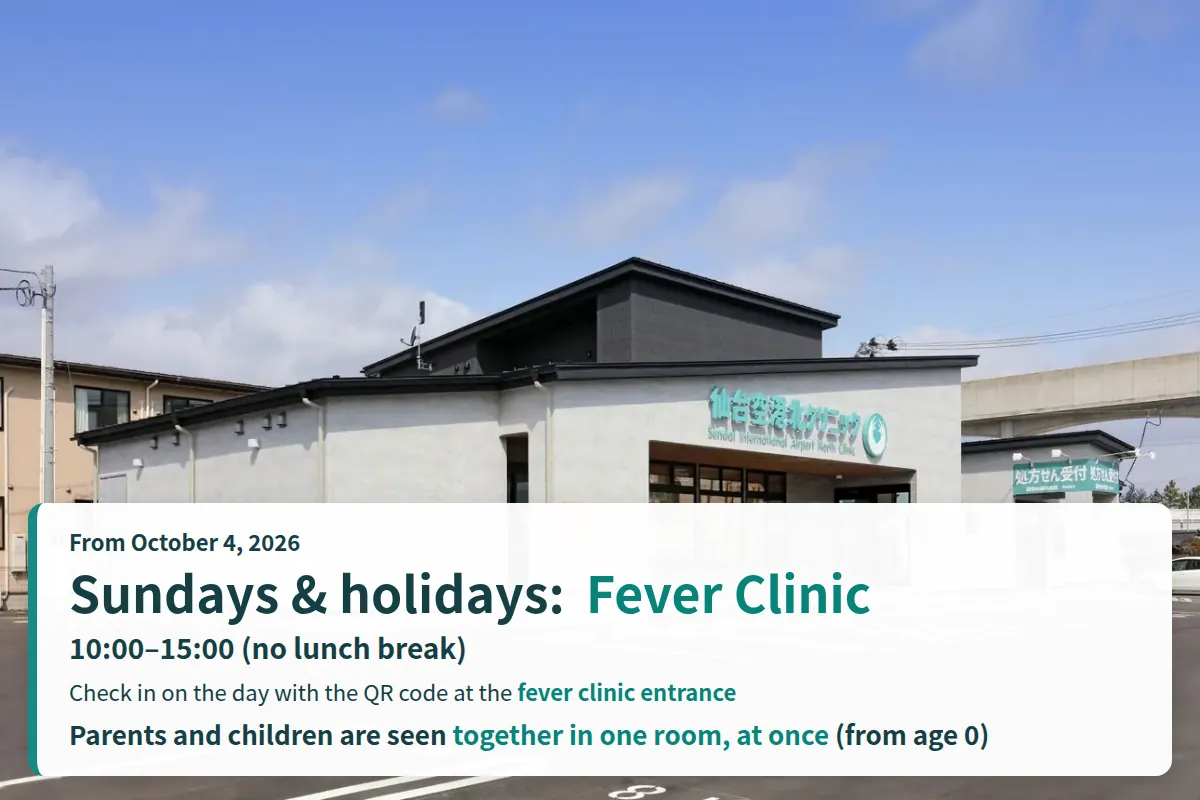
From October 4, 2026, we also run the fever clinic on Sundays and national holidays
10:00 to 15:00 (no lunch break). You check in on the day. We give you the PCR result the same day. On Sundays and holidays we see fever patients only, and we do not offer general outpatient care or IV drips. Please check the clinic calendar for clinic dates and closed days. Notice: fever clinic on Sundays and national holidays

Shunichi Gamo, MD, PhD
Director, Sendai International Airport North Clinic
Born and raised locally, he attended Yuriage Elementary School and Yuriage Junior High School in Natori City. After graduating from Tohoku University School of Medicine, he worked at Sendai Open Hospital and Kesennuma City Hospital, and then at Tohoku University Hospital. In April 2021, in the middle of the COVID-19 pandemic, he opened Sendai International Airport North Clinic. Holding to a fever clinic that never turns patients away, he cared for well over 20,000 patients with fever in the two years before COVID-19 was moved to Class 5 under Japan’s infectious disease law.
Society memberships and board certifications
Certified Member and Board Certified Fellow, Japanese Society of Internal Medicine
Board Certified Pulmonologist, Japanese Respiratory Society
Board Certified Allergist, Japanese Society of Allergology
Board Certified Specialist, Japanese Society of Anti-Aging Medicine
PhD in Medicine (Tohoku University)
Rotavirus vaccine: by when, and how many doses? First dose by 14 weeks 6 days
The rotavirus vaccine is a routine vaccination, and the standard period for the first dose is from 2 months of age to 14 weeks 6 days after birth[1]. Roughly speaking, you only need to keep these three points in mind.
- First dose
From 2 months of age to 14 weeks 6 days after birth (it can be given from 6 weeks 0 days after birth). For safety reasons, we do not recommend giving the first dose at 15 weeks 0 days after birth or later[1] - Type and number of doses
The monovalent vaccine (Rotarix) is given in 2 doses, and the pentavalent vaccine (RotaTeq) in 3 doses. Your baby receives the set number of doses with the same vaccine[1] - Deadline for completion
Finish the monovalent vaccine by 24 weeks 0 days after birth and the pentavalent vaccine by 32 weeks 0 days after birth. Leave at least 27 days between doses from the second dose on[1]
The key points are that it is a vaccine taken by mouth (an oral live vaccine) and that the number of doses is fixed[1]. I have put the detailed schedule in a table in the section below.
 Dr. Gamo
The first dose is due by 14 weeks 6 days of age. Writing the plan on your calendar helps you avoid missing it.
What is rotavirus gastroenteritis, and what can the vaccine prevent?
Rotavirus gastroenteritis is an acute infection of the stomach and intestines whose main symptoms are watery diarrhea, nausea, vomiting, fever, and abdominal pain[1]. It is common in infancy and early childhood (roughly ages 0 to 6), and it is said that almost every child is usually infected with rotavirus by the age of 5[1].
It is by no means a mild illness. Of children under 5 admitted to hospital with acute gastroenteritis, around 40 to 50% have rotavirus as the cause[1]. When dehydration becomes severe, it can lead to shock or electrolyte disturbances (an imbalance of the salts in the body), and severe dehydration is seen mainly in children aged 4 to 23 months[2].
That is why the protection a vaccine gives matters. The Ministry of Health, Labour and Welfare cites reports that vaccination reduced hospital admissions for rotavirus gastroenteritis by about 70 to 90%[1].
Nationwide data from Japan also show a fall in hospital admissions. Admissions for gastroenteritis in children under 5 fell by 60%, from 12.0 per 1,000 children per year before the vaccine was introduced to 4.8 after it became publicly funded[3]. Admissions for rotavirus gastroenteritis also fell by 58%, from 5.8 to 2.5[3]. This is the result of an observational study using a database, and it does not prove cause and effect[3].
Dr. GamoSevere dehydration can mean a hospital stay[1]. If watery diarrhea goes on, please watch for signs of dehydration.
When did the rotavirus vaccine become a routine vaccination?
Vaccination against rotavirus infection became a routine vaccination on October 1, 2020 (Reiwa 2)[4]. Before that, parents paid for the vaccine themselves[3].
It is also set out as a routine vaccination in law (the Order for Enforcement of the Preventive Vaccinations Act), and this system applies to children born on or after August 1, 2020[5]. The eligible age runs from the day after the baby reaches 6 weeks of age up to the date set for each type of rotavirus vaccine[5].
Dr. GamoChildren born on or after August 1, 2020 are covered by this routine vaccination.
Vaccination coverage in Japan rose from 30.0% in 2012 to 78.4% in 2019[6].
How do the monovalent and pentavalent vaccines differ in doses and deadlines?
There are two kinds of rotavirus vaccine, and they are considered equally effective[1]. The number of doses and the deadline for completion are as follows.
| Vaccine | Type | Doses | Deadline for completion |
|---|---|---|---|
| Rotarix | Monovalent (oral live attenuated human rotavirus vaccine) | 2 | By 24 weeks 0 days after birth |
| RotaTeq | Pentavalent (pentavalent oral live attenuated rotavirus vaccine) | 3 | By 32 weeks 0 days after birth |
From the second dose on, leave at least 27 days between doses[1]. It is important not to switch to the other type partway through, and to finish the set number of doses with the same type of vaccine[1].
Dr. GamoMaking a note of which type you started with means you will not be unsure at the next dose.
Because the period in which the vaccine can be given is limited for safety reasons, it can no longer be given as a routine vaccination once this period has passed[1]. Count from your baby’s date of birth and plan early. For the overall vaccination schedule, please also see our article on the Japanese encephalitis vaccine.

Why is the first dose recommended by 14 weeks 6 days?
We recommend the first dose by 14 weeks 6 days after birth to keep the risk of a condition called intussusception as low as possible[1]. Intussusception is a condition in which part of the intestine slides into the next section of bowel, and blood flow to the intestine becomes poor[1].
In the first year of life, babies become more prone to intussusception as they get older[1]. There are also research reports that vaccination raises the risk of intussusception, especially for about 1 to 2 weeks after the first dose[1]. So that your baby can be vaccinated at an age when intussusception is as unlikely as possible, we recommend giving the first dose by 14 weeks 6 days[1].
As of 2019, the Japan Pediatric Society stated that, in principle, it did not recommend a first dose from 15 weeks of age onward. The reason was that the risk of intussusception within 7 days after the first dose increases[7]. Later post-marketing surveillance showed a small increase in the risk of intussusception within 7 days of the first dose (1 to 5 per 100,000 children)[7].
On the other hand, a meta-analysis of randomized controlled trials comparing vaccine groups with placebo (dummy drug) groups (25 trials, 200,594 participants) found no clear link between the vaccine and intussusception[8]. Japanese data also show that the rate of intussusception did not rise after the vaccine was introduced[6].
In a study in Akita Prefecture, 30 of 58 infants diagnosed with intussusception had not been vaccinated, and none of the vaccinated infants developed it within 1 to 7 days after the first dose[9]. These results show that this does not mean the vaccine is dangerous; it means that keeping to the vaccination timing keeps the risk to a minimum[7][9].
Dr. GamoNumbers like these can be worrying. Getting the vaccine on schedule is an important way to keep the risk small.
What are the signs of intussusception? When to see a doctor, and when to call 119?
After vaccination, and especially for about 1 to 2 weeks after the first dose, watch for the following signs of intussusception[1]. If you see even one of them, or if your baby just seems different from usual, take your baby to a medical facility promptly[1].
- Suddenly cries hard (stays fussy)
- Goes back and forth between being content and being fussy
- Vomits
- Has bloody stools
- Is limp and looks pale
Pay particular attention to “crying, vomiting, and bloody stools.” The Japan Pediatric Society also advises watching for persistent fussiness, vomiting, and bloody stools in the 7 days after the first dose, and seeing a doctor promptly if any one of them appears[7].
Dr. GamoFor 1 to 2 weeks after the first dose, please watch for intense crying, vomiting or bloody stool.
Note that intussusception is not a rare condition in babies and young children, whether or not they have been vaccinated[1]. Because poor blood flow to the intestine can damage the intestinal tissue, prompt treatment is needed[1].
And if your baby has even one of the following, call 119 without hesitation. The same applies if, on the day of vaccination, your baby has symptoms that suggest anaphylaxis, such as a rash or difficulty breathing. Anaphylaxis is a serious side effect that rarely occurs on the day of vaccination[1].
- Does not respond when you call, or is drowsy and confused (not fully conscious)
- Is having a seizure
- Suddenly has trouble breathing, is heaving the shoulders to breathe, or has purplish lips
- Has symptoms that suggest anaphylaxis, such as a rash with difficulty breathing
Even at night or on a holiday, if hard crying, repeated vomiting, or bloody stools continue, do not wait until morning; see a doctor. If you are unsure what to do, you can also use Miyagi Prefecture’s children’s emergency advice line (#8000) or the emergency advice line for adults (#7119).
When can the vaccine not be given? What should you watch for afterwards?
If your baby has a fever or a serious acute illness, the vaccine is given after recovery[1]. Also, the following babies cannot receive the rotavirus vaccine[1][5].
- Babies who have had, or were suspected of having, hypersensitivity (an allergic reaction) to a rotavirus vaccine in the past[1]
- Babies with a congenital disorder of the digestive tract (because it may raise the chance of intussusception)[1][5]
- Babies who have had intussusception before (because it may recur)[1][5]
- Babies with severe combined immunodeficiency[1][5]
There are no restrictions on feeding before or after vaccination. However, because a baby may vomit after feeding, we recommend waiting about 30 minutes after vaccination before feeding[1]. Even if your baby spits out the vaccine after it is given, it is considered unnecessary to give it again[1].
Dr. GamoEven if your baby spits it out after the vaccine, there is no need to panic.
For about one week after vaccination, the vaccine virus is passed in the stool[2]. Wash your hands thoroughly after handling diapers[2].
Frequently asked questions
- My baby could not get the first dose by 14 weeks 6 days after birth. Is it too late now?
-
Because the period in which the vaccine can be given is limited for safety reasons, it can no longer be given as a routine vaccination once this period has passed[1]. Also, even if you wish to have the first dose at 15 weeks 0 days after birth or later, the doctor may decide that it cannot be given for safety reasons[1]. Please talk to your family doctor first.
- Which is better, the monovalent or the pentavalent vaccine?
-
The two vaccines are considered equally effective[1]. What matters is not switching types partway through, and finishing the set number of doses with the same vaccine (2 doses for the monovalent, 3 doses for the pentavalent) by the deadline[1].
- My baby got a fever or diarrhea after the vaccine. What should I do?
-
Fussiness, fever, diarrhea, poor appetite, vomiting, and passing bloody stools have been reported with rotavirus vaccines, but all of these are temporary and serious reactions are considered rare[1]. However, if your baby suddenly cries hard, vomits again and again, or has bloody stools, these may be signs of intussusception, so see a doctor the same day[1].
- I am worried about the link between the vaccine and intussusception.
-
There are reports that the risk rises for about 1 to 2 weeks after the first dose, and to reduce it, the first dose is recommended by 14 weeks 6 days[1]. Intussusception is not a rare condition in babies and young children, whether or not they are vaccinated, and it is important to notice it early and see a doctor[1][7]. If you know the signs, there is no need to be overly afraid.
- My child became unwell at night or on a holiday. Where can I get advice?
-
If your child is not fully conscious, is having a seizure, or suddenly has trouble breathing, call 119 without hesitation. If you are unsure what to do, you can call the children’s emergency advice line (#8000) or the emergency advice line for adults (#7119). On Sundays and national holidays, our clinic also runs a fever clinic from 10:00 to 15:00 (check in on the day).
Summary: Give the first dose by 14 weeks 6 days after birth, and finish the set number of doses
- The rotavirus vaccine is a routine vaccination, and the first dose is given between 2 months of age and 14 weeks 6 days after birth
- For about 1 to 2 weeks after a dose (especially the first), watch for intussusception. If your baby suddenly cries hard, vomits again and again, or has bloody stools, see a doctor the same day. If your baby is not responding normally, has a seizure, or is struggling to breathe, call 119
- There are two types, monovalent (2 doses) and pentavalent (3 doses); finish the set number of doses with the same vaccine by 24 weeks 0 days or 32 weeks 0 days after birth
- Rotavirus gastroenteritis can lead to hospital admission through dehydration, and vaccination has been reported to reduce admissions
- If your baby has a fever or a serious acute illness, vaccinate after recovery
Counting from the date of birth, the window for the first dose passes surprisingly quickly. Check the schedule in your Maternal and Child Health Handbook, and if anything worries you, please talk to your family doctor. Leave the medical care to us.
That’s all.
Disclaimer
This article is intended to provide general medical information and does not replace an examination, diagnosis, or treatment by a doctor. The content is based on medical knowledge at the time of publication, but the right course of action differs for each person. If you are worried about symptoms, please consult a medical facility.
References
- Ministry of Health, Labour and Welfare. Rotavirus vaccine. MHLW website (Vaccination and vaccine information; Q&A, March 10, 2026 version) (in Japanese). Accessed October 2026. https://www.mhlw.go.jp/stf/seisakunitsuite/bunya/kenkou_iryou/kenkou/kekkaku-kansenshou/yobou-sesshu/vaccine/rota/index.html
- Japan Institute for Health Security (JIHS). Infectious gastroenteritis caused by rotavirus (detailed version). Infectious disease information website (in Japanese). Accessed October 2026. https://id-info.jihs.go.jp/infectious-diseases/rotavirus-infectious-gastroenteritis/detail/index.html
- Yanai T, Yoshida S, Kawakami K. Gastroenteritis hospitalizations over 19 years before and after introduction of rotavirus vaccine in Japan: a nationwide claims database. Vaccine. 2025 May;55:127027. doi:10.1016/j.vaccine.2025.127027 PMID: 40101324
- Ministry of Health, Labour and Welfare. Rotavirus. MHLW website (in Japanese). Accessed October 2026. https://www.mhlw.go.jp/stf/seisakunitsuite/bunya/kenkou_iryou/kenkou/kekkaku-kansenshou03/rota_index.html
- Ministry of Health, Labour and Welfare. Order for Enforcement of the Preventive Vaccinations Act (Cabinet Order No. 197 of 1948) / Ordinance for Enforcement of the Preventive Vaccinations Act (Ordinance of the Ministry of Health and Welfare No. 36 of 1948). e-Gov Laws and Regulations Search (in Japanese). Accessed October 2026. https://laws.e-gov.go.jp/law/323CO0000000197 / https://laws.e-gov.go.jp/law/323M40000100036
- Tsugawa T, Akane Y, Honjo S, Kondo K, Kawasaki Y. Rotavirus vaccination in Japan: efficacy and safety of vaccines, changes in genotype, and surveillance efforts. J Infect Chemother. 2021 Jul;27(7):940-948. doi:10.1016/j.jiac.2021.04.002 PMID: 33867267
- Japan Pediatric Society, Committee on Immunization and Infectious Disease Control. On the timing of the first dose of rotavirus vaccine (2nd edition) (December 2019). Japan Pediatric Society website (in Japanese). Accessed October 2026. https://www.jpeds.or.jp/uploads/files/rotavirus_vaccine.pdf
- Lu HL, Ding Y, Goyal H, Xu HG. Association between rotavirus vaccination and risk of intussusception among neonates and infants: a systematic review and meta-analysis. JAMA Netw Open. 2019 Oct;2(10):e1912458. doi:10.1001/jamanetworkopen.2019.12458 PMID: 31584679
- Kikuchi W, Noguchi A, Sato Y, Konno Y, Komatsu A, Tandai S, et al. The apparent lack of the risk of intussusception immediately after rotavirus vaccination among Japanese infants. Viruses. 2024 Nov;16(11):1758. doi:10.3390/v16111758 PMID: 39599872