If you are in a hurry
- The standard routine (publicly funded) Japanese encephalitis vaccination is the first stage (3 doses) at around age 3 and the second stage (1 dose) at around age 9[1]
- If hives, difficulty breathing, or swelling of the eyelids or lips appears after the shot, or if your child does not seem fully conscious or is having a seizure, call 119 (Japan’s emergency number) without hesitating
- After the shot, watch for unusual symptoms such as a high fever or a seizure, and if they appear, have your child seen by a doctor promptly[2]
Hello. I am Shunichi Gamo, MD, PhD, a board-certified pulmonologist and the director of Sendai Airport North Clinic.
Are you unsure about your child’s Japanese encephalitis vaccine, asking yourself “When, and how many times?” or “I was worried about side effects and kept putting it off”? Many families look at the Maternal and Child Health Handbook and then simply leave it at that.
To give you the answer first: the standard routine Japanese encephalitis vaccination is 2 doses plus 1 booster at around age 3 for the first stage, and 1 dose at around age 9 for the second stage[1]. And there is a special arrangement for people who missed their chance to be vaccinated[1].
In this article, I explain, step by step and from the standpoint of a pulmonologist, the routine vaccination schedule, who qualifies for the special arrangement, the side effects, and why the vaccine matters.
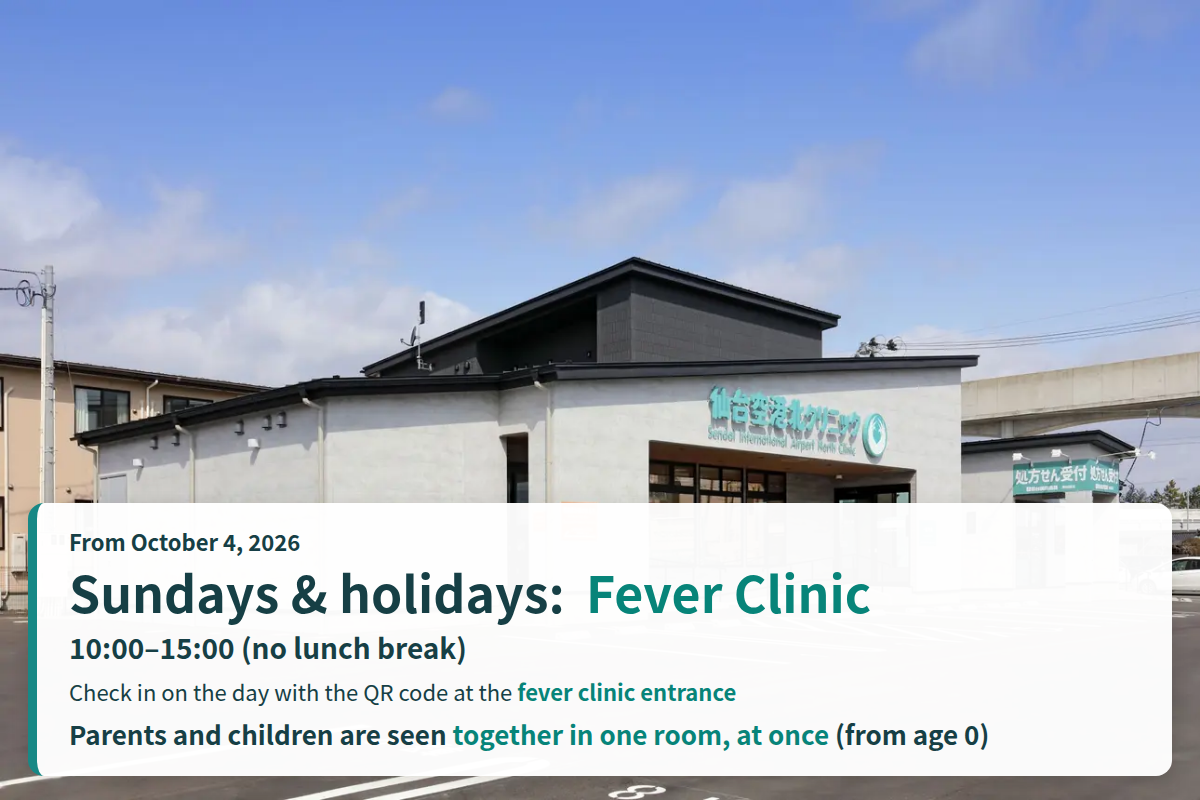
First, a note about our fever clinic on Sundays and national holidays. PCR testing for influenza and COVID (a test that copies the virus’s genetic material in order to detect it) gives results the same day.
From October 4, 2026, we also run the fever clinic on Sundays and national holidays
10:00 to 15:00 (no lunch break). You check in on the day. We give you the PCR result the same day. On Sundays and holidays we see fever patients only, and we do not offer general outpatient care or IV drips. Please check the clinic calendar for clinic dates and closed days. Notice: fever clinic on Sundays and national holidays
Shunichi Gamo, MD, PhD
Director, Sendai International Airport North Clinic
Born and raised locally, he attended Yuriage Elementary School and Yuriage Junior High School in Natori City. After graduating from Tohoku University School of Medicine, he worked at Sendai Open Hospital and Kesennuma City Hospital, and then at Tohoku University Hospital. In April 2021, in the middle of the COVID-19 pandemic, he opened Sendai International Airport North Clinic. Holding to a fever clinic that never turns patients away, he cared for well over 20,000 patients with fever in the two years before COVID-19 was moved to Class 5 under Japan’s infectious disease law.
Society memberships and board certifications
Certified Member and Board Certified Fellow, Japanese Society of Internal Medicine
Board Certified Pulmonologist, Japanese Respiratory Society
Board Certified Allergist, Japanese Society of Allergology
Board Certified Specialist, Japanese Society of Anti-Aging Medicine
PhD in Medicine (Tohoku University)
In short: When and how many times is the routine Japanese encephalitis vaccine given?
The standard routine Japanese encephalitis vaccination is the first stage at around age 3 and the second stage at around age 9[1]. The first stage is 3 doses in total and the second stage is 1 dose, so the basic total is 4 doses.
The Ministry of Health, Labour and Welfare also advises, “Give the first-stage vaccination once your child turns 3, and the second-stage vaccination once your child turns 9”[1]. If you grasp this overall pattern first, you can plan calmly while looking at the Maternal and Child Health Handbook.
 Dr. Gamo
Two doses and a booster around 3, then stage two at 9. Note it in the handbook; seeing the next date brings peace of mind.
What is the routine schedule? (3 doses in the first stage, 1 dose in the second)
The first stage is 2 doses given 6 to 28 days apart between the 3rd and 4th birthdays, plus 1 booster about a year later, for 3 doses in total[1]. The second stage is 1 dose between the 9th and 10th birthdays[1].
The package insert (the official document that sets out how to use a medicine and its precautions) gives the same standard ages[2].
| Dose | Standard age | Number of doses | Interval |
|---|---|---|---|
| First stage, primary doses | From the 3rd birthday until the 4th birthday | 2 doses | 6 to 28 days |
| First stage, booster | From the 4th birthday until the 5th birthday | 1 dose | About 1 year after the primary doses |
| Second stage | From the 9th birthday until the 10th birthday | 1 dose | — |
By law, the first stage can be given to children from 6 months of age until they reach 90 months (7 years and 6 months), and the second stage to children aged 9 or older and under 13[3]. These age ranges are the “range in which the vaccine can be given”; the actual standard is as shown in the table above[1][3].
Dr. GamoThe period when the shot can be given and the standard timing are different things. If unsure, use the standard timing as your guide.
Can it be given from 6 months of age? Which children should start early?
The first stage of routine vaccination can be given from 6 months of age until just before 90 months (7 years and 6 months), and if you wish, your child can be vaccinated at any time from 6 months of age[4]. However, the standard starting age is 3 years[4].
The Japan Pediatric Society recommends starting at 6 months of age for children who travel to or stay in areas where Japanese encephalitis is spreading. The same applies to children who live in areas with recent cases or where a high proportion of pigs carry antibodies to the virus[4]. If this may apply to your child, please talk to your regular doctor.
Dr. GamoIf you plan to travel to an area where it is spreading, thinking early about when to vaccinate gives peace of mind.
What if the vaccine was missed? (The special arrangement)
People born between April 2, 1995 and April 1, 2007, who missed their chance to be vaccinated because, for example, active recommendation of the vaccine was suspended, can receive it as routine vaccination until they turn 20[1].
Under the law, too, people with these birth dates (aged 4 or older and under 20) are covered by the special arrangement[3]. The package insert also lists people with these birth dates who are aged 7 years 6 months or older and under 9, or aged 13 or older and under 20, as eligible for routine vaccination[2].
To find out whether you or your child qualifies, check the past vaccination record in the Maternal and Child Health Handbook and ask your city, ward, town or village office[1]. It is considered desirable to receive any doses that were missed, so it is a good idea to discuss the remaining doses with a doctor[1].
Dr. GamoFirst, please open the maternal and child health handbook and look at the vaccination record so far.
What are the side effects of the Japanese encephalitis vaccine? (Mostly mild and within 3 days; rarely serious)
The main side effects of the Japanese encephalitis vaccine are fever, cough, runny nose, redness (erythema) or swelling at the injection site, and rash, and almost all of them appear within 3 days after the shot[1].
Dr. GamoFor about 3 days after the shot, please watch for fever and how the injection site looks.
Let us also look at the figures from clinical trials (studies that check effectiveness and safety before approval). In the ENCEVAC trial in healthy children aged 6 months to under 90 months, side effects occurred in 51.5% (84 of 163). The main ones were fever 21.5%, redness at the injection site 16.6%, cough 8.0%, swelling at the injection site 6.7%, runny nose 6.7% and rash 5.5%[2]. In the JEBIK V trial, side effects occurred in 39.8% (49 of 123) of healthy children, mainly fever 18.7%, cough 11.4%, runny nose 9.8% and redness at the injection site 8.9%[5].
Very rarely, serious side effects may occur, such as shock, anaphylaxis-like symptoms, acute disseminated encephalomyelitis (ADEM), encephalopathy, seizures, and acute thrombocytopenic purpura (immune thrombocytopenia) (frequency unknown for all of these)[1][2]. Anaphylaxis can cause hives, difficulty breathing, and angioedema (swelling of the eyelids, lips and so on)[2].
For ADEM (acute disseminated encephalomyelitis: inflammation of the brain and spinal cord), about 45.94 million doses were given in the 11 years from April 1, 2013 to March 31, 2024. In that period, a total of 30 side-effect reports of ADEM (including suspected cases) after vaccination were made[1]. It is said to be difficult to tell whether ADEM was caused by the vaccine[1]. Among children in Japan, about 60 to 120 cases a year are thought to occur from any cause (about 0.30 to 0.64 per 100,000 children per year)[1].
Also, according to a meta-analysis comparing several vaccines (an analysis that combines the results of many studies), the inactivated Vero cell vaccine used today produced immunity more readily than the older mouse brain-derived vaccine (odds ratio 2.98, 95% confidence interval 1.02 to 8.65). Its odds of side effects did not differ from placebo (a dummy with no active ingredient), and serious side effects did not differ between vaccine types[6].
Why get the Japanese encephalitis vaccine? (To prevent a serious illness)
Japanese encephalitis is a viral illness spread by mosquitoes; it causes high fever, headache and vomiting, and in severe cases it brings nerve damage such as seizures and paralysis and can be fatal[7]. Vaccination is the mainstay of prevention and is used as routine vaccination[7].
The Ministry of Health, Labour and Welfare explains that about 1 in 1,000 people infected with the Japanese encephalitis virus is said to develop Japanese encephalitis. Of those who develop it, 20 to 40% die, and 45 to 70% of survivors are left with lasting effects such as mental disabilities[1]. When symptoms do appear, a high fever, headache and vomiting for several days come after an incubation period of 6 to 16 days, followed by central nervous system problems such as impaired consciousness and seizures[1].
There is no specific treatment for Japanese encephalitis, and care focuses on relieving symptoms[7]. That is exactly why prevention with the vaccine is important. Vaccination is reported to reduce the risk of getting Japanese encephalitis by 75 to 95%[1].
The number of patients has fallen, but it is not zero. Since 1992, 10 or fewer cases have been reported each year, and 3 cases were reported in 2021[1]. The Culex tritaeniorhynchus mosquito travels over a wide area, so the risk of Japanese encephalitis infection is not zero even in cities[1].
A 2002 review by the National Institute of Infectious Diseases states that mosquitoes carrying the Japanese encephalitis virus appear every summer and that the chance of infection has not disappeared in Japan[8]. An analysis at that time also reported that almost all patients with Japanese encephalitis had not been vaccinated[8].
How long immunity (the body’s ability to fight off germs) lasts also shows why the booster matters. One year after the primary doses, the antibody-positive rate was 83.4%, but 10 days after the booster it reached 96.9%, and it stayed at 95% or higher 6 years later[9].
Along with the vaccine, take steps to avoid mosquito bites. In summer, avoid going out at night as much as possible, wear long sleeves and long trousers, use insect repellent spray on exposed skin, and use window screens to keep mosquitoes out of the house[1].
Dr. GamoWhen going out on summer evenings, please help your child avoid mosquito bites with long sleeves, long trousers and insect repellent spray.
Which signs after the shot mean you should get help quickly?
If unusual symptoms such as a high fever or a seizure appear after the shot, have your child seen by a doctor promptly[2]. Do not miss signs like the following.
- If hives, difficulty breathing, or swelling of the eyelids or lips (angioedema) appears, call 119 without hesitating
- If your child does not answer when you call out, or does not seem fully conscious, call 119
- If your child is having a seizure, call 119
- If fever, headache, or difficulty moving the arms or legs (movement problems) appears from a few days to 2 weeks after the shot, see a doctor the same day[2]. If there is a seizure or impaired consciousness, call 119
- If purpura (bleeding under the skin), nosebleeds, or bleeding inside the mouth appears from a few days to about 3 weeks after the shot, see a doctor the same day[2]
Even at night or on a holiday, if your child seems to struggle to breathe, responds strangely when you call out, or has a seizure that continues, call 119 directly without calling an advice line first. Fortunately, most side effects are mild and settle down, but if you feel something is “not like usual”, trust that feeling.
Dr. GamoMost side effects are mild and settle down. Even so, please feel free to tell the doctor about any change that concerns you.
Frequently asked questions
- At what age should my child get the Japanese encephalitis vaccine?
-
The first stage is 2 doses given 6 to 28 days apart between the 3rd and 4th birthdays, plus 1 booster about a year later, for 3 doses in total[1]. The second stage is 1 dose between the 9th and 10th birthdays[1]. Routine vaccination can be given from 6 months of age until just before 90 months (7 years and 6 months), and starting at 6 months of age is recommended for children at high risk[4].
- We missed the vaccine. Can we still get it now?
-
People born between April 2, 1995 and April 1, 2007 can receive it as routine vaccination until they turn 20[1]. Check the vaccination record in the Maternal and Child Health Handbook and ask your city, ward, town or village office[1].
- I am worried about side effects. What kinds are there?
-
The main ones are fever, cough, runny nose, redness or swelling at the injection site, and rash, and almost all appear within 3 days after the shot[1]. In a clinical trial, side effects occurred in 51.5% of 163 children, mostly fever and redness at the injection site[2]. Very rarely, serious side effects may occur (frequency unknown)[2].
- What should I do if my child gets a fever after the shot?
-
Almost all side effects after the shot (such as fever) appear within 3 days after it[1]. For an ordinary fever, you can also use a fever reducer. For children, acetaminophen (such as Calonal) is commonly used; follow the doctor’s instructions for the dose and how often to give it. If there are unusual symptoms such as a high fever or a seizure, have your child seen by a doctor promptly[2]. If your child is having a seizure or does not respond when you call out, call 119.
- Where can my child get the Japanese encephalitis vaccine?
-
Follow the guidance from your city, ward, town or village, and get the vaccine at a medical facility that provides vaccinations. Check the past vaccination record in the Maternal and Child Health Handbook, and if anything is unclear, ask your municipal office[1].
- How can we avoid mosquito bites?
-
In summer, avoid going out at night as much as possible, wear long sleeves and long trousers, use insect repellent spray on exposed skin, and use window screens to keep mosquitoes out of the house[1]. It is important to take these steps along with the vaccine[1].
Summary: Ages 3 and 9 are the key times for routine vaccination, and most side effects appear within 3 days
- The standard routine Japanese encephalitis vaccination is the first stage (3 doses) at around age 3 and the second stage (1 dose) at around age 9[1]
- If hives, difficulty breathing, or swelling of the eyelids or lips appears after the shot, or if your child does not seem fully conscious or is having a seizure, call 119 without hesitating
- After the shot, watch for unusual symptoms such as a high fever or a seizure, and if they appear, have your child seen by a doctor promptly[2]
- People born between April 2, 1995 and April 1, 2007 can receive it as routine vaccination until they turn 20[1]. Check the Maternal and Child Health Handbook and the guidance from your municipality
- The main side effects are fever and redness at the injection site, and almost all appear within 3 days after the shot[1]
- Japanese encephalitis is severe once it develops, and there is no specific treatment. The vaccine is reported to reduce the risk of getting it by 75 to 95%[1][7]
The Maternal and Child Health Handbook shows your vaccination schedule at a glance. If anything is unclear, please feel free to ask your municipal office or your regular medical facility. Let us check together to protect your child’s health. Leave the medical care to us.
That’s all.
Disclaimer
This article is intended to provide general medical information and does not replace an examination, diagnosis, or treatment by a doctor. The content is based on medical knowledge at the time of publication, but the right course of action differs for each person. If you are worried about symptoms, please consult a medical facility.
References
- Ministry of Health, Labour and Welfare. Japanese encephalitis vaccine. Ministry of Health, Labour and Welfare website (in Japanese). Accessed October 2026. https://www.mhlw.go.jp/stf/seisakunitsuite/bunya/kenkou_iryou/kenkou/kekkaku-kansenshou/yobou-sesshu/vaccine/japanese-encephalitis/index.html
- KM Biologics. ENCEVAC for subcutaneous injection (freeze-dried, cell culture-derived Japanese encephalitis vaccine) package insert (revised May 2026, 4th edition). Pharmaceuticals and Medical Devices Agency (PMDA), prescription drug package insert information (in Japanese). Accessed October 2026. https://www.pmda.go.jp/PmdaSearch/iyakuDetail/ResultDataSetPDF/261976_631340ND1030_3_06
- Order for Enforcement of the Preventive Vaccinations Act (Cabinet Order No. 197 of 1948). e-Gov Law Search (in Japanese). Accessed October 2026. https://laws.e-gov.go.jp/law/323CO0000000197
- Japan Pediatric Society, Committee on Immunization and Infectious Disease Control. Recommendation of Japanese encephalitis vaccination from 6 months of age for people at high risk of Japanese encephalitis. Japan Pediatric Society website (in Japanese). Accessed October 2026. https://www.jpeds.or.jp/society-activities/pediatric-medical-care/vaccination/vaccinations-infectiousdiseases/20207.html
- The Research Foundation for Microbial Diseases of Osaka University (BIKEN), et al. JEBIK V (freeze-dried, cell culture-derived Japanese encephalitis vaccine) package insert (revised June 2026, 4th edition). Pharmaceuticals and Medical Devices Agency (PMDA), prescription drug package insert information (in Japanese). Accessed October 2026. https://www.pmda.go.jp/PmdaSearch/iyakuDetail/ResultDataSetPDF/630144_631340ND1022_3_26
- Furuya-Kanamori L, Xu C, Doi SAR, Clark J, Wangdi K, Mills DJ, et al. Comparison of immunogenicity and safety of licensed Japanese encephalitis vaccines: A systematic review and network meta-analysis. Vaccine. 2021 Jul;39(32):4429-4436. doi:10.1016/j.vaccine.2021.06.023 PMID: 34175128
- Japan Institute for Health Security (JIHS). Japanese encephalitis. Infectious Disease Information website (in Japanese). Accessed October 2026. https://id-info.jihs.go.jp/infectious-diseases/japanese-encephalitis/index.html
- Takasaki T, Department of Virology 1, National Institute of Infectious Diseases. Japanese encephalitis (detailed version). Infectious Disease Information website (in Japanese) (IDWR 2002, combined issue Nos. 1 and 2). Accessed October 2026. https://id-info.jihs.go.jp/infectious-diseases/japanese-encephalitis/detail/index.html
- Islam N, Xu C, Lau CL, Mills DJ, Clark J, Devine GJ, et al. Persistence of antibodies, boostability, and interchangeability of Japanese encephalitis vaccines: A systematic review and dose-response meta-analysis. Vaccine. 2022 Jun;40(26):3546-3555. doi:10.1016/j.vaccine.2022.04.079 PMID: 35568587
▶ Overview of this topic: How to tell what a fever after vaccination means
Related articles on vaccination
To tell what a fever after a shot means, see Fever after vaccination, and for another example of routine vaccination, see The MR vaccine for measles and rubella.