If you are in a hurry
- After a strep infection, kidney inflammation (acute glomerulonephritis) can follow a few weeks later. As a guide, it appears about 1 to 2 weeks after a throat infection and about 2 to 6 weeks after a skin infection[1]
- If your child is not fully conscious, is having a seizure, or suddenly has trouble breathing, call 119 (Japan’s emergency number)
- If there is cola-colored urine, puffy eyelids, little urine, or high blood pressure, see a doctor early and have the urine tested[2]
Hello. I am Shunichi Gamo, MD, PhD, a board-certified pulmonologist and the director of Sendai Airport North Clinic.
After a child has had a strep (group A streptococcus) throat infection, or a skin infection such as impetigo, I am often asked for advice by parents who say, “I heard it can affect the kidneys, and now I am worried.”
“The strep is gone, so can the kidneys really get worse a few weeks later?”
To give you the conclusion first: after a strep infection, kidney inflammation (acute glomerulonephritis: inflammation of the glomeruli, the kidney’s filtering units) can follow a few weeks later[3]. As a guide, it has been reported to appear about 1 to 2 weeks after a throat infection and about 2 to 6 weeks after a skin infection[1]. The clues to notice it are changes such as the color and amount of urine and puffy eyelids[2].
In this article, I explain in turn how kidney inflammation happens after strep, the incubation period and symptoms, why follow-up urine tests are said to be needed, the signs that mean you should hurry, how to take antibiotics, and the course and outlook.
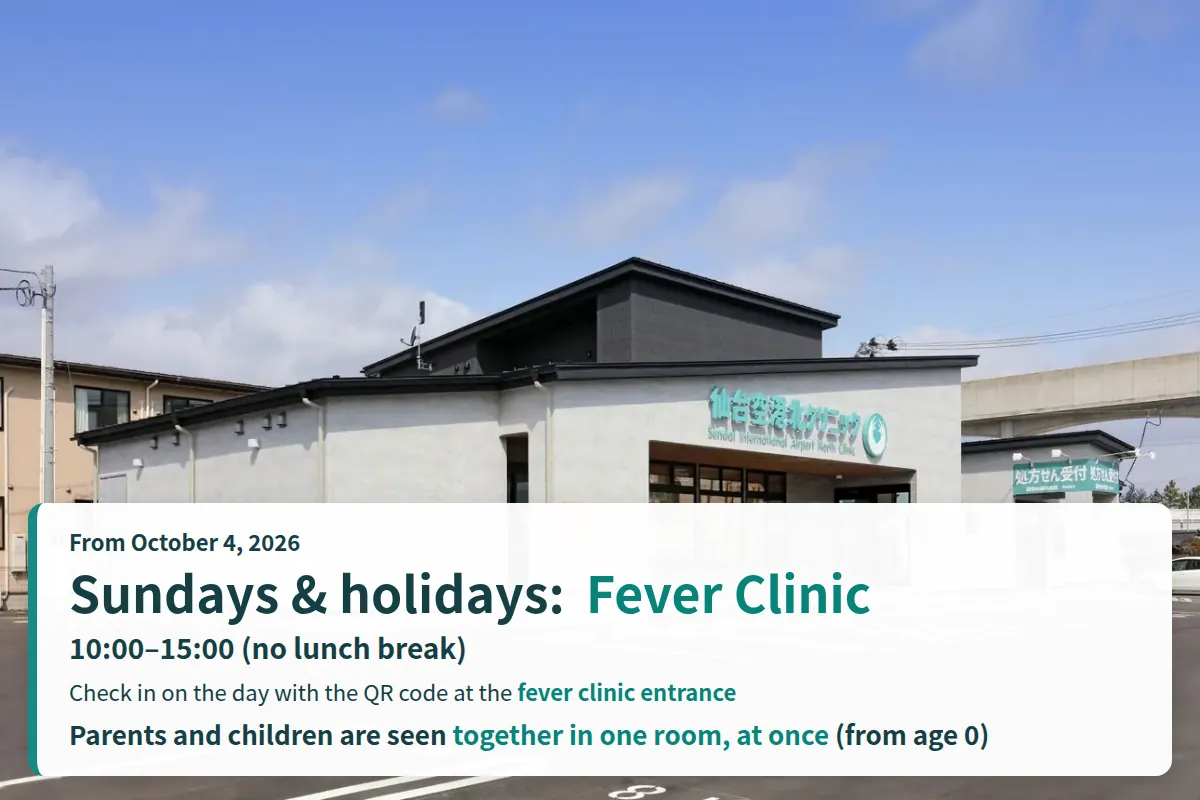
First, a note about our fever clinic on Sundays and national holidays. PCR testing for influenza and COVID (a test that copies the virus’s genetic material in order to detect it) gives results the same day.
From October 4, 2026, we also run the fever clinic on Sundays and national holidays
10:00 to 15:00 (no lunch break). You check in on the day. We give you the PCR result the same day. On Sundays and holidays we see fever patients only, and we do not offer general outpatient care or IV drips. Please check the clinic calendar for clinic dates and closed days. Notice: fever clinic on Sundays and national holidays
Shunichi Gamo, MD, PhD
Director, Sendai International Airport North Clinic
Born and raised locally, he attended Yuriage Elementary School and Yuriage Junior High School in Natori City. After graduating from Tohoku University School of Medicine, he worked at Sendai Open Hospital and Kesennuma City Hospital, and then at Tohoku University Hospital. In April 2021, in the middle of the COVID-19 pandemic, he opened Sendai International Airport North Clinic. Holding to a fever clinic that never turns patients away, he cared for well over 20,000 patients with fever in the two years before COVID-19 was moved to Class 5 under Japan’s infectious disease law.
Society memberships and board certifications
Certified Member and Board Certified Fellow, Japanese Society of Internal Medicine
Board Certified Pulmonologist, Japanese Respiratory Society
Board Certified Allergist, Japanese Society of Allergology
Board Certified Specialist, Japanese Society of Anti-Aging Medicine
PhD in Medicine (Tohoku University)
Why does kidney inflammation happen after strep?
Kidney inflammation happens after strep because inflammation of the glomeruli in the kidney can occur as a complication of a strep infection[4].
Strep (group A streptococcus) infections can lead to complications such as acute glomerulonephritis and rheumatic fever[4]. Among these, acute glomerulonephritis is a temporary kidney inflammation that starts about 10 days after tonsillitis or a similar infection has cleared up[2].
A review in the Japanese Journal of Pediatric Nephrology explains that, in cases caused by strep, after a preceding infection such as pharyngitis, tonsillitis, or skin pustules, and an incubation period of 1 to 2 weeks, blood in the urine, protein in the urine, edema (swelling), high blood pressure, and oliguria (passing little urine) are seen[5].
It is also said that rheumatic fever is more likely when treatment is not sufficient, and that kidney inflammation is often found through blood in the urine a few weeks after onset[3]. The nursery school guidelines also explain that with proper treatment the illness heals without after-effects, but that when treatment is not sufficient, complications such as rheumatic fever and kidney inflammation can occur a few weeks after onset[6].
 Dr. Gamo
Don’t stop at “the throat is better, so we’re fine”. Please keep an eye on your child for the next few weeks too.
Incubation period and symptoms: cola-colored urine, puffy eyelids, little urine
The incubation period from a strep infection to kidney inflammation has been reported as 1 to 2 weeks after a throat infection and 2 to 6 weeks after a skin infection[1].
A Japanese review gives 1 to 2 weeks[5], and the Japanese Society of Nephrology explains it as about 10 days after tonsillitis or a similar infection has cleared up, so the figures vary between reports[2].
Dr. GamoIt can come about 10 days after the throat gets better. Please keep an eye on the color of the urine around that time.
The main symptoms seen when kidney inflammation occurs are as follows[2][5].
| Symptom | Examples |
|---|---|
| Change in urine color (visible blood in the urine) | Cola-colored or brown urine[2] |
| Swelling (edema) | Puffy eyelids, face, or legs[2] |
| Little urine (oliguria) | Passing urine less often or in smaller amounts than usual[2] |
| Raised blood pressure (hypertension) | Higher blood pressure[2] |
If you have been told your child’s blood pressure is high, or if there is a strong headache or nausea, see a doctor early.
Why are urine tests done after strep? Doctors have different views
Urine tests are done after strep because kidney inflammation can be hard to notice when there is no visible blood in the urine, and a urine test is considered a useful first test[7].
In a 2007 questionnaire survey of 52 pediatricians working in general pediatric practice, 47 said they “do” a urine test, 4 said they “do not”, and 1 said they “decide case by case”, and 2 weeks later was the most common timing for the test[8]. The survey reported that how to look for kidney inflammation after a strep infection is left to each doctor’s judgment, and that various approaches are used[8].
Acute glomerulonephritis can also occur without clear symptoms (subclinical)[9]. A US study also found that diagnosis tends to be delayed when there is no visible blood in the urine, and considers a urine test a useful first test[7].
However, please decide with your family doctor what to do about urine tests for a child without symptoms. If there are changes such as swelling, reddish-brown urine, little urine, or high blood pressure, it is important to see a doctor early and have the urine tested[2].
Dr. GamoThe color of the urine and puffy eyelids are important changes you can notice in daily life.
For testing for strep itself, please see Fever and sore throat: when is a strep test helpful?, and for skin infections such as impetigo, please see Impetigo in Children: A Skin Infection That Increases in Summer.
Signs to seek care urgently: 119, the emergency department, or the same day
Call 119 right away
If even one of the following applies, call 119 without hesitation. The same applies at night and on holidays.
- Your child does not answer when you call, or is drowsy and confused (not fully conscious)
- Your child is having a seizure
- Your child suddenly has trouble breathing, is breathing with the shoulders, or has purplish lips
- Your child lost consciousness and collapsed with chest pain
Go to an emergency department the same day, even at night or on a holiday
In the following cases, do not wait until morning; go to an emergency department, even at night or on a holiday. If your child is struggling and cannot be moved, call 119.
- Your child can hardly take any fluids, or has not passed urine for half a day or more
- The eyelids or face are very puffy, or the body has suddenly become swollen[2]
- Even at rest, breathing is clearly faster than usual, or your child seems to be struggling
- Your child is pale or ashen gray and limp
See a pediatrician, an internal medicine doctor, or a similar doctor the same day (or the next morning if it is night)
If breathing, consciousness, and fluid intake are fine but any of the following apply, do not wait and watch for too long; see a doctor.
- Your child has passed cola-colored or brown urine[2]
- Your child is passing less urine than usual[2]
- The eyelids, face, or legs are puffy[2]
- 1 to 2 weeks after a strep infection (several weeks after a skin infection), your child somehow lacks energy[1]
If your child’s condition changes during the night, go back to the “119” and “emergency department” guidance above at that point and decide again.
Dr. GamoIf things change at night, please look at the guide again at that point. Feeling unsure is only natural.
Finish the antibiotics exactly as instructed (even though prevention of kidney inflammation is not certain)
Once strep has been diagnosed, it is important to take the prescribed antibiotic exactly as the doctor instructs and finish the whole course.
The nursery school guidelines state that with suitable antibiotic treatment, most cases heal without after-effects. However, to prevent complications, the antibiotic must be continued for the set period even after the symptoms have settled[6].
However, looking only at kidney inflammation, it is not yet clear whether antibiotics can reliably prevent it. A 2021 Cochrane review (a review that brings together and evaluates several studies) reported that there were too few cases of acute glomerulonephritis to determine whether antibiotics prevent it (Peto OR 0.07, 95% confidence interval 0.00 to 1.32, low certainty of evidence)[10]. On the other hand, it reported that antibiotics reduced rheumatic fever (Peto OR 0.36, 95% confidence interval 0.26 to 0.50)[10].
In the survey of pediatricians as well, opinions were divided, with 35 doctors (67.3%) thinking antibiotics are effective in preventing kidney inflammation and 9 doctors (17.3%) thinking they are not[8].
In summary, it cannot be said that kidney inflammation is reliably prevented, but finishing the prescribed antibiotic is recommended[6][10]. Finish all the medicine you were given, and do not use leftover medicine from before on your own judgment.
Dr. GamoEven when the symptoms settle, keep taking it for the set period. It is important not to stop halfway because “it’s already better”.
Course and outlook of kidney inflammation after strep
Acute glomerulonephritis after strep is an illness with a good outlook, and it usually improves over time[2].
The Japanese Society of Nephrology explains that it is an illness with a good outlook in which blood in the urine, protein in the urine, and kidney function improve naturally over time after onset, but that sometimes abnormal urine findings continue and impaired kidney function remains[2].
A US review states that the long-term outlook is also good, and that although it is the most common glomerulonephritis in children, it rarely causes chronic kidney disease, but persistent microscopic blood in the urine and protein in the urine are seen in less than 10%[1].
Another review also states that most cases have a good outlook, and only a very small number are left with persistent abnormal urine findings, high blood pressure, or chronic kidney disease[9]. For this reason, when kidney inflammation is suspected, and even after the symptoms have settled, it is important for a doctor to check on the course[2].
Dr. GamoMost cases get better. Even after the symptoms settle, having the progress checked gives peace of mind.
Frequently asked questions
- Once strep has cleared up, is there no need to worry about kidney inflammation?
-
Kidney inflammation can occur a few weeks after strep has cleared up[3]. As a guide, it appears about 1 to 2 weeks after a throat infection and about 2 to 6 weeks after a skin infection[1]. Watch for changes in the color and amount of urine and for swelling, and see a doctor if you notice a change that worries you.
- Should every child have a urine test?
-
Doctors have different views on whether to do a urine test after strep[8]. Please discuss with your family doctor what to do about urine tests for a child without symptoms. If there are changes such as swelling, cola-colored urine, little urine, or high blood pressure, see a doctor early and have the urine tested[2].
- If my child finishes the antibiotics, will kidney inflammation be prevented?
-
Whether antibiotics reliably prevent kidney inflammation has not yet been clearly determined[10]. However, to prevent complications, it is considered necessary to keep taking the antibiotic for the set period even after the symptoms have settled[6]. Finish all of what was prescribed, exactly as the doctor instructs.
- What changes in the urine should I watch for?
-
Cola-colored or brown urine (visible blood in the urine), less urine, and puffy eyelids, face, or legs[2]. Blood pressure can also go up[2].
- What should I do if my child has a seizure or is not fully conscious?
-
If your child is having a seizure, does not answer when you call, or is drowsy and confused, call 119 without hesitation. The same applies at night and on holidays.
- Can impetigo (a skin infection) also lead to kidney inflammation?
-
Kidney inflammation after a skin infection has been reported to occur later than after a throat infection, about 2 to 6 weeks afterwards[1]. For when to see a doctor about impetigo, please see the related article.
Summary: After strep, watch for changes in the urine
- After a strep infection, kidney inflammation (acute glomerulonephritis) can follow a few weeks later. As a guide, it appears about 1 to 2 weeks after a throat infection and about 2 to 6 weeks after a skin infection[1]
- If your child is not fully conscious, is having a seizure, or suddenly has trouble breathing, call 119
- If there is cola-colored urine, puffy eyelids, little urine, or high blood pressure, see a doctor early and have the urine tested[2]
- Doctors have different views on urine tests after strep. If there are symptoms, see a doctor early[8]
- Finish the antibiotics exactly as the doctor instructs. Prevention of kidney inflammation is not certain, but finishing the course is recommended[6][10]
- Most cases have a good outlook, but abnormal urine findings can persist, so a doctor should check on the course[2]
After strep, the family is the first to notice small changes such as “somehow lacking energy” or “the urine is a different color from usual”. If you notice a change that worries you, please seek advice early. Leave the medical care to us.
That’s all.
Disclaimer
This article is intended to provide general medical information and does not replace an examination, diagnosis, or treatment by a doctor. The content is based on medical knowledge at the time of publication, but the right course of action differs for each person. If you are worried about symptoms, please consult a medical facility.
References
- VanDeVoorde RG. Acute poststreptococcal glomerulonephritis: the most common acute glomerulonephritis. Pediatr Rev. 2015 Jan;36(1):3-12. doi:10.1542/pir.36-1-3 PMID: 25554106
- Japanese Society of Nephrology. 5. Glomerulonephritis: for the general public. Japanese Society of Nephrology website (in Japanese). Accessed October 2026. https://jsn.or.jp/general/kidneydisease/symptoms05.php
- Japan Pediatric Society, Committee on Immunization and Infectious Disease Control. Explanation of infectious diseases to be prevented in schools, kindergartens, certified centers for early childhood education and care, and nursery schools (revised April 2025): Streptococcal infection. Japan Pediatric Society website (in Japanese). Accessed October 2026. https://www.jpeds.or.jp/general/prevention/yobo-kansensho/kansensho03-07.html
- Japan Institute for Health Security. Group A streptococcal infection. Infectious Disease Information website (in Japanese). Accessed October 2026. https://id-info.jihs.go.jp/diseases/alphabet/agun/index.html
- Nakanishi K. Education Committee beginners’ course in pediatric nephrology 1: “Can you explain the difference between acute glomerulonephritis and acute nephritic syndrome?” Jpn J Pediatr Nephrol (in Japanese). 2018;31(2):109-113. doi:10.3165/jjpn.rv.2018.0003
- Children and Families Agency. Guidelines for infectious disease control in nursery schools (2018 revision). Ministry of Health, Labour and Welfare website (in Japanese). Accessed October 2026. https://www.mhlw.go.jp/content/10900000/20231010_policies_hoiku_25.pdf
- Pais PJ, Kump T, Greenbaum LA. Delay in diagnosis in poststreptococcal glomerulonephritis. J Pediatr. 2008 Oct;153(4):560-4. doi:10.1016/j.jpeds.2008.04.021 PMID: 18534213
- Tsuji Y, Abe Y, Mikawa T, Itabashi K, Sakai T. Results of a questionnaire survey on urinalysis after group A beta-hemolytic streptococcal infection. Jpn J Pediatr Nephrol (in Japanese). 2007;20(2):105-110. doi:10.3165/jjpn.20.105
- Ong LT. Management and outcomes of acute post-streptococcal glomerulonephritis in children. World J Nephrol. 2022 Sep;11(5):139-145. doi:10.5527/wjn.v11.i5.139 PMID: 36187464
- Spinks A, Glasziou PP, Del Mar CB. Antibiotics for treatment of sore throat in children and adults. Cochrane Database Syst Rev. 2021 Dec;12(12):CD000023. doi:10.1002/14651858.CD000023.pub5 PMID: 34881426
Related articles
For testing for strep itself, see When is strep testing needed?, and for skin infections such as impetigo, see Impetigo in children.