If you are in a hurry
- Strep mainly causes fever and a sore throat; in scarlet fever, there is also a bright red rash all over the body, a strawberry tongue, and peeling skin after the rash fades
- If your child is having a seizure, does not answer when you call them, or suddenly has trouble breathing, call 119 (Japan’s emergency number)
- Taking the antibiotic for the full prescribed period, to the very end, is important to prevent complications (as a guide, your child can go back to school from 24 hours after starting it)
Hello. I am Shunichi Gamo, MD, PhD, a board-certified pulmonologist and the director of Sendai Airport North Clinic.
When your child has a fever, complains of a sore throat, and a red rash appears on their body,
“Is this strep? Or is it something else?”
you naturally start to worry. Once a rash appears, it is hard to feel at ease until you know the cause.
To give you the conclusion first: pharyngitis caused by group A streptococcus (commonly called strep) mainly causes fever and a sore throat, and in scarlet fever there is also a bright red rash all over the body, a strawberry tongue, and peeling skin after the rash fades[1][2]. The way the rash appears is not enough to tell it apart from other illnesses, so a throat test is used to confirm it[1].
In this article, I explain, as a pulmonologist, the features of the scarlet fever rash, strawberry tongue, and peeling skin; how they differ from viral rashes, measles, and Kawasaki disease; how to think about testing; why it matters to finish the antibiotic; when your child can go back to school or nursery school; and the signs that mean calling 119.
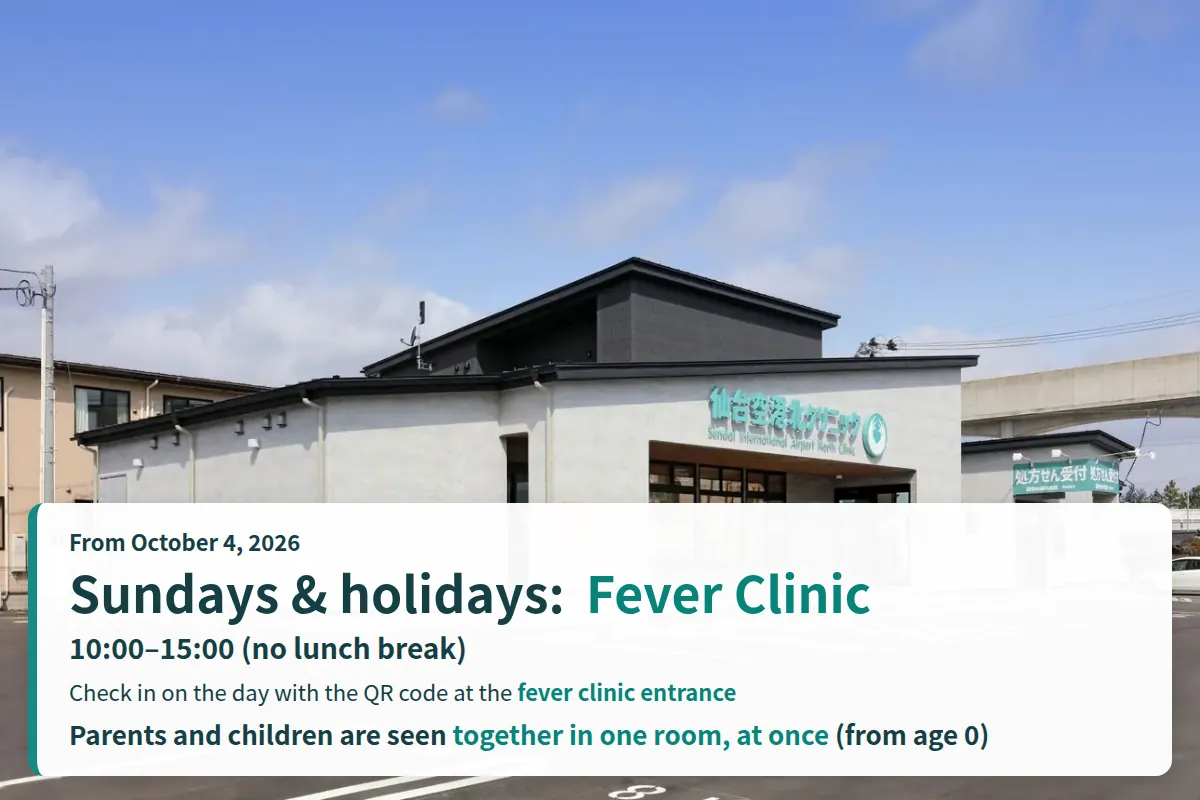
First, a note about our fever clinic on Sundays and national holidays. PCR testing for influenza and COVID (a test that copies the virus’s genetic material in order to detect it) gives results the same day.
From October 4, 2026, we also run the fever clinic on Sundays and national holidays
10:00 to 15:00 (no lunch break). You check in on the day. We give you the PCR result the same day. On Sundays and holidays we see fever patients only, and we do not offer general outpatient care or IV drips. Please check the clinic calendar for clinic dates and closed days. Notice: fever clinic on Sundays and national holidays
Shunichi Gamo, MD, PhD
Director, Sendai International Airport North Clinic
Born and raised locally, he attended Yuriage Elementary School and Yuriage Junior High School in Natori City. After graduating from Tohoku University School of Medicine, he worked at Sendai Open Hospital and Kesennuma City Hospital, and then at Tohoku University Hospital. In April 2021, in the middle of the COVID-19 pandemic, he opened Sendai International Airport North Clinic. Holding to a fever clinic that never turns patients away, he cared for well over 20,000 patients with fever in the two years before COVID-19 was moved to Class 5 under Japan’s infectious disease law.
Society memberships and board certifications
Certified Member and Board Certified Fellow, Japanese Society of Internal Medicine
Board Certified Pulmonologist, Japanese Respiratory Society
Board Certified Allergist, Japanese Society of Allergology
Board Certified Specialist, Japanese Society of Anti-Aging Medicine
PhD in Medicine (Tohoku University)
In short: How do you tell a strep sore throat and rash apart?
A strep sore throat mainly means fever and pain at the back of the throat, and a rash appears in scarlet fever. Here are the 3 points to understand first.
- Main symptoms
Mainly fever and a sore throat; in scarlet fever, a bright red rash all over the body, a strawberry tongue, and peeling skin after the rash fades[1][2][3] - Confirm with a test
The rash alone is not enough to decide, so a rapid test using a swab from the back of the throat or a culture is done[1][2] - Treatment and contagiousness
It is treated with a suitable antibiotic, and the child is said to stop being contagious within 24 hours of starting treatment[2][4]
Strep spreads through droplets and through contact[1]. Strep pharyngitis is common in school-age children and has two peaks: winter, and spring to early summer[1].
 Dr. Gamo
It spreads through droplets and contact, so please take care with coughs, sneezes and things touched by hand.
What are the features of the scarlet fever rash, strawberry tongue, and peeling skin?
The scarlet fever rash is “a bright red rash all over the body,” and it is characterized by a strawberry tongue and peeling skin after the rash fades[1][2][3].
The Japan Pediatric Society explains that scarlet fever is common around ages 5 to 10, and that along with fever, pharyngitis, and tonsillitis, the tongue becomes red and swollen like a strawberry, a bright red rash appears all over the body, and the skin peels off after the rash fades[2].
The Children and Families Agency’s guidelines state: “The tongue becomes red and swollen like a strawberry, and a bright red rash appears all over the body. Also, after the rash fades, the skin on the fingers may peel”[3]. JIHS (the Infectious Diseases Information website) also says that in scarlet fever there is a characteristic red rash, a strawberry tongue, and desquamation (peeling of the skin)[1].
As for how the rash feels, one review from outside Japan describes the scarlet fever rash as a “sandpaper-like skin rash”[5]. This is just one way of describing it, and it is not what decides the diagnosis.
The incubation period of strep pharyngitis is 2 to 5 days, and symptoms include fever, sore throat, tiredness, and vomiting[1].
Dr. GamoA strawberry tongue is seen not only in scarlet fever but also in Kawasaki disease, so the tongue alone cannot tell them apart[6]. A bright red rash is also seen in the early stage of measles, so the color of the rash alone cannot tell them apart either[7].
How is it different from viral rashes, measles, and Kawasaki disease?
Fever with a rash is not only caused by strep; it is also seen in measles, rubella, roseola, Kawasaki disease, and other illnesses, so doctors think about the combination of symptoms[3][7][6].
The Children and Families Agency’s guidelines set out how rashes appear, for reference[3]. When “the rash appeared at the same time as the fever,” rubella and strep infection are listed. When “after a fever with cold-like symptoms, the fever came down a little, then rose again, and a red rash spread all over the body,” it is measles. When “a fever of 38°C or higher lasted 3 to 4 days, and after it came down a red rash appeared all over the body,” it is roseola[3].
In measles, a fever of around 38°C lasts 2 to 4 days, and symptoms of upper airway inflammation (cough, runny nose, sore throat) and of conjunctivitis (red eyes, eye discharge, sensitivity to light) appear at almost the same time[7]. Also, 1 to 2 days before the rash appears, Koplik spots (small white spots about 1 mm across) are seen on the inside of the cheeks; the fever drops by about 1°C and then a high fever returns (a biphasic fever), and the rash spreads from behind the ears, the neck, and the forehead[7].
Kawasaki disease is most common in babies and young children aged 4 or under, and it is diagnosed when at least 5 of these 6 symptoms are present: high fever, redness of the whites of both eyes, bright red lips and a bumpy strawberry-like tongue, a red rash on the body, swelling of the hands and feet, and swollen lymph nodes in the neck[6]. In young children, redness and swelling at the BCG vaccination site is also a feature[6].
| Illness | Features (as described in official sources) |
|---|---|
| Strep (scarlet fever) | Fever and sore throat. A bright red rash all over the body, a strawberry tongue, peeling skin after the rash fades[1][2][3] |
| Measles | Cough, runny nose, red eyes, Koplik spots, biphasic fever, a rash spreading from behind the ears and the face[7] |
| Kawasaki disease | Diagnosed with at least 5 of 6 symptoms. Red eyes, swollen hands and feet, swollen lymph nodes in the neck[6] |
| Roseola | A fever of 38°C or higher lasts 3 to 4 days, then a rash all over the body after the fever comes down[3] |
The official sources do not contain a single table that compares these side by side. The table above summarizes what each source says as reference information, and it is not meant for telling them apart yourself[3][7][6]. Also, in children who have been vaccinated, measles can take a mild course (modified measles), and the rash pattern may not fit[7].
Dr. GamoHow the rash appears is a useful hint, but please leave the telling apart to the examination.
Kawasaki disease can cause aneurysms (bulges) in the coronary arteries, so it is important to start treatment as early as possible during the high-fever phase[6]. For the measles and rubella vaccine, please see Measles and Rubella: Two MR Vaccine Doses, at 1 and Before School.
How is strep tested for?
It is confirmed with a rapid test (rapid diagnostic kit) or a bacterial culture, using a cotton swab wiped at the back of the throat[1][2].
According to JIHS, the diagnosis is based on isolating the bacteria from the infected site[1]. For pharyngitis, a rapid diagnostic kit using a throat swab is also useful[1]. The Japan Pediatric Society also says that rapid antigen diagnostic kits, bacterial culture, and antibody tests are used[2]. The doctor makes the judgment by combining the test results with the state of the back of the throat and how the symptoms have developed. For how to think about testing, please also see Fever and sore throat: when is a strep test helpful?
Testing also has limits to its accuracy. In a Cochrane review that combined 98 studies of pharyngitis in children, the rapid test had a sensitivity (the proportion of children with strep it finds) of 85.6% and a specificity (the proportion of children without strep it correctly rules out) of 95.4%[8]. This means that out of 100 children with strep, 86 are correctly found and 14 are missed[8].
That is why it is important that you cannot conclude “a negative test means it is not strep”[8]. The doctor makes an overall judgment, taking into account the symptoms and whether strep is going around[1][2].
Dr. GamoEven if the test is negative, it is important to think about it together with the symptoms and what is going around.
How long should the antibiotic be taken? When can my child go back to school or nursery school?
Taking the antibiotic for the “prescribed period,” to the very end, is important to prevent complications[3].
Strep is treated with penicillin-type or macrolide-type antibiotics[1]. The Children and Families Agency’s guidelines say that with proper treatment it heals without lasting effects, but if treatment is inadequate, complications such as rheumatic fever and nephritis can develop a few weeks after the illness starts[3]. That is why your child needs to keep taking the antibiotic for the prescribed period, even after the symptoms have settled[3].
On contagiousness, the Japan Society of School Health’s guide states: “Because the child stops being contagious to others within 24 hours of starting appropriate antibiotic treatment, the child may attend school (or kindergarten/nursery) from then on. However, the antibiotic must be continued for the prescribed period”[4]. The Japan Pediatric Society also says that with antibiotics, the child stops being contagious within 24 hours[2].
For nursery schools, the approach is slightly different. The Children and Families Agency’s guidelines give “24 to 48 hours having passed since taking the antibiotic” as the guide for returning to nursery school[3]. Note that the numbers differ: 24 hours for schools and 24 to 48 hours for nursery schools[3][4].
Dr. GamoThe time guide differs for schools and nurseries, so checking the rules where your child goes gives peace of mind.
Let me also clarify the legal side. The Enforcement Regulations of the School Health and Safety Act do not name strep as a disease; it is treated as something that may be included under “other infectious diseases” in Category 3[9]. For Category 3, the principal can suspend attendance, and the period is set as “until a school doctor or other doctor recognizes that there is no risk of infection, depending on the condition”[9]. The 24-hour figure is not law but a guide from the explanatory guidebook[4][9]. The same guidebook also states that suspension of attendance is not mandatory for “other infectious diseases”[4].
In other words, the accurate picture is that many schools and nursery schools use 24 hours after starting the antibiotic, or similar, as a guide, but in practice you should follow the instructions of the school or nursery school and the doctor[3][4][9].
On the effect of antibiotics, a Cochrane review covering sore throats in general, including old trials from outside Japan, reported that antibiotics reduced rheumatic fever (Peto OR 0.36, 95% CI 0.26 to 0.50), and also reduced middle ear infections (OR 0.21) and peritonsillar abscesses (OR 0.16)[10]. However, these data come from a time when complications were more common than today[10]. To help prevent complications, start antibiotics without hesitation when they are needed, finish everything that was prescribed, and do not use leftover medicine from before on your own judgment[3].
Complications can appear a few weeks after the illness starts. The Japan Pediatric Society explains that nephritis is often found a few weeks after the illness starts, through blood in the urine[2]. Complications such as acute glomerulonephritis and rheumatic fever can occur[1], and, although rare, strep can also cause streptococcal toxic shock syndrome, which progresses suddenly and rapidly to multiple organ failure[1]. For changes in the urine a few weeks later, please see Nephritis After Strep: Urine Changes Weeks Later and Urine Tests.
A fever that is making your child miserable can be brought down with acetaminophen (such as Calonal). Follow your doctor’s instructions for the dose and how to use it, and if you are worried, ask early.
Signs to act quickly: 119, night-time emergency care, or the same day
Call 119 right away
If even one of the following applies, call 119 without hesitation, however high or low the temperature is. The same applies at night and on holidays. These are general emergency signs.
- Having a seizure, or a seizure that keeps going
- Does not answer when you call them, consciousness seems abnormal, or limp and barely responsive
- Suddenly has trouble breathing, is heaving the shoulders to breathe, or has purplish lips
Go to an emergency department the same day, even at night or on a holiday
In the following cases, do not wait until morning; go to an emergency department, even at night or on a holiday. If your child is struggling and cannot be moved, call 119.
- Can hardly drink anything, or has not passed urine for half a day or more
- Breathing is clearly faster than usual even at rest, or seems labored
- Cold hands and feet, a pale or poor color, and limp
See a doctor the same day (the next morning if it is night)
If breathing, consciousness, and drinking are all fine but you see the following, do not wait too long; see a doctor.
- A high fever and a painful sore throat that make swallowing hard
- The rash has started spreading all over the body
- A few weeks later, cola-colored urine or puffy eyelids (blood in the urine can be a sign of nephritis[2])
- Strep is going around in the family or at school or nursery school
If things change during the night, go back to the “119” and “emergency department” guides above at that point and decide again.
Dr. GamoIf things change, please think it over again based on how your child is at that point. Feeling unsure is only natural.
Frequently asked questions
- If a rash appears, does that mean it is strep?
-
Fever with a rash is not only caused by strep; it is also seen in rubella, measles, roseola, and other illnesses[3][7]. If there is a sore throat and fever, the back of the throat is tested to confirm[1][2]. Do not decide based on the rash alone; see a doctor and ask.
- If the test is negative, does that mean it is not strep?
-
A negative result cannot completely rule it out. The rapid test works out to missing about 14 out of 100 children with strep[8]. The doctor makes an overall judgment, taking into account the symptoms and whether strep is going around[1][2]. If worrying symptoms continue, please see a doctor again.
- Once the fever goes down, can my child stop the antibiotic?
-
Please do not stop it. To prevent complications, your child needs to keep taking it for the prescribed period, even after the symptoms have settled[3]. The guide for going back to school is from 24 hours after starting the antibiotic, but the medicine is continued for the prescribed period[4].
- When can my child go back to nursery school?
-
The guide for returning to nursery school is that 24 to 48 hours have passed since taking the antibiotic[3]. For school, the guide is from 24 hours after starting it, so the numbers differ[3][4]. For the final decision, follow the instructions of the nursery school and the doctor[3][4].
- Is there anything to watch for a few weeks after it seems to have cleared up?
-
Nephritis is often found a few weeks after the illness starts, through blood in the urine[2]. If you notice changes such as cola-colored urine or puffy eyelids, see a doctor. For details, see Nephritis After Strep: Urine Changes Weeks Later and Urine Tests.
- My child had a seizure. What should I do?
-
If your child is having a seizure, does not answer when you call them, or suddenly has trouble breathing, call 119 without hesitation. Even if the seizure stops and your child comes round, see a doctor the same day for advice.
Summary: Seek advice early about rash and fever
- Strep mainly causes fever and a sore throat; in scarlet fever, there is also a bright red rash all over the body, a strawberry tongue, and peeling skin after the rash fades
- If your child is having a seizure, does not answer when you call them, or suddenly has trouble breathing, call 119
- Taking the antibiotic for the full prescribed period, to the very end, is important to prevent complications (as a guide, your child can go back to school from 24 hours after starting it)
- The rash alone is not enough to decide, so confirm with a rapid throat test or a culture
- Also watch for changes in the urine (cola color, puffiness) a few weeks after the illness settles
A rash is unsettling, but if there is a sore throat and fever, a test can confirm the cause, and a suitable antibiotic can treat it properly. If you notice any worrying change, please tell us just as you see it. Leave the medical care to us.
That’s all.
Disclaimer
This article is intended to provide general medical information and does not replace an examination, diagnosis, or treatment by a doctor. The content is based on medical knowledge at the time of publication, but the right course of action differs for each person. If you are worried about symptoms, please consult a medical facility.
References
- Japan Institute for Health Security (JIHS). Group A streptococcal infection. Infectious Diseases Information website (in Japanese). Accessed October 2026. https://id-info.jihs.go.jp/infectious-diseases/group-a-streptococcal-infection/index.html
- Japan Pediatric Society, Committee on Immunization and Infectious Disease Control. Explanation of infectious diseases to be prevented in schools, kindergartens, certified centers for early childhood education and care, and nursery schools. Japan Pediatric Society website (in Japanese). Accessed October 2026. https://www.jpeds.or.jp/general/prevention/yobo-kansensho/index.html
- Children and Families Agency. Guidelines for infection control in nursery schools (2018 revised edition). Children and Families Agency website (in Japanese). Accessed October 2026. https://www.cfa.go.jp/assets/contents/node/basic_page/field_ref_resources/e4b817c9-5282-4ccc-b0d5-ce15d7b5018c/c60bb9fc/20230720_policies_hoiku_25.pdf
- Japan Society of School Health. Explanation of infectious diseases to be prevented in schools (FY2023 [Reiwa 5] revision). Japan Society of School Health website (in Japanese). Accessed October 2026. https://www.gakkohoken.jp/book/ebook/ebook_R050080/data/670/src/670.pdf
- Matsubara VH, Christoforou J, Samaranayake L. Recrudescence of Scarlet Fever and Its Implications for Dental Professionals. Int Dent J. 2023 Jun;73(3):331-6. doi:10.1016/j.identj.2023.03.009 PMID: 37062653
- National Center for Child Health and Development. Kawasaki disease. National Center for Child Health and Development website (in Japanese). Accessed October 2026. https://www.ncchd.go.jp/hospital/sickness/children/030.html
- Japan Institute for Health Security (JIHS). Measles (detailed version). Infectious Diseases Information website (in Japanese). Accessed October 2026. https://id-info.jihs.go.jp/infectious-diseases/measles/detail/
- Cohen JF, Bertille N, Cohen R, Chalumeau M. Rapid antigen detection test for group A streptococcus in children with pharyngitis. Cochrane Database Syst Rev. 2016 Jul;7(7):CD010502. doi:10.1002/14651858.CD010502.pub2 PMID: 27374000
- Ministry of Education, Culture, Sports, Science and Technology. Enforcement Regulations of the School Health and Safety Act. e-Gov Law Search (in Japanese). Accessed October 2026. https://laws.e-gov.go.jp/law/333M50000080018
- Spinks A, Glasziou PP, Del Mar CB. Antibiotics for treatment of sore throat in children and adults. Cochrane Database Syst Rev. 2021 Dec;12(12):CD000023. doi:10.1002/14651858.CD000023.pub5 PMID: 34881426
More articles to read when you have a fever
For rapid throat tests, see Fever and sore throat: when is a strep test helpful?; for nephritis a few weeks later, see Nephritis After Strep: Urine Changes Weeks Later and Urine Tests; for a high fever that lasts, see Kawasaki Disease: 6 Signs to Watch for With a Child’s Fever; and for preventing measles and rubella, see Measles and Rubella: Two MR Vaccine Doses, at 1 and Before School.