
If you are in a hurry
- If your child’s fever continues with no clear cause, such as cough or runny nose, think of a urinary tract infection (a bacterial infection of the passage that carries urine) and have the urine tested
- If your child does not respond when called, has a seizure, or seems to be struggling to breathe, call 119 (Japan’s emergency number). For a fever in a baby under 3 months, or if your child vomits and cannot drink, go to an emergency department even at night
- Once the diagnosis is made, start antibiotics early and finish all that is prescribed. After the first infection, talk with the doctor about an ultrasound and other tests
Hello. I am Shunichi Gamo, MD, PhD, a board-certified pulmonologist and the director of Sendai Airport North Clinic.
Your child has a fever, but no cough, no runny nose, and the throat is not red. Yet the fever alone keeps going, and that is very worrying. What I often hear from parents then is
“Apart from the fever, there is nothing else wrong. I don’t know the cause, so I’m anxious.”
In fact, this “fever only” state is a reason to think of a urinary tract infection (a disease in which bacteria get into the passage that carries urine).
Let me give you the conclusion first. In a child with a fever of unclear cause, a urinary tract infection may be hiding, and it is checked with a urine test. Small children cannot say “it hurts when I pee,” so it can be found from the fever alone.
In this article, I explain, as a respiratory specialist, how common it is, how urine is collected and tested, treatment, imaging after a first fever, when to call 119 versus going to an emergency department, and what to watch for if it comes back.
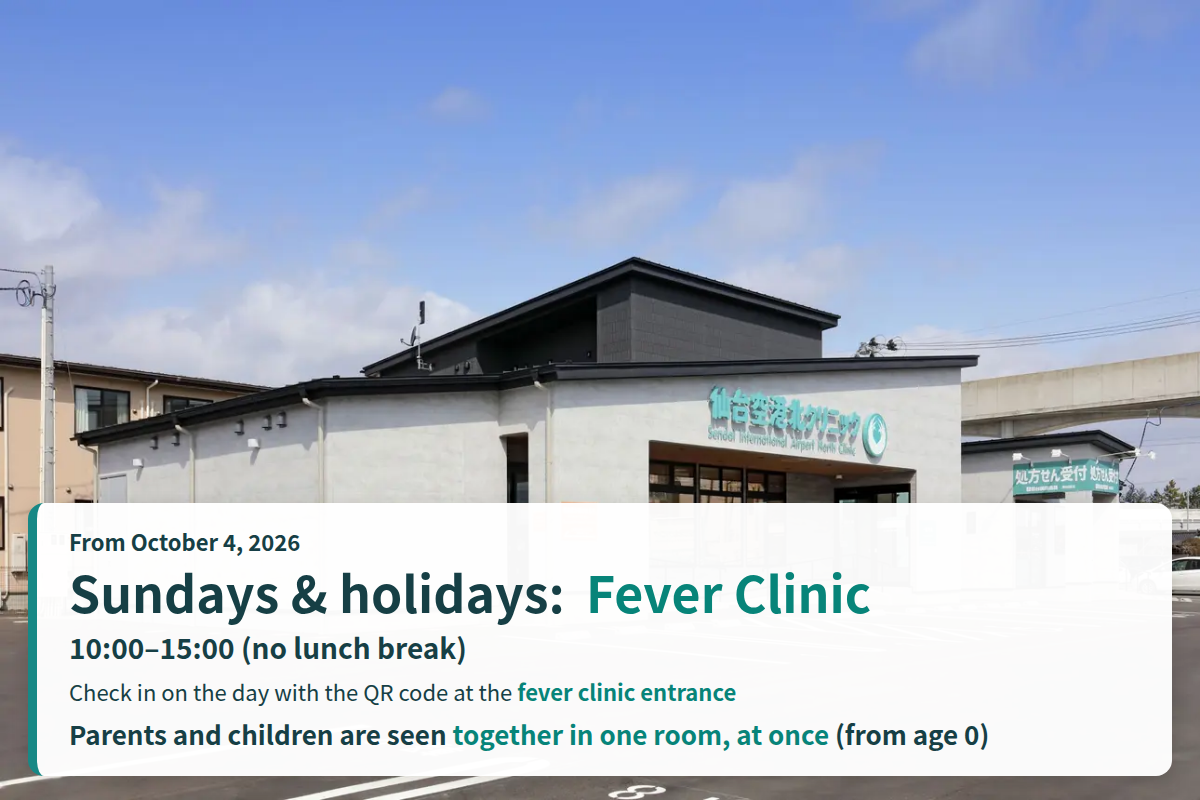
First, a note about our fever clinic on Sundays and national holidays. PCR testing for influenza and COVID (a test that copies the virus’s genetic material in order to detect it) gives results the same day.
From October 4, 2026, we also run the fever clinic on Sundays and national holidays
10:00 to 15:00 (no lunch break). You check in on the day. We give you the PCR result the same day. On Sundays and holidays we see fever patients only, and we do not offer general outpatient care or IV drips. Please check the clinic calendar for clinic dates and closed days. Notice: fever clinic on Sundays and national holidays
Shunichi Gamo, MD, PhD
Director, Sendai International Airport North Clinic
Born and raised locally, he attended Yuriage Elementary School and Yuriage Junior High School in Natori City. After graduating from Tohoku University School of Medicine, he worked at Sendai Open Hospital and Kesennuma City Hospital, and then at Tohoku University Hospital. In April 2021, in the middle of the COVID-19 pandemic, he opened Sendai International Airport North Clinic. Holding to a fever clinic that never turns patients away, he cared for well over 20,000 patients with fever in the two years before COVID-19 was moved to Class 5 under Japan’s infectious disease law.
Society memberships and board certifications
Certified Member and Board Certified Fellow, Japanese Society of Internal Medicine
Board Certified Pulmonologist, Japanese Respiratory Society
Board Certified Allergist, Japanese Society of Allergology
Board Certified Specialist, Japanese Society of Anti-Aging Medicine
PhD in Medicine (Tohoku University)
In short: for a child’s fever of unknown cause, think of a urinary tract infection too, and check with a urine test
When your child’s fever continues, first check the following three things.
- Course of the fever:
Are there symptoms other than fever, such as cough, runny nose, or diarrhea? Or has the fever been the only symptom? - Urine:
How often, the smell, the color, and whether your child feels pain or cries when passing urine - Overall condition:
Is your child drinking, responding when called, and not limp?
If the third point, overall condition, is clearly off, hurry no matter how high the temperature is. I have set out the details of where to draw the line in the section below on signs that mean you should hurry.
If your child looks miserable, acetaminophen (such as Calonal) can bring the fever down. Use it as the doctor directs. Even when the fever comes down, the cause is still there, so please do come in and talk to us.
 Dr. Gamo
Even if a fever reducer makes your child more comfortable, the cause of the fever is still there. Checking that is what matters.
How common are urinary tract infections in babies with a fever?
Pooling studies of febrile infants, a urinary tract infection was found in about 7% (roughly 7 in 100)[1].
A urinary tract infection occurs when bacteria get into the passage that carries urine: the kidneys, ureters, bladder, and urethra. A summary of a guideline from European urology societies calls it the most common bacterial infection in children[2].
In 2011, the American Academy of Pediatrics (AAP) published a clinical practice guideline on the diagnosis and management of the first urinary tract infection in febrile children aged 2 to 24 months[3].
The proportion changes a lot with age and sex
In the same pooled study, the proportion of febrile infants with a urinary tract infection differed by age and sex as follows[1].
| Febrile infants | Proportion with a urinary tract infection |
|---|---|
| Girls, 0 to 3 months | 7.5% |
| Girls, 3 to 6 months | 5.7% |
| Girls, 6 to 12 months | 8.3% |
| Girls, over 12 months | 2.1% |
| Boys under 3 months (uncircumcised) | 20.1% |
| Boys under 3 months (circumcised) | 2.4% |
These are figures pooled from studies abroad and are averages across the studies. They are not the probability for each child in Japan[1]. Even so, they show that smaller infants need more attention.
A urinary tract infection in which the bacteria have reached the kidney is called pyelonephritis. For adults, see Pyelonephritis in adults (fever with back and flank pain).
Dr. GamoThere are many viral illnesses in which the fever comes first and alone. When we test the urine in a “fever only” case, it is to rule out one of the causes we do not want to miss.
How is a urinary tract infection diagnosed? The way urine is collected changes the result
Urine tests (a urinalysis and a urine culture) are essential for the diagnosis. The AAP guideline says the diagnosis is made when both are present: pyuria (a state in which white blood cells are increased in the urine) and 50,000 or more colonies of a single organism per mL in a properly collected urine sample[3].
The summary of the European guideline recommends a microscopic urine examination when a dipstick (test strip) is positive[2].
There are four ways to collect urine
Urine can be collected with a collection bag, a clean-catch sample, a catheter, or suprapubic aspiration (a needle through the lower abdomen), and each has strengths and weaknesses[2].
In a hospital study of urine cultures from children under 2 years old, “contamination” (mixing in of organisms from the skin and elsewhere) was 26% with clean-catch, 12% with a catheter, and 1% with suprapubic aspiration[4]. In that study, urine collected in a bag made up only 2% of the total, and the contamination rate for bags was not reported[4].
| Method | How it is done | What is known |
|---|---|---|
| Collection bag | A bag is stuck on around the genitals to collect the urine | This method has a high chance of contamination. A review (a summary of studies) states that, among collection methods that do not use a tube or needle, collecting urine in a bag or diaper is not recommended for children[5] |
| Clean-catch (midstream urine) | The area around the genitals is wiped, and urine is caught partway through urination | The review found that midstream urine after cleaning had less contamination than urine from a bag or diaper[5]. However, a hospital survey found contamination of 26%, so the technique needs care[4] |
| Catheter | A thin tube is passed through the urethra to collect urine from the bladder | Contamination was 12%, lower than with clean-catch[4] |
| Suprapubic aspiration | A thin needle through the skin of the abdomen collects urine from the bladder | Contamination was 1%. The authors of that study state that suprapubic aspiration should ideally be used[4] |
The doctor decides which method to use based on your child’s age and condition. Urine collected in a bag is easily contaminated, so care is needed in reading the results[5].
Dr. GamoCollecting urine is a burden for both the child and the parents. But urine collected the right way is the best clue to the diagnosis.
A urinalysis and a urine culture play different roles
- Urinalysis:
Components of the urine, such as white blood cells, are checked with a test strip or a microscope. When the strip is positive, a microscopic examination is recommended[2] - Urine culture:
The organisms in the urine are grown to identify the type and find which antibiotic (a medicine that stops bacteria) works. It takes several days to get the result - Reviewing the medicine:
The antibiotic is chosen based on how well medicines work in the local area, and adjusted to the culture result[2]
What is the treatment? Start antibiotics early and finish them all
Treatment centers on antibiotics, started early once the diagnosis is made[2]. Please finish all of what is prescribed.
Dr. GamoIt is tempting to stop the medicine once the fever goes down, but please finish all of what was prescribed.
How the medicine is given (by mouth, by drip, and so on) is decided according to your child’s condition[2].
In a study that followed 482 children under 6 years old for 2 years, the longer the fever lasted before antibiotics were started, the more likely new scarring of the kidney (renal scarring) was to be seen[6]. The length of fever before starting antibiotics (median) was 72 hours in children who developed scars and 48 hours in those who did not[6].
This was a study of an “association,” and it is not settled that the delay caused the scarring. Still, the researchers state that testing for urinary tract infection in a child with a fever should not be delayed[6].
- Even if the fever comes down partway, do not stop on your own judgment; finish all that is prescribed
- If your child vomits the medicine or is hard to give it to, contact the doctor
- Do not use leftover medicine from before for the next fever
- When your child looks miserable with the fever, use acetaminophen (such as Calonal) as the doctor directs
After a first urinary tract infection with fever, are imaging tests needed?
After a first urinary tract infection with fever, an ultrasound of the kidneys and bladder (a test that shows their shape using sound waves) is generally recommended[3][2].
This is to check for any birth defects in the shape of the urinary passage[3]. In 29 studies of children with a first febrile urinary tract infection (9,170 children in total), about 1 in 5 (22.1%) had some abnormality on ultrasound[7].
Abnormalities that changed the treatment plan were found in 3.1% (about 1 in 32)[7]. The most common was hydronephrosis (swelling of the kidney caused by poor flow of urine) and similar findings[7]. The results varied a lot from study to study, and the researchers state that studies are needed to confirm how useful the test is[7].
When are more detailed tests considered?
Additional tests are considered based on your child’s characteristics and how the infection looks[2]. The AAP guideline says a voiding cystourethrogram (an X-ray test of the bladder and urethra taken while the child urinates) is not done in everyone after the first infection[3].
| Test | What it shows | When it is considered |
|---|---|---|
| Kidney and bladder ultrasound | Abnormal shape, hydronephrosis, and so on | Generally recommended after a first urinary tract infection with fever[3][2] |
| Voiding cystourethrogram | “Reflux,” where urine flows backward from the bladder toward the kidney, and so on | When ultrasound finds hydronephrosis or scarring, when the course is atypical or complicated, or when a urinary tract infection with fever comes back[3] |
| Renal scintigraphy (DMSA scan) | Scarring of the kidney | Used in studies to confirm scarring[6] |
Which tests are done, and where, is decided by the doctor in discussion with you, according to your child’s condition.
Dr. GamoWhich tests are needed differs from child to child. Please feel free to ask the doctor about anything you do not understand.
Signs that mean you should hurry: 119, an emergency department, or the same day
Call 119 right away
If even one of the following is present, call 119 without hesitating, no matter how high the temperature is. This is the same at night and on holidays.
- Your child does not respond when called, or is limp and does not make eye contact (consciousness is abnormal)
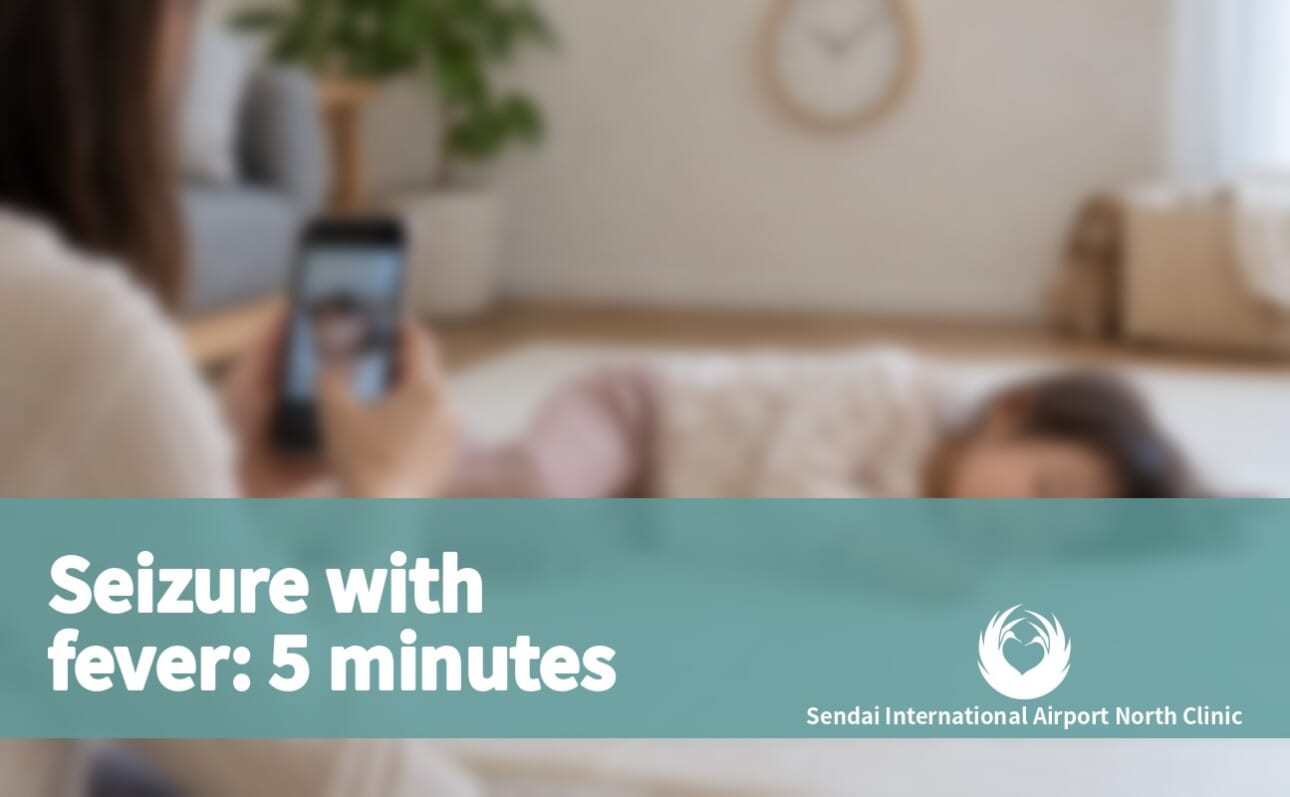
- A seizure has occurred (for febrile seizures, please also see our article on febrile seizures)
- Your child seems to be struggling to breathe, is breathing with the shoulders, or has purplish lips
Go to an emergency department the same day, even at night or on a holiday
In the following situations, do not wait until morning; go to an emergency department even at night or on a holiday. If your child is in distress and cannot be moved, call 119.
- A fever in a baby under 3 months old
- Your child vomits and cannot drink
- Your child is passing hardly any urine
- The face looks unwell, the hands and feet are cold, or your child stays fretful even when comforted
If you are unsure, call #8000 (children’s night-time advice line)
If you cannot judge whether it is serious enough for an emergency department, you can phone Miyagi Prefecture’s children’s night-time advice line (#8000). Nurses advise on whether to be seen and related questions every day from 7:00 p.m. until 8:00 a.m. the next morning[8]. From a landline that cannot dial #8000, call 022-212-9390[8].
The line gives advice only and does not provide medical treatment[8]. If there is a clearly dangerous sign, call 119 without stopping to ask for advice.
Be seen the same day (the next morning if it is night)
If your child is energetic and drinking but any of the following applies, please do not wait too long; be seen.
- The fever continues, yet there is no clear symptom pointing to a cause, such as cough or runny nose
- Your child feels pain or cries when passing urine, the urine smells strong, or your child passes urine often
- Your child complains of pain in the back, flank, or belly
- Your child has been told before that they had a urinary tract infection
- A fever that had come down has gone up again
If your child’s condition changes during the night, go back to the “119” and “emergency department” guides above at that point and judge again. For how to decide at night or on holidays, see also Fever in a child: can it wait until morning, or should you go now?
Dr. GamoIf your child’s condition changes during the night, it is fine to judge again as many times as needed.
What about recurrence? What parents should watch for after recovery
Even after the fever has come down with treatment, if a similar fever comes back, think of a recurrence of the urinary tract infection and be seen early.
The AAP guideline asks for careful follow-up after treatment so that a recurrence can be diagnosed and treated promptly[3]. When a urinary tract infection with fever comes back, a voiding cystourethrogram is also done[3].
- A fever of unclear cause has come back
- Your child feels pain or cries when passing urine, or passes urine more often
- A child who had been using the toilet has started having accidents
- Strong-smelling urine continues, feeding has dropped, or your child is in a bad mood
- Your child complains of pain in the back, flank, or belly
As ways to reduce recurrence, the summary of the European guideline lists preventive medicine, preventive measures that do not use medicine, and treatment of phimosis (a foreskin that will not retract) and of bladder and bowel dysfunction[2]. Whether to use preventive medicine is decided by the doctor after looking at the test results.
In children with problems with urinating or bowel movements (bladder and bowel dysfunction), new kidney scarring was also found more often[6]. If your child has constipation or a habit of holding in urine, please tell us at the visit.
Each time your child has a fever, please say that “they have had a urinary tract infection before.” It helps to write down the diagnosis and date in the maternal and child health handbook or similar.
Dr. GamoIf the diagnosis and date are in the maternal and child health handbook, you will not forget to mention them even in a hurry.
Frequently asked questions
- My child has only a fever, with no cough or runny nose. Should the urine be tested?
-
When a fever continues with no clear cause, a urine test can give a clue. A summary of studies found a urinary tract infection in about 7% of febrile infants[1]. Please come in and talk to us. A fever in a baby under 3 months needs an emergency department, even at night or on a holiday.
- Can the diagnosis be made from a urine sample collected in a bag alone?
-
Urine collected in a bag is said to have a high chance of contamination[5]. The doctor makes the diagnosis by putting the urinalysis and urine culture results together[3].
- The fever came down after antibiotics. Can we stop the medicine now?
-
Even after the fever comes down, please finish all that was prescribed. Do not use leftover medicine for the next illness. If it is hard to give the medicine, or your child vomits it, contact the doctor.
- Is an ultrasound always done after a first urinary tract infection?
-
An ultrasound of the kidneys and bladder is generally recommended[3][2]. More detailed tests are considered based on the ultrasound result and how the infection went[3].
- My child has a fever at night. They are not limp, but I am worried. What should I do?
-
If your child does not respond when called, has a seizure, or seems to be struggling to breathe, call 119. For a baby under 3 months, or if your child vomits and cannot drink, go to an emergency department. If you are unsure, you can call #8000 for advice[8].
Summary: when only a fever continues, check with a urine test
- If your child’s fever continues with no clear cause, such as cough or runny nose, think of a urinary tract infection (a bacterial infection of the passage that carries urine) and have the urine tested
- If your child does not respond when called, has a seizure, or seems to be struggling to breathe, call 119. For a fever in a baby under 3 months, or if your child vomits and cannot drink, go to an emergency department even at night
- Once the diagnosis is made, start antibiotics early and finish all that is prescribed. After the first infection, talk with the doctor about an ultrasound and other tests
- After a first urinary tract infection with fever, an ultrasound of the kidneys and bladder is generally recommended, and additional tests are decided based on the results
- If the same fever comes back after recovery, think of a recurrence, be seen early, and tell the doctor the previous diagnosis
When your child keeps having “only a fever,” the first to notice is the parent who is always close by. Please pass that observation on to us just as it is. Leave the medical care to us.
That’s all.
Disclaimer
This article is intended to provide general medical information and does not replace an examination, diagnosis, or treatment by a doctor. The content is based on medical knowledge at the time of publication, but the right course of action differs for each person. If you are worried about symptoms, please consult a medical facility.
References
- Shaikh N, Morone NE, Bost JE, Farrell MH. Prevalence of urinary tract infection in childhood: a meta-analysis. Pediatr Infect Dis J. 2008 Apr;27(4):302-8. doi:10.1097/INF.0b013e31815e4122 PMID: 18316994
- Gnech M, Bujons A, Radmayr C, ’t Hoen L, Bogaert G, Burgu B, et al. Update and summary of the EAU/ESPU paediatric guidelines on urinary tract infection in children. J Pediatr Urol. 2026 Apr;22(2):105481. doi:10.1016/j.jpurol.2025.06.016 PMID: 40615247
- Subcommittee on Urinary Tract Infection, Steering Committee on Quality Improvement and Management, Roberts KB. Urinary tract infection: clinical practice guideline for the diagnosis and management of the initial UTI in febrile infants and children 2 to 24 months. Pediatrics. 2011 Sep;128(3):595-610. doi:10.1542/peds.2011-1330 PMID: 21873693
- Tosif S, Baker A, Oakley E, Donath S, Babl FE. Contamination rates of different urine collection methods for the diagnosis of urinary tract infections in young children: an observational cohort study. J Paediatr Child Health. 2012 Aug;48(8):659-64. doi:10.1111/j.1440-1754.2012.02449.x PMID: 22537082
- LaRocco MT, Franek J, Leibach EK, Weissfeld AS, Kraft CS, Sautter RL, et al. Effectiveness of preanalytic practices on contamination and diagnostic accuracy of urine cultures: a Laboratory Medicine Best Practices systematic review and meta-analysis. Clin Microbiol Rev. 2016 Jan;29(1):105-47. doi:10.1128/CMR.00030-15 PMID: 26598386
- Shaikh N, Mattoo TK, Keren R, Ivanova A, Cui G, Moxey-Mims M, et al. Early antibiotic treatment for pediatric febrile urinary tract infection and renal scarring. JAMA Pediatr. 2016 Sep;170(9):848-54. doi:10.1001/jamapediatrics.2016.1181 PMID: 27455161
- Yang S, Gill PJ, Anwar MR, Nurse K, Mahood Q, Borkhoff CM, et al. Kidney ultrasonography after first febrile urinary tract infection in children: a systematic review and meta-analysis. JAMA Pediatr. 2023 Aug;177(8):764-73. doi:10.1001/jamapediatrics.2023.1387 PMID: 37252727
- Miyagi Prefecture. Miyagi Prefecture Children’s Night-time Advice Line Program (#8000). Miyagi Prefecture website (in Japanese). Accessed October 2026. https://www.pref.miyagi.jp/soshiki/iryou/shouni04.html
▶ Overview of this topic: Fever clinic on Sundays and national holidays (from October 4, 2026, 10:00 to 15:00)
More articles to read when you have a fever
For our Sunday and holiday fever clinic, see Notice: fever clinic on Sundays and national holidays.