If you are in a hurry
- Roseola is a common cause of a first high fever between about 6 months and 2 years of age, and almost every child is infected with the causative viruses by age 2
- After a high fever of about 3 days (about 4 days on average), a red rash appears just as the fever goes away, and most children recover on their own
- See a doctor even at night for: a temperature of 38°C or higher under 3 months of age, limpness, trouble breathing, a bulging soft spot (fontanelle), or a first seizure. Call 119 (Japan’s emergency number) if a seizure lasts 5 minutes or more
Hello. I am Shunichi Gamo, MD, PhD, a board-certified pulmonologist and the director of Sendai Airport North Clinic.
A baby just past six months old suddenly runs a fever in the high 39s one day. The cough and runny nose, if any, are mild, but the fever alone goes on for 3 days, then 4. If this is your first child, I am sure you are beside yourself with worry. In our fever clinic, too, quite a few babies come in with what is their “first high fever in life.”
Let me start with the conclusion: one of the most common causes of a first high fever at this age is roseola (exanthem subitum). In most cases the fever goes away in 3 to 4 days, a rash appears in its place, and most children get better on their own. However, it is also a disease for which you cannot say “this is roseola” while the fever is still present. This article explains the typical course of roseola, its relationship to febrile seizures, the signs that mean you should see a doctor even at night, guidelines for returning to nursery school, and how to visit our fever clinic, including data from research papers.
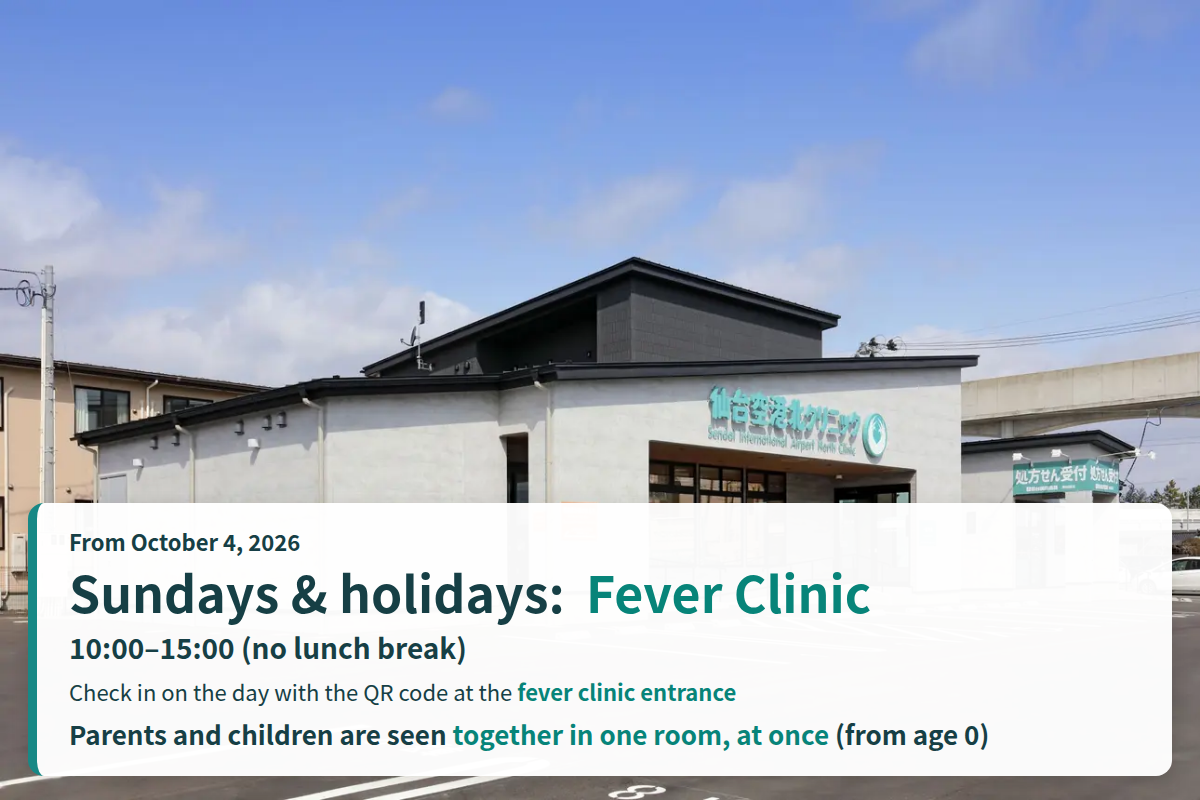
From October 4, 2026, we also run the fever clinic on Sundays and holidays
10:00 to 15:00 (no lunch break). You are seen by checking in on the day. We tell you the PCR test result on the same day. On Sundays and holidays we run the fever clinic only; there is no general outpatient clinic and no IV drip service. Please check the clinic calendar for clinic dates and closed days. Notice about the Sunday and holiday fever clinic
Shunichi Gamo, MD, PhD
Director, Sendai International Airport North Clinic
Born and raised locally, he attended Yuriage Elementary School and Yuriage Junior High School in Natori City. After graduating from Tohoku University School of Medicine, he worked at Sendai Open Hospital and Kesennuma City Hospital, and then at Tohoku University Hospital. In April 2021, in the middle of the COVID-19 pandemic, he opened Sendai International Airport North Clinic. Holding to a fever clinic that never turns patients away, he cared for well over 20,000 patients with fever in the two years before COVID-19 was moved to Class 5 under Japan’s infectious disease law.
Society memberships and board certifications
Certified Member and Board Certified Fellow, Japanese Society of Internal Medicine
Board Certified Pulmonologist, Japanese Respiratory Society
Board Certified Allergist, Japanese Society of Allergology
Board Certified Specialist, Japanese Society of Anti-Aging Medicine
PhD in Medicine (Tohoku University)
[Conclusion] You cannot tell during the fever; only when the rash appears do you know it was roseola
In brief, this is what roseola is like.
- A viral illness common in babies from about 6 months to 2 years old. Almost every child is infected with the causative viruses by age 2
- After a high fever of about 3 days (about 4 days on average), a red rash appears on the face and body just as the fever goes away
- Many children are relatively cheerful for the height of the fever, but fussiness, diarrhea, and puffy eyelids can also occur
- Most children recover on their own, but a febrile seizure can occur during the fever phase
- The diagnosis is made by the “course.” During the fever, it often cannot be told apart from other illnesses
The last point is the important one. On day 1 or 2 of the fever, all that can be seen is “a baby with a high fever.” By appearance it cannot be told apart from illnesses that need treatment, such as a urinary tract infection (a bacterial infection of the kidneys or bladder), an ear infection, or Kawasaki disease. So the real-life way roseola is diagnosed is this: you first see a doctor during the fever to check “whether there are any signs of a dangerous illness right now,” and then, when the fever goes down and the rash appears, you confirm “ah, that was roseola.”
 Dr. Gamo
Being able to say with a smile, “So it was roseola after all,” is the happiest ending for us, too.
What is roseola? [HHV-6 and HHV-7, relatives of the herpes viruses]
Roseola is caused by human herpesvirus 6 (HHV-6) and, sometimes, type 7 (HHV-7). When you hear “herpes,” you may think of the blisters around the mouth, but that is type 1; HHV-6 and 7 are relatives but different viruses[1][2]. These viruses are normally present in the saliva of many children and adults. It is thought that babies catch it from the saliva of parents or siblings after about 6 months of age, when the antibodies received from the mother (maternal antibodies) have declined[2].
In the United States, there is a study that followed 277 babies from birth to age 2 and tested their saliva for the virus every week[3]. The proportion of children infected with HHV-6 was 40% by 12 months of age and 77% by 24 months, with infections peaking at 9 to 21 months. Children with older siblings were more likely to be infected (adjusted hazard ratio 2.1, 95% confidence interval 1.4 to 2.9). Also, among 81 children whose time of infection was clear, 93% had some symptoms, and 38% saw a doctor[3].
An adjusted hazard ratio is a number that compares “how likely something is to happen” after making the other conditions equal; 2.1 means about twice as likely. A 95% confidence interval is the range in which the true value is thought to lie. In other words, this is a very common infection that almost every child gets by age 2, and children with older siblings tend to get it a little earlier. However, only some of the infected children showed the typical roseola picture, and many had only a fever or mild symptoms[3].
It can happen twice
Even though “my child should have already had roseola,” a similar course can occur again. In a Japanese study, a baby who had roseola twice within two months was reported to have HHV-6 found the first time and HHV-7 the second time[1]. Roseola caused by HHV-7 is said to be most common at around 2 to 4 years of age, a little later than HHV-6[2]. The way to read the course and the guideposts for seeing a doctor are the same the second time as the first.
Dr. GamoEven if it comes a 2nd time, there is no need to panic. The points to watch are the same as the 1st time.
The typical course [3 to 4 days of high fever, then a rash as the fever breaks]
In Japan, there is a study that summarized the course of 176 babies (average age 7.3 months) who were suspected of having roseola and were later confirmed to have a first HHV-6 infection[4]. It shows the textbook course well, so let’s look at the numbers.
- [Fever]
98% had a fever. The average peak temperature was 39.4°C, and the fever lasted 4.1 days on average - [Rash]
98% had a red rash (spots or small bumps). It appeared on the face and body, mostly around the time the fever went down, and disappeared in 3.8 days on average - [Other signs]
Mild diarrhea 68%, red bumps at the back of the throat 65%, cough 50%, mildly swollen lymph nodes in the neck 31%, puffy eyelids 30% - [Fontanelle]
A bulging of the soft spot on the top of the baby’s head (the anterior fontanelle) in 26% - [Seizure]
Febrile seizure in 8%
The key point is that the rash appears “after the fever goes down”[2]. The order is different from illnesses in which the rash appears while the fever is still present (such as rubella or strep throat). The rash is not very itchy, and it usually disappears in a few days without leaving a mark.
It is often said that “the child is relatively cheerful,” but 68% of the 176 had diarrhea, and 3 in 10 had puffy eyelids[4]. With a high fever, it is not unusual for the appetite to drop and for the child to be fussy at night. Please do not assume “if it’s roseola, my child should be lively,” and watch for the danger signs described later.
Dr. GamoRather than whether your child seems cheerful, please check that there are no danger signs.
If the soft spot is bulging
A bulging fontanelle is known as a sign of meningitis (a bacterial or viral infection of the membranes that surround the brain). Yet as the study above shows, it is seen in 1 in 4 children even with roseola[4]. You cannot decide on your own that “it’s meningitis” or “it’s roseola.” Everyone’s fontanelle tightens when crying or straining, so check, while the baby is calm and being held, whether the top of the head is clearly raised and tense. If it is clearly bulging and tense even when the baby is calm, please see a doctor day or night, even if the baby looks well. It often turns out to be roseola in the end, but a doctor needs to examine the baby to confirm that it is not meningitis.
Relationship with febrile seizures [In the US, one third of febrile seizures up to age 2]
A febrile seizure is a seizure that occurs with a temperature of 38°C or higher, mainly in children from 6 months to 5 years old. Seizures with a clear cause such as meningitis are excluded[5]. In Japan, up to 9% of children (3.4 to 9.3% depending on the report) experience one, which is known to be more than the 2 to 5% in the United States or the 2.3% in the United Kingdom[5].
Roseola is one major cause of these febrile seizures. In a study of 1,653 children under 3 years old who came to a US emergency department with a sudden fever, 160 (9.7%) had a first HHV-6 infection[6]. Looking only at the 365 emergency visits for fever at 6 to 12 months of age, 1 in 5 (20%) was caused by HHV-6. And 21 of the 160 children with a first HHV-6 infection had a seizure (about 13%); one third of the febrile seizures up to age 2 seen in this emergency department were caused by HHV-6[6]. The seizures often came in the later part of the fever and were reported to be prone to lasting long or recurring[6].
On the other hand, in the 277-child follow-up study mentioned earlier from the US, none of the 81 children whose time of infection was clear had a seizure[3]. This is the difference between a study of children who came to an emergency department[6] and a study that followed children living ordinary lives at home[3]. Please understand that both are true: “only some children with roseola have a seizure,” but also “among febrile seizures up to age 2 seen in the emergency department, one third were from the fever of roseola.”
Dr. GamoOnly some children have a seizure, but knowing about it helps you stay calm if it happens.
What to do when a seizure happens
Most febrile seizures stop within a few minutes and leave no aftereffects. Even so, anyone would panic seeing their own child have a seizure. Just remember the order of steps.
- First look at the clock (note the time it started; if you can, take a video with your smartphone)
- Lay the child on a flat surface with the face turned to the side (so that vomit does not block the throat)
- Do not put fingers or a towel in the mouth, do not shake the body, and do not hold the child tightly to restrain the movements
- Call 119 if it lasts 5 minutes or more, if it repeats within a short time, or if consciousness does not return after it stops
For a first seizure or a seizure on only one side of the body, see a doctor right away even if it stops quickly (at night, go to an after-hours clinic or an emergency department). A doctor needs to confirm that it is not due to another cause such as meningitis. Also, the clinical guideline on febrile seizures states that there is no evidence that fever reducers prevent a recurrence of febrile seizures[5]. Fever reducers are used not to “prevent seizures” but to “ease discomfort,” and you may use them just as you would for any other fever[5]. For children who have repeated seizures, diazepam suppositories (a medicine inserted through the anus) may be prescribed as a preventive medicine to use when a fever starts, but whether to use it is up to your family doctor’s judgment[5].
[See a doctor now, or call 119] Signs that mean you must not wait just because “it’s probably roseola”
This is the most important chapter of the article. Between the start of the fever and the appearance of the rash, roseola cannot be told apart from illnesses that need treatment. If even one of the following applies, see a doctor day or night, even if you think it is “probably roseola.” If a seizure lasts 5 minutes or more, the child does not respond when called, or the child is struggling badly to breathe, call 119 without hesitation.
- The baby is under 3 months old and has a temperature of 38°C or higher (see a doctor even if the baby looks well[7])
- Limp with a dull response, does not wake when you try to wake the baby, or does not make eye contact (this is also an ambulance criterion in the Japan Pediatric Society’s “Kodomo no Kyukyu” (children’s emergency) website[7])
- Appears to be struggling to breathe (breathing with the shoulders, the chest or the hollow below the throat sinking in, wheezing, or grunting breaths)
- The lips or face are pale or purplish, or the hands and feet are cold and mottled
- A seizure has occurred (if it is the first, see a doctor even if it was brief. Call 119 if it lasts 5 minutes or more, repeats, or consciousness does not return after it stops)
- Will not take any fluids at all, or has not passed urine for half a day or more
- A rash of purple or dark-red dots that does not fade when pressed (the rash of roseola fades when pressed)
- Vomiting that will not stop, pain or stiffness when the neck is bent forward, sensitivity to light, or a fontanelle that is clearly bulging and tense even when the baby is calm
- A weak or high-pitched cry, and the baby cannot be soothed
In addition, in the following situations you may be able to wait through the night, but be sure to see a doctor the next morning (or within clinic hours).
- The baby is 3 to 6 months old and has a temperature of 39°C or higher (even if the baby looks well. If in doubt, consult #8000, the children’s medical advice phone line)
- The fever has lasted 5 days or more (the fever of roseola averages about 4 days[4]. Kawasaki disease and other conditions need to be checked)
- The rash has appeared but the fever has not gone down, or a fever that had gone down came back up
- The rash turns into blisters, there is also a severe rash inside the mouth, or the rash has not faded after a week
- The child keeps touching an ear or has discharge from the ear (it may be an ear infection)
At night, if you cannot decide whether you can wait, call the children’s medical advice phone line (#8000). From anywhere in Japan it connects you to the service of the prefecture where you live. In Miyagi Prefecture it is open from 19:00 to 8:00 the next morning on both weekdays and holidays (as of May 2026; this may change)[8]. How to think about a child’s fever at night is explained in detail in the related article at the end of this page, “Child’s fever: can it wait until morning, or should we go now?”
Dr. GamoEven if you think it is probably roseola, do not wait if there is a danger sign. This is the most important point.
Care at home [fluids, fever reducers, and the rash]
If there are no danger signs, please care for your baby at home as follows.
- [Fluids]
Breast milk or formula as usual, as much as the baby wants. For babies already eating solid foods, give barley tea or oral rehydration solution little by little, often. Drinking a lot at once makes babies more likely to vomit, so start with one spoonful. Food can be whatever the baby can eat - [Fever reducer]
For babies we basically use acetaminophen (such as Calonal), which can bring the fever down. It helps when the baby looks miserable, cannot sleep, or cannot drink. The dose is decided by body weight, so use the prescribed medicine (including suppositories) as instructed. For babies under 3 months, do not use it on your own; see a doctor first - [Cooling and clothing]
While the baby is shivering with chills, keep the baby warm; once the fever has peaked and the baby feels hot, use lighter clothing. Be careful with cooling sheets: in babies they can come off and block the mouth or nose - [Rash]
It is not very itchy and fades in a few days. You usually do not need to apply any medicine. A bath is fine once the fever is down and the baby is lively - [Notes]
The course of the fever, the times you gave a fever reducer, how much the baby drank, how many times the baby passed urine, and the day the rash appeared. These are very helpful at the visit
Diarrhea is common[4], so please watch for diaper rash too. If your baby vomits and cannot keep fluids down, please also see the article on what to do when a child with fever and vomiting cannot drink.
Dr. GamoDiarrhea can easily make the bottom red, so please take a look when you change the diaper.
What to tell the doctor at the visit [age in months, course of the fever, fluids, seizures]
When we examine a baby during the fever, this is what we want to know. Please also bring the maternal and child health handbook and the medication notebook[7].
- The baby’s age in months, the date and time the fever started, and the highest temperature
- Whether the baby is more limp than usual, smiles when you play with the baby, and is sleeping
- How much the baby is drinking (breast milk, formula, other fluids) and how many times the baby passes urine
- Whether there was a seizure (if so, how many minutes it lasted, whether it was on only one side of the body, and please show us the video if you have one)
- Symptoms other than fever, such as cough, runny nose, diarrhea, vomiting, or touching an ear
- Whether you gave a fever reducer (when, and which), whether the baby had a recent vaccination, and illnesses going around among older siblings or at nursery school
I well understand the feeling of “I want to know right now whether it is roseola.” But an examination during the fever is not to “confirm roseola”; it is to check “whether this child has any sign of an illness that needs treatment right now.” Once the fever goes down and the rash appears, you are welcome to come back if anything worries you. If you take a photo of the rash, you can show it to us at the visit. However, if any of the signs above (see a doctor even at night, or be sure to see a doctor the next morning) apply, please see a doctor even after the rash has appeared.
Dr. GamoI truly understand how worrying a first high fever is for a family. There is no need to hold back thinking “it’s only a fever.”
When can the baby go back to nursery school? [Guideline for returning]
Roseola is not among the diseases (such as influenza and measles) for which a school absence period is individually set by the enforcement regulations of the School Health and Safety Act. In the Children and Families Agency’s “Guidelines for Infectious Disease Control in Nursery Facilities,” the guideline for returning is “the fever has gone down, the child is in good spirits, and the child’s overall condition is good”[2]. Whether the rash remains is not part of this guideline. Because the virus is normally present in the saliva of many children and adults, it is treated as a disease for which a clear “contagious period” cannot be given[2].
Dr. GamoRather than whether the rash is still there, the guide is whether the fever is down and your child is cheerful and well.
The same guideline also states that “if a baby in the 0-year-old class has a fever for the first time after enrolling, it may be roseola”[2]. Some nurseries require a doctor’s note or a form filled in by the parent when the child returns, so please check your nursery’s rules. Spread between infants is said to be uncommon[2], but right after the fever goes down the baby’s strength is also low, so there is no need to rush; waiting until the baby is eating and playing happily is enough.
About our fever clinic
Our policy is that we do not turn away anyone who comes to the fever clinic (depending on the symptoms, we may direct you to a more suitable medical institution). Please come even for a baby’s first fever. If you have an examination once during the fever and confirm that “there are no danger signs right now,” you can then watch calmly when the rash appears and think, “so it was roseola after all.”
| Day | Hours |
|---|---|
| Mon, Tue, Wed, Fri, Sat | 9:00 to 12:00 / 14:00 to 18:00 |
| Sundays and holidays (from October 4, 2026) | 10:00 to 15:00 (no lunch break, fever clinic only) |
| Thursday | Closed |
Please check the clinic calendar for clinic dates and closed days. For details, please see Notice about the Sunday and holiday fever clinic.
How a visit works
- Before you come, fill in the pre-visit questionnaire (optional; you may also fill it in when you check in at the entrance)
- Scan the QR code at the fever clinic entrance and check in by choosing “I have arrived, check me in” (required)
- On weekdays, once you have checked in, please wait in your car
- On Sundays and holidays, after check-in we confirm your insurance card (My Number insurance card, certificate of eligibility, and so on) at the general outpatient entrance. The general outpatient clinic is not open on Sundays and holidays, so please feel free to go in. When the confirmation is done, please wait in your car or elsewhere
- When your turn is near, we will call you by SMS or phone. Press the intercom at the fever clinic entrance and give your name
For the detailed steps, please see About the pre-visit questionnaire and same-day check-in for the fever clinic. Patients are seen in check-in order as a rule, but the order may change depending on the severity of symptoms and other factors. Many children can do a saliva PCR test from around age 3 (How to take the saliva PCR test).
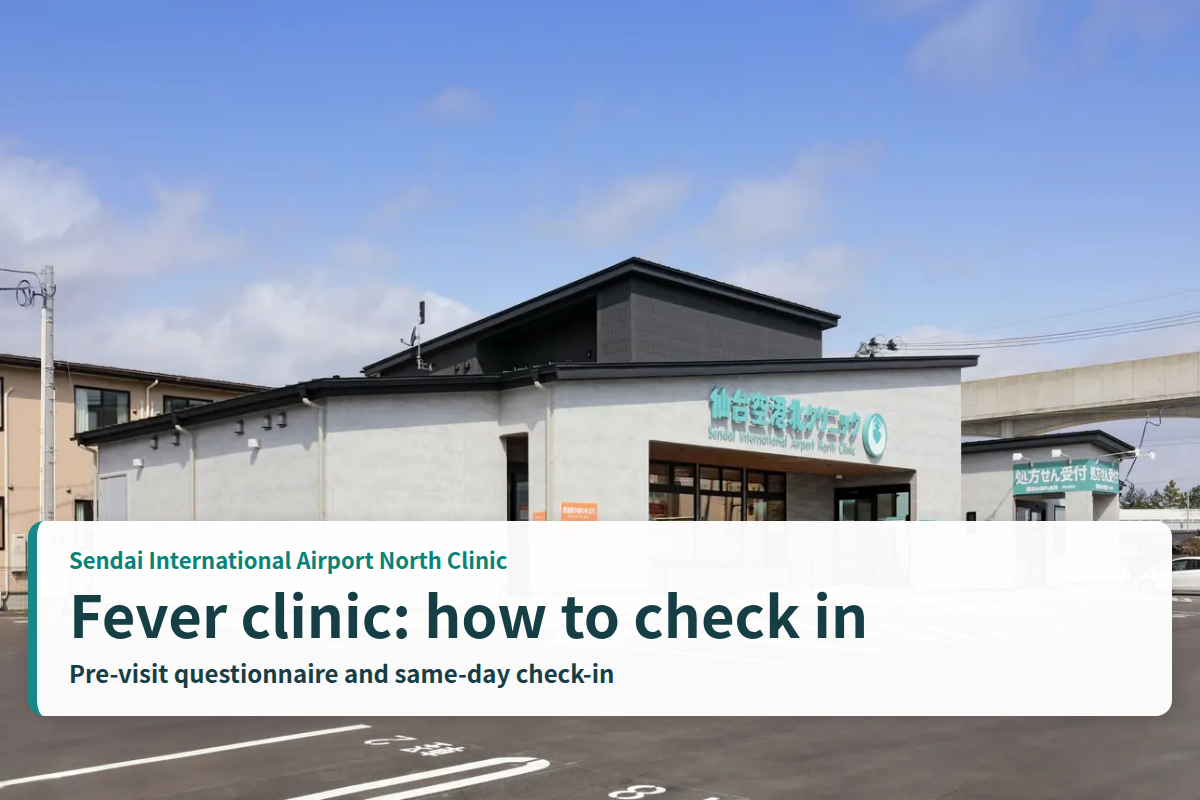
Please note that we cannot give IV drips on Sundays and holidays. If an IV drip seems likely to be needed, for example when the child cannot take any fluids and is limp, please go to a medical institution that can give IV drips.
Frequently asked questions (FAQ)
- My 8-month-old has a fever of 39°C for the first time. Is it roseola?
-
For a first high fever at that age, roseola is one of the most common causes. However, while the fever is present, it cannot be told apart from a urinary tract infection, an ear infection, and so on by appearance. Please have an examination once during the fever to confirm that there are no danger signs. If the fever goes down and a rash appears, you will know it was roseola.
- The fever has gone down and a rash has appeared. Do I need to see a doctor again?
-
If the child is in good spirits, is drinking, and the rash is red spots that fade when pressed, the course is often going well. You are welcome to come back if anything worries you. The rash fades in a few days. However, if the child is limp or has a purple rash that does not fade when pressed, see a doctor even at night. If the fever does not go down even after the rash appears, goes up again, or the rash turns into blisters, be sure to see a doctor the next morning (within clinic hours).
- My child had a febrile seizure. Will there be another seizure after the rash appears?
-
The febrile seizures of roseola occur during the fever phase. A seizure after the rash has appeared and the fever has gone down is not usual. A first seizure needs a visit right away even if it is brief, and call 119 if it lasts 5 minutes or more, repeats, or consciousness does not return after it stops. There is said to be no evidence that fever reducers prevent a recurrence of febrile seizures[5].
- The rash is still there. Can I send my child to nursery school?
-
In the guidelines for infectious disease control in nursery facilities, the guideline for returning is “the fever has gone down, the child is in good spirits, and the child’s overall condition is good,” and the presence of a rash is not a condition[2]. If the fever is down and the child is eating and playing happily, the child can usually go back even if the rash remains. Please check with the nursery whether a doctor’s note or form is needed.
- My older child has roseola. Will it spread to the younger one (2 months old)?
-
The virus spreads through saliva, and it is known that children with older siblings are more likely to be infected[3]. In the first few months of life, antibodies from the mother remain and babies are less likely to catch it[2], but they do not escape it completely; in a US study, 23% of the children with a first HHV-6 infection were under 6 months old[6]. What matters is that if a baby under 3 months old has a temperature of 38°C or higher, whatever the cause, you should see a doctor right away even at night, even if the baby looks well[7].
- Can I take my baby to the fever clinic on Sundays and holidays?
-
Yes. We run the fever clinic on Sundays and holidays from 10:00 to 15:00 (no lunch break). You are seen by checking in on the day with the QR code at the fever clinic entrance. Please check the clinic calendar for clinic dates and closed days. On Sundays and holidays there is no general outpatient clinic and no IV drip service.
Summary [See a doctor during the fever; when the rash appears, you can relax]
- Roseola is a common cause of a first high fever between about 6 months and 2 years of age, and almost every child is infected with the causative viruses by age 2
- After a high fever of about 3 days (about 4 days on average), a red rash appears just as the fever goes away, and most children recover on their own
- During the fever it cannot be told apart from other illnesses. Have an examination once to confirm there are no danger signs
- See a doctor even at night for: a temperature of 38°C or higher under 3 months of age, limpness, trouble breathing, a bulging fontanelle, or a first seizure. Call 119 if a seizure lasts 5 minutes or more
- In a US study, one third of the febrile seizures up to age 2 seen in an emergency department were caused by HHV-6. Fever reducers do not prevent a recurrence of seizures
- The guideline for returning to nursery school is “the fever has gone down, the child is in good spirits, and the child’s overall condition is good.” It is fine if the rash remains
A first high fever is truly worrying for every family. During the fever, please do not hesitate to have an examination, and when the rash appears, take a breath of relief and tell your baby, “You did so well.” Leave the medical care to us.
That’s all.
Disclaimer
This article is intended to provide general medical information and does not replace an examination, diagnosis, or treatment by a doctor. The content is based on medical knowledge at the time of publication, but the appropriate response differs from person to person. If you are worried about your symptoms, please consult a medical institution.
References
- Tanaka K, Kondo T, Torigoe S, Okada S, Mukai T, Yamanishi K. Human herpesvirus 7: another causal agent for roseola (exanthem subitum). J Pediatr. 1994 Jul;125(1):1-5. doi:10.1016/s0022-3476(94)70113-x PMID: 8021757
- Children and Families Agency. Guidelines for Infectious Disease Control in Nursery Facilities (2018 revised edition; partially revised May 2023, partially amended October 2023). Children and Families Agency. 2023. https://www.mhlw.go.jp/content/10900000/20231010_policies_hoiku_25.pdf (in Japanese)
- Zerr DM, Meier AS, Selke SS, Frenkel LM, Huang ML, Wald A, et al. A population-based study of primary human herpesvirus 6 infection. N Engl J Med. 2005 Feb;352(8):768-76. doi:10.1056/NEJMoa042207 PMID: 15728809
- Asano Y, Yoshikawa T, Suga S, Kobayashi I, Nakashima T, Yazaki T, et al. Clinical features of infants with primary human herpesvirus 6 infection (exanthem subitum, roseola infantum). Pediatrics. 1994 Jan;93(1):104-8. PMID: 8265302
- Japanese Society of Child Neurology (supervision), Febrile Seizure Clinical Practice Guideline Revision Working Group (authors). Clinical Practice Guidelines for Febrile Seizures 2023. Shindan to Chiryo Sha (listed in the Minds Guideline Library). 2023. https://minds.jcqhc.or.jp/summary/c00763/ (in Japanese)
- Hall CB, Long CE, Schnabel KC, Caserta MT, McIntyre KM, Costanzo MA, et al. Human herpesvirus-6 infection in children. A prospective study of complications and reactivation. N Engl J Med. 1994 Aug;331(7):432-8. doi:10.1056/NEJM199408183310703 PMID: 8035839
- Japan Pediatric Society. Kodomo no Kyukyu (Children’s Emergency, ONLINE-QQ): Fever (38°C or higher). Kodomo no Kyukyu website. Accessed October 2026. https://kodomo-qq.jp/index.php?pname=hatsunetsu (in Japanese)
- Ministry of Health, Labour and Welfare. About the Children’s Medical Telephone Consultation Program (#8000). Ministry of Health, Labour and Welfare website. Accessed October 2026. https://www.mhlw.go.jp/topics/2006/10/tp1010-3.html (in Japanese)
Related articles to read when there is a fever
For the Sunday and holiday fever clinic, see Notice about the Sunday and holiday fever clinic; for how to visit, see About the pre-visit questionnaire and same-day check-in for the fever clinic.