
If you are in a hurry
- With dizziness in adults, whatever the type, such as spinning or floating, decide whether to suspect a stroke by “whether it came on suddenly” and “whether other symptoms come with it”
- If any of these comes on suddenly, call 119 (Japan’s emergency number) right away: a drooping face, a weak arm, slurred speech, a severe headache, or sudden unsteadiness so bad you cannot stand
- The most common cause is the inner ear (deep inside the ear), but a diagnosis needs a doctor’s questions and examination, and you must not assume it is harmless and just wait and see
Hello. I am Shunichi Gamo, MD, PhD, a board-certified pulmonologist and the director of Sendai Airport North Clinic.
“Suddenly everything was spinning.” “I was so unsteady I could not stand.” With dizziness like this, the biggest worry is
“Could this be a stroke?”
That is the question I am often asked. Dizziness is a symptom many people experience, and the most common cause is an inner ear disorder, but sometimes a life-threatening disease, such as a stroke or heart disease, is hidden behind it[1][2].
To get straight to the point, whether dizziness is a stroke is judged not by the type of dizziness but by “whether it came on suddenly” and “whether other symptoms, involving the face, arms, speech, or walking, come with it”. This is because a stroke starts “suddenly”[3].
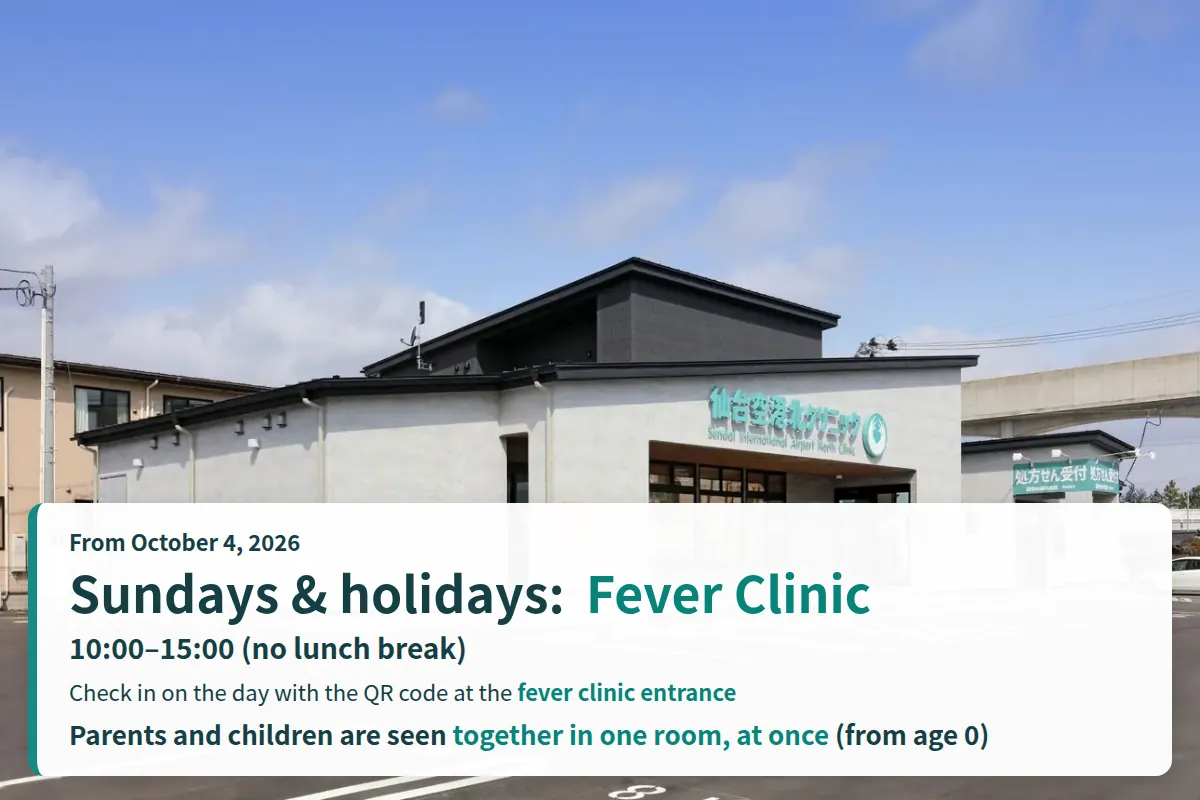
First, a note about our fever clinic on Sundays and national holidays. PCR testing for influenza and COVID (a test that copies the virus’s genetic material in order to detect it) gives results the same day.
From October 4, 2026, we also run the fever clinic on Sundays and national holidays
10:00 to 15:00 (no lunch break). You check in on the day. We give you the PCR result the same day. On Sundays and holidays we see fever patients only, and we do not offer general outpatient care or IV drips. Please check the clinic calendar for clinic dates and closed days. Notice: fever clinic on Sundays and national holidays

Shunichi Gamo, MD, PhD
Director, Sendai International Airport North Clinic
Born and raised locally, he attended Yuriage Elementary School and Yuriage Junior High School in Natori City. After graduating from Tohoku University School of Medicine, he worked at Sendai Open Hospital and Kesennuma City Hospital, and then at Tohoku University Hospital. In April 2021, in the middle of the COVID-19 pandemic, he opened Sendai International Airport North Clinic. Holding to a fever clinic that never turns patients away, he cared for well over 20,000 patients with fever in the two years before COVID-19 was moved to Class 5 under Japan’s infectious disease law.
Society memberships and board certifications
Certified Member and Board Certified Fellow, Japanese Society of Internal Medicine
Board Certified Pulmonologist, Japanese Respiratory Society
Board Certified Allergist, Japanese Society of Allergology
Board Certified Specialist, Japanese Society of Anti-Aging Medicine
PhD in Medicine (Tohoku University)
In short: Judge dizziness in adults by “Was it sudden?” and “Are there other symptoms?”
When you feel dizzy, roughly check the following 3 things.
- Was it sudden?
A stroke starts “suddenly,” so check whether the symptoms began suddenly[3] - Other symptoms
Check for a drooping face, a weak arm, slurred speech, a severe headache, or unsteadiness so bad you cannot stand[3] - If unsure, see a doctor
Inner-ear dizziness is the most common, but some cases are life-threatening, so leave the diagnosis to a doctor[1]
The third point, if unsure, see a doctor, is an important principle for not missing anything. I have set out the details in the section “Signs that you need care quickly” below.
 Dr. Gamo
Dizziness has many causes. Please do not decide for yourself; leave the diagnosis to a doctor.
What types of dizziness are there?
The single word “dizziness” actually covers many different symptoms. The Japanese Society of Neurology includes in dizziness a feeling that you or your surroundings are spinning, a floating feeling, feeling as if you are about to faint, things going dark before your eyes, seeing double, anxiety, palpitations, nausea, and more[1].
The table shows examples of how it can feel[1].
| How it feels | Descriptions given by the Japanese Society of Neurology |
|---|---|
| Spinning | You or your surroundings are spinning round |
| Floating | A floating, unsteady feeling |
| Feeling faint | Feeling as if you are about to faint, things going dark before your eyes |
| Other | Seeing double, anxiety, palpitations, nausea |
The important thing is that you cannot tell the cause yourself from how the dizziness feels alone. The Japanese Society of Neurology says that a doctor’s questions and examination are the most important for diagnosis[1].
The causes of dizziness range widely, from the ears to the brain, the heart, and the body as a whole. Inner-ear dizziness is the most common, but dizziness can also be life-threatening, as with a stroke or heart disease[1].
Dr. GamoRather than wondering “Which type am I?”, first recall “Was it sudden?” and “Are there other symptoms?” That is where the decision turns.
Which signs help you not miss a stroke when you are dizzy?
The watchword for not missing a stroke is “ACT FAST.” A leaflet supervised by the Japan Stroke Society says to suspect a stroke if a problem with the face (Face), arm (Arm), or speech (Speech) appears suddenly, and urges: “If you think it might be a stroke, call an ambulance right away”[3].
The Ministry of Health, Labour and Welfare’s public relations magazine also lists symptoms such as one side of the face drooping, weakness in the arm or hand on one side, slurred speech, or being unable to get words out. It writes that if even one of them “occurs suddenly, suspect a stroke and call an ambulance right away”[4].
The 5 main symptoms listed by the Japan Stroke Society are as follows. If you have dizziness or unsteadiness, pay particular attention to the first item (all of them come on “suddenly”)[3].
- Unable to stand or walk, or unsteady, even though you have strength[3]
- A severe headache unlike any you have had before[3]
- Others: paralysis or numbness of one arm and leg or of half the face, slurred speech, loss of sight in one eye, seeing double, or losing half of the field of vision[3]
The National Cerebral and Cardiovascular Center introduces BE-FAST, which adds Balance (being unable to stand, unsteadiness) and Eyes (seeing double, losing part of the field of vision) to FAST, and says it has the advantage of making a stroke harder to miss[5].
The Ministry of Health, Labour and Welfare says that subarachnoid hemorrhage causes “a sudden severe headache and impaired consciousness,” and that “even if the symptoms recover quickly, there is a risk of recurrence and severe illness.” It urges people not to ignore it but to go to a specialist hospital[4].
The National Cerebral and Cardiovascular Center also warns: “Even if the symptoms improve temporarily, do not let your guard down”[5].
Dr. GamoIt is easy to feel relieved when symptoms suddenly ease, but even then, please do not let your guard down.
Signs that you need care quickly: 119, the emergency department, or the same day
Call 119 right away
If even one of the following comes on suddenly, call 119 without hesitation. The same goes at night and on holidays. Material from the Fire and Disaster Management Agency (FDMA) lists symptoms like the following under “For sudden symptoms like these, call 119 right away!!”[6].
- One half of the face is hard to move or numb. When smiling, one side of the mouth or face droops[6]
- Speech is slurred, and it is hard to talk properly[6]
- Suddenly no strength in one arm or leg. Sudden numbness[6]
- A sudden severe headache[6]
- Suddenly so unsteady you cannot stand without support[6]
- The field of vision narrows, or suddenly everything looks double[6]
- Unconscious (no response), or drowsy and confused. A seizure that does not stop[6]
- Sudden shortness of breath, difficulty breathing[6]
- A problem with the face, arm, or speech appeared suddenly. Even if it settles for a while, it is still a reason to call an ambulance[3][5]
If you are dizzy and suddenly so unsteady you cannot stand without support, that is on the FDMA’s 119 list[6]. If you have dizziness plus any of the above suddenly, call 119 without hesitation. The same applies if the person does not answer when you call to them, is having a seizure, or is severely breathless.
About night-time, the National Cerebral and Cardiovascular Center also writes: “If symptoms appear when you wake up in the night or before you go to bed, do not wait and see; call an ambulance without hesitation”[5]. Also, do not let your guard down even if the symptoms settle for a while. If a problem with the face, arm, or speech has appeared, call an ambulance even if it has settled[5].
Go to an emergency department the same day, even at night or on a holiday
Even without the 119 signs above, consider going to an emergency department, even at night or on a holiday, in cases like the following.
- The dizziness goes on and on without getting better (tests in neurology or neurosurgery may be needed[2])
- The dizziness gets stronger day by day, or is getting worse
If unsure, call the emergency advice line (#7119)
If you “can’t decide whether it is serious enough to call 119,” you can consult the emergency advice line (#7119 or similar) that the FDMA material introduces[6]. However, if there are clearly dangerous signs, call 119 without calling for advice first.
Dr. GamoKeeping the #7119 number where the whole family can find it gives peace of mind.
See a doctor the same day (or the next morning if it is night)
Even if breathing and consciousness are fine, see a doctor without waiting too long in cases like the following.
- The dizziness keeps coming back
- It comes with ringing in the ears or hearing loss
- You have been told you have high blood pressure, diabetes, atrial fibrillation, or similar, or you smoke (all of these are risk factors for stroke[1])
Is it all right to wait and see if it is benign dizziness (such as BPPV)?
No, please avoid assuming it is benign and just waiting. Let me explain why.
The most common cause of dizziness is a disorder of the inner ear (the part deep inside the ear that controls balance). According to the Japan Society of Otorhinolaryngology-Head and Neck Surgery, more than 60% of dizziness has its cause in the ear, about 10% comes from brain diseases, and about 30% has other causes. These figures are based on a 2005 report[2].
A typical inner-ear dizziness is benign paroxysmal positional vertigo (BPPV). It occurs especially when you change position, such as turning over in bed, getting up from your futon, or changing the direction of your head. It is caused by tiny stones floating inside the semicircular canals of the inner ear, and there is no ringing in the ears or hearing loss during the dizzy attacks[1].
However, you cannot judge for yourself whether it is BPPV. The Japanese Society of Neurology says that a doctor’s questions and examination are the most important for diagnosis, and that some causes of dizziness can be life-threatening[1]. Even vertigo exercises (the Epley maneuver) are said to require confirmation of the diagnosis by a neurologist and an assessment of complications before they are done[1].
Dr. GamoEven exercises for dizziness should come after the diagnosis is confirmed. Please do not start them on your own.
A 2006 study looked at patients who came to an emergency department with dizziness. Among dizzy patients over 45, a stroke or transient ischemic attack (an attack in which blood flow to the brain is temporarily reduced) was found in 3.2%, and in 0.7% when dizziness was the only symptom. People who reported unsteadiness (a balance problem) tended to have a stroke or transient ischemic attack more often[7].
This study looked at patients who came to an emergency department, so its figures do not apply directly to ordinary outpatient clinics in Japan. Still, please remember that a stroke can be hidden even when dizziness is the only symptom[7].
When should you see a doctor if dizziness continues or worries you?
When you are unsure whether to see a doctor for dizziness, the deciding factors are, again, “whether it came on suddenly” and “whether there are other symptoms.” The Japanese Society of Neurology urges people to see a doctor right away if dizziness comes suddenly with a severe headache, slurred speech, inability to move an arm and leg (hemiplegia), numbness, or impaired consciousness, because a brain lesion is suspected[1]. However, if these come on suddenly, they call for 119 as in the previous section, not a visit to a doctor[6].
Also, if dizziness goes on and on without getting better, the possibility of a brain disease must be considered, and tests in neurology or neurosurgery are needed[2].
There is also something I would like you to know about tests. The Japanese Society of Neurology says that “imaging tests are not all-powerful,” and that imaging is useful only together with a doctor’s questions and examination[1]. A study that pooled emergency department patients with dizziness also reported that imaging early after onset can miss a stroke[8].
So do not decide “the tests were normal, so I am fine.” If symptoms continue, further tests or care at a specialist medical facility will be considered depending on the results of the examination. If you are unsure, consult your family doctor, as the FDMA material also advises[6].
Dr. GamoEven if the tests show nothing abnormal, please tell the doctor if your symptoms continue.
Frequently asked questions
- Do I need to worry about a stroke if I only have dizziness?
-
Yes, keep the possibility of a stroke in mind. We judge by whether it came on suddenly and whether other neurological symptoms come with it. In the FDMA material, the 119 item related to dizziness is “suddenly so unsteady you cannot stand without support”[6]. Some causes of dizziness are life-threatening, so leave the diagnosis to a doctor[1].
- Does spinning dizziness come from the ear, and floating dizziness from the brain?
-
No, you cannot tell them apart that simply. You cannot tell the cause from how the dizziness feels alone, and a doctor’s questions and examination are the most important for diagnosis[1]. If your dizziness worries you, see a doctor to check.
- I was told I have BPPV. Is it all right to wait and see?
-
No, please avoid assuming it is benign and just waiting. BPPV is dizziness caused by stones in the inner ear and triggered by changes of position, such as turning over or getting up[1]. However, the diagnosis needs a doctor’s questions and examination, and a life-threatening cause can sometimes be hidden behind dizziness[1]. Please see a doctor once to get a diagnosis.
- I felt dizzy in the middle of the night. Should I wait until morning?
-
No. If you have any of the following signs, do not wait until morning; call an ambulance without hesitation, even in the middle of the night. The signs are a drooping face, a weak arm, slurred speech, a severe headache, or unsteadiness so bad you cannot stand[5][6]. Even without these, if the dizziness continues or gets stronger, go to an emergency department even at night or on a holiday, and in other cases see a doctor the next morning. If you are unsure, you can consult the emergency advice line (#7119 or similar)[6].
- It settled for a while. Do I still need to see a doctor?
-
Even if the symptoms improve for a while, do not let your guard down. It can be a warning sign of a severe ischemic stroke[5]. With subarachnoid hemorrhage too, there is a risk of recurrence and severe illness even if the symptoms recover quickly[4]. If a problem with the face, arm, or speech appeared suddenly, call an ambulance even if it has settled. In other cases too, do not ignore it; see a doctor.
- Which department should I go to for dizziness?
-
First, consult your family doctor[6]. If the dizziness continues, tests in neurology or neurosurgery may be needed[2].
Summary: Judge dizziness in adults by “Was it sudden?” and “Are there other symptoms?”
- With dizziness in adults, whatever the type, such as spinning or floating, decide whether to suspect a stroke by “whether it came on suddenly” and “whether other symptoms come with it”
- If any of these comes on suddenly, call 119 right away: a drooping face, a weak arm, slurred speech, a severe headache, or sudden unsteadiness so bad you cannot stand
- The most common cause is the inner ear (deep inside the ear), but a diagnosis needs a doctor’s questions and examination, and you must not assume it is harmless and just wait and see
- Even if a problem with the face, arm, or speech settles for a while, do not let your guard down; it is still a reason to call an ambulance
- If dizziness continues, tests in neurology or neurosurgery may be needed
- If unsure, consult your family doctor; if you are unsure whether to call 119, consult the emergency advice line (#7119 or similar)
Dizziness is a familiar symptom for many people. That is exactly why you should trust the feeling that something is “not like usual” or “came on suddenly.” If there are 119 signs, call 119 right away, and if you are unsure, do not hesitate to see a doctor or ask for advice. Leave the medical care to us.
That’s all.
Disclaimer
This article is intended to provide general medical information and does not replace an examination, diagnosis, or treatment by a doctor. The content is based on medical knowledge at the time of publication, but the right course of action differs for each person. If you are worried about symptoms, please consult a medical facility.
References
- Japanese Society of Neurology. What is dizziness? | (Symptoms) Dizziness | Main neurological diseases. Japanese Society of Neurology website (in Japanese). Accessed October 2026. https://www.neurology-jp.org/public/disease/memai_detail.html
- Japan Society of Otorhinolaryngology-Head and Neck Surgery. Dizziness | Otorhinolaryngology-head and neck surgery (causes and treatment of dizziness). Japan Society of Otorhinolaryngology-Head and Neck Surgery website (in Japanese). Accessed October 2026. https://www.jibika.or.jp/owned/contents2.html
- Japan Stroke Society (supervision), Japan Stroke Association (cooperation). Preventing stroke and what to do when it occurs. Japan Stroke Society website (in Japanese). Accessed October 2026. https://www.jsts.gr.jp/common/asset/pdf/onset.pdf
- Ministry of Health, Labour and Welfare. Public relations magazine “Kosei Rodo”, October 2024 issue, series part 3: What is a stroke?. Ministry of Health, Labour and Welfare website (in Japanese). Accessed October 2026. https://www.mhlw.go.jp/stf/houdou_kouhou/kouhou_shuppan/magazine/202410_006.html
- National Cerebral and Cardiovascular Center Hospital. Stroke | About diseases | Learning about cardiovascular diseases. National Cerebral and Cardiovascular Center website (in Japanese). Accessed October 2026. https://www.ncvc.go.jp/hospital/pub/knowledge/disease/stroke-2/
- Fire and Disaster Management Agency, Ministry of Internal Affairs and Communications. Use ambulances wisely: when do you need an ambulance?. Fire and Disaster Management Agency website (in Japanese). Accessed October 2026. https://www.fdma.go.jp/publication/portal/items/portal002_japanese.pdf
- Kerber KA, Brown DL, Lisabeth LD, Smith MA, Morgenstern LB. Stroke among patients with dizziness, vertigo, and imbalance in the emergency department: a population-based study. Stroke. 2006 Oct;37(10):2484-7. doi:10.1161/01.STR.0000240329.48263.0d PMID: 16946161
- Shah VP, Oliveira J E Silva L, Farah W, Seisa M, Kara Balla A, Christensen A, et al. Diagnostic accuracy of neuroimaging in emergency department patients with acute vertigo or dizziness: a systematic review and meta-analysis for the guidelines for reasonable and appropriate care in the emergency department. Acad Emerg Med. 2023 May;30(5):517-30. doi:10.1111/acem.14561 PMID: 35876220