If you are in a hurry
- Fifth disease (erythema infectiosum) spreads most easily during the cold-like stage before the rash appears, and if a pregnant woman is infected for the first time, there is a risk of fetal hydrops, miscarriage or stillbirth
- Call 119 (Japan’s emergency number) if your child does not answer when you call out, is having a seizure, or seems to struggle to breathe
- If you are pregnant, contact your obstetrician as soon as you have been in contact with an infected person; a child who only has the rash and is otherwise well can go to school or nursery
Hello. I am Shunichi Gamo, MD, PhD, a board-certified pulmonologist and the director of Sendai Airport North Clinic.
More and more people are worried after hearing the words “fifth disease” at nursery or elementary school. We especially often hear this from pregnant women who look after young children.
“My older child’s cheeks are bright red, and we were told it is fifth disease. I am worried it might affect the baby I am carrying.”
That worry is completely natural. Fifth disease often spreads among children, and because there may be no obvious symptoms while it is most contagious, it can spread without anyone noticing.
To give you the answer first: erythema infectiosum (fifth disease) is an infection in which redness of both cheeks is followed by a lace-like rash on the arms and legs[1].
The key points are these. It is most contagious during the cold-like stage before the rash appears[2]. And if a pregnant woman is infected for the first time, it can lead to fetal hydrops (a condition in which fluid builds up throughout the baby’s body), miscarriage or stillbirth[1][2].
If you are pregnant and have been in contact with an infected person, I recommend contacting your obstetrician for advice, even if you have no symptoms.
In this article, I explain these points as a pulmonologist: how fifth disease progresses (from the cheeks to a lace-like rash), when it spreads, and guidance on school and nursery. I also cover the risks in pregnancy, what to do after contact, and when to see a doctor or call 119.
First, a note about our fever clinic on Sundays and national holidays. PCR testing for influenza and COVID (a test that copies the virus’s genetic material in order to detect it) gives results the same day.
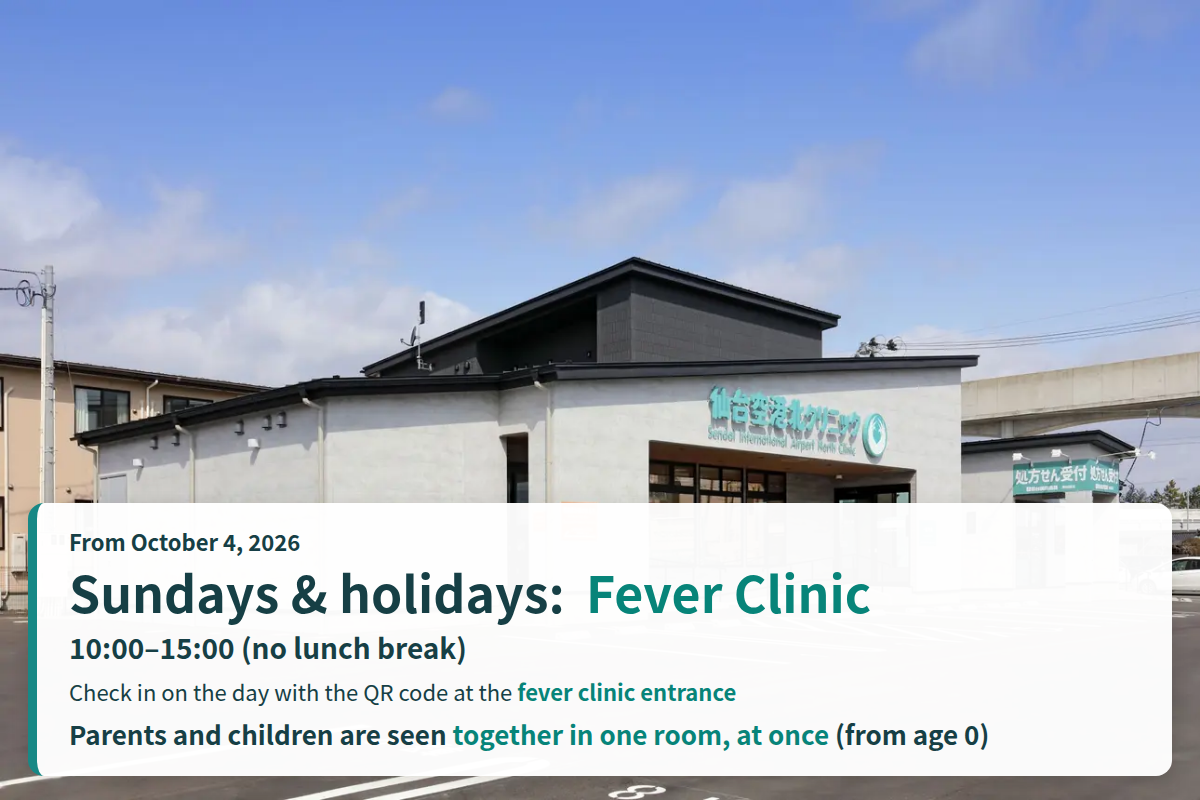
From October 4, 2026, we also run the fever clinic on Sundays and national holidays
10:00 to 15:00 (no lunch break). You check in on the day. We give you the PCR result the same day. On Sundays and holidays we see fever patients only, and we do not offer general outpatient care or IV drips. Please check the clinic calendar for clinic dates and closed days. Notice: fever clinic on Sundays and national holidays
Shunichi Gamo, MD, PhD
Director, Sendai International Airport North Clinic
Born and raised locally, he attended Yuriage Elementary School and Yuriage Junior High School in Natori City. After graduating from Tohoku University School of Medicine, he worked at Sendai Open Hospital and Kesennuma City Hospital, and then at Tohoku University Hospital. In April 2021, in the middle of the COVID-19 pandemic, he opened Sendai International Airport North Clinic. Holding to a fever clinic that never turns patients away, he cared for well over 20,000 patients with fever in the two years before COVID-19 was moved to Class 5 under Japan’s infectious disease law.
Society memberships and board certifications
Certified Member and Board Certified Fellow, Japanese Society of Internal Medicine
Board Certified Pulmonologist, Japanese Respiratory Society
Board Certified Allergist, Japanese Society of Allergology
Board Certified Specialist, Japanese Society of Anti-Aging Medicine
PhD in Medicine (Tohoku University)
In short: Fifth disease spreads before the rash, so pregnant women should call after contact
Erythema infectiosum is an infection in which the typical rash has often not yet appeared when it is most contagious[2]. That is why it spreads to others without anyone noticing.
If you are pregnant and may come into contact with an infected child, remember these three points.
- Order of the rash
Both cheeks turn bright red, and then a lace-like rash appears on the arms and legs[1][2] - When it spreads
During the cold-like stage before the rash. Once the rash appears, it is almost no longer contagious[2][3] - During pregnancy
Pregnant women who have had contact with an infected person are considered candidates for testing[4]. Even without symptoms, talk to your obstetrician early
The third point, “During pregnancy”, is especially important: please talk to your obstetrician even if you have no symptoms. I explain this in detail in the sections below.
 Dr. Gamo
If you wonder, “My older child has it. Am I all right?”, first call your obstetrician. That one call brings peace of mind.
How does fifth disease progress? From the cheeks to a lace-like rash
The typical course is cold-like symptoms, then red cheeks, and then a lace-like rash on the arms and legs[1][2].
According to the detailed JIHS page, some people have early warning symptoms (symptoms that come before the main illness) such as a mild fever or cold-like symptoms, about 7 days after infection. Then, about 10 to 20 days after infection, a clearly outlined red rash appears on both cheeks (butterfly-shaped, the so-called “apple cheeks”)[2]. Next, a rash described as net-like, lace-like or ring-shaped appears on the arms and legs, and it may also appear on the chest, abdomen and back[2].
In most cases, the rash fades in about a week. However, it may last longer, or come back after it has faded[2].
Dr. GamoA rash that has faded can come back. Knowing this helps you stay calm.
The incubation period (the time from infection until symptoms appear) varies between sources. The JIHS overview gives about 10 to 20 days[1], and the guide of the Japan Society of School Health gives 4 to 14 days (sometimes about 21 days)[3]. Either way, there is a period before the rash appears when it can spread[2].
When is it most contagious? Can my child go to school once the rash appears?
It is most contagious during the cold-like stage before the rash appears[2][3]. Human parvovirus B19 spreads mainly through droplet infection (spreading through droplets from coughs and sneezes) and through contact[1].
By the time the rash appears, the virus is no longer being shed, and the child is considered not to be contagious to others[2][3]. So if your child only has the rash and is otherwise well, they can go to nursery or school[2][3][5].
Dr. GamoBy the time the cheeks turn red, the period of passing it on to others is considered to be over.
Erythema infectiosum is not named in the Ordinance for Enforcement of the School Health and Safety Act[6]. The ordinance lists “other infectious diseases” under Category 3 infectious diseases[6], and depending on the circumstances, erythema infectiosum falls under these “other infectious diseases”[1]. The Japan Society of School Health explains that, for these “other infectious diseases”, “suspension from attendance is not always required”[3].
In other words, fifth disease is not listed as a reason for suspension from attendance, and if the rash has appeared and your child is well, they may go to nursery or school[3][5]. When it is going around, it is important for pregnant women to take care not to catch it[3].
The Japan Pediatric Society notes that “more than half of pregnant women have no immunity”. It says that when a case occurs, parents should be informed, and that it is desirable to let pregnant staff who have never had it stay off work until the outbreak ends[5].
What happens when adults or people with hemolytic anemia catch it?
In adults, redness of the face is less likely, and joint pain or arthritis may stand out[2][5]. The detailed JIHS page says that arthritis symptoms can make walking difficult for 1 to 2 days[2].
Dr. GamoWhen adults catch it, joint pain can stand out more than redness of the cheeks.
Adults also often have inapparent infection (infection without symptoms). The detailed JIHS page says about a quarter of cases of this disease are inapparent infections[2], and the Japan Pediatric Society says that in adults more than half are inapparent, so many people do not realize they have been infected[5].
Also, when a person with hemolytic anemia is infected, a severe anemia attack (aplastic crisis) can occur[2]. If you have a chronic condition such as hemolytic anemia, see a doctor early as soon as infection is suspected.
When fever or joint pain is hard to bear, symptom relief such as fever and pain relievers is given[2]. If you are pregnant and want to use a fever reducer, do not decide on your own; check with your obstetrician. If you feel unwell, do not put up with it; see a doctor and ask for advice.
What happens to the baby if a pregnant woman is infected?
If a pregnant woman is infected for the first time, it can lead to fetal hydrops, miscarriage or stillbirth[4][7]. However, the reported figures differ greatly between sources. Here, I present the figures from each source together with their denominator (the group the figure is based on).
| Report | Group studied (denominator) | Main figures |
|---|---|---|
| Japan Pediatric Society, 2025[5] | Pregnant women infected for the first time | Miscarriage or stillbirth 2 to 6%, fetal hydrops 3% |
| Guidelines for Obstetrical Practice in Japan, 2020 edition[4] | Infected pregnant women | Fetal infection 17 to 33%, fetal hydrops 3% |
| IASR (Yamada), 2016[7] | Pregnant women infected for the first time | Fetal infection about 20%; of these, about 20% had fetal anemia or fetal hydrops, about 4% overall |
| Meta-analysis, Xiong 2019[8] | Infected pregnant women | Fetal loss 7.6%, fetal hydrops 9.3% |
| Meta-analysis, Sorrenti 2026[9] | Maternal infection | Intrauterine death 7.3% |
| Meta-analysis, Sorrenti 2026[9] | Cases with confirmed fetal infection | Intrauterine death 38.7% |
| Yamada 2015 (nationwide survey)[10] | Cases with confirmed congenital infection | Fetal death up to 71.0% |
The figures for “risk in pregnancy” differ so much because the groups studied and the denominators are different.
In particular, the high figures in cases with confirmed fetal infection (intrauterine death 38.7%[9], fetal death up to 71.0%[10]) come from counts of babies in whom problems were found, for example by ultrasound. They do not directly show the risk for a pregnant woman who has simply been in contact with a child with fifth disease[9][10].
On the other hand, it is also true that fetal hydrops, miscarriage or stillbirth occurs in a certain proportion of infected pregnant women. A meta-analysis reported fetal loss of 7.6% and fetal hydrops of 9.3% in infected pregnant women[8]. Another meta-analysis found intrauterine death of 7.3% with maternal infection, lower than the 38.7% when fetal infection was confirmed[9].
In the meta-analysis by Xiong and colleagues, the odds (a statistical measure of how strong a link is) of fetal loss compared with uninfected pregnant women were 2.68 (95% confidence interval 2.02 to 3.55)[8]. Odds are not an absolute probability, so care is needed in reading this figure.
Timing also matters. Fetal hydrops almost always develops within 8 weeks of the mother’s infection (median 3 weeks), and after 8 weeks the chance becomes lower[4]. With infection before 20 weeks of pregnancy, 13% end in spontaneous miscarriage or fetal death, while from 20 weeks onward the figure drops sharply to 0.5%[4].
The proportion of pregnant women in Japan who have antibodies varies between sources: 20 to 50% according to IASR[7] and about 46 to 70% according to the detailed JIHS page[2]. Quite a few pregnant women have no immunity. About 30% of cases of fetal hydrops are said to improve on their own[7]. Infection in the first half of pregnancy is reported to be more likely to lead to a serious outcome[2].
No birth defects are said to be known in babies who survive, but because miscarriage, stillbirth and fetal hydrops can occur, infection during pregnancy needs care[2][3].
Dr. GamoThe numbers can be scary, but not every pregnant woman with contact becomes seriously ill. That is why an early check with your obstetrician matters.
What should a pregnant woman do after contact with an infected person?
If you are pregnant and have been in contact with someone who is infected or may be infected, contact your obstetrician early, even if you have no symptoms. The guidelines for obstetrical practice recommend that pregnant women who have had contact with a person who has symptoms of infection, or who is suspected of being infected, be tested[4].
Testing measures IgM antibodies to parvovirus B19 (a blood test value that shows recent infection)[4]. IgM antibody testing is covered by health insurance for people aged 15 or older who have the rash, and for pregnant women[5].
Assuming it takes 10 days for IgM antibodies to become detectable, the guide is to start testing early on, from 10 days after contact onward[4]. Also, when a family member living in the same home falls ill, about 50% of pregnant women without immunity are said to become infected[4].
IASR reported that, among babies with confirmed congenital infection, 54% had a family member with symptoms of erythema infectiosum, and 94% of those family members were children[7]. Pregnant women in a household where an older child has the disease need to be especially careful[7].
When caring for an infected child, it is recommended to wash your hands thoroughly, not share tableware, and wear a mask[2]. The guidelines also recommend that pregnant women with infected people around them wear a mask and wash their hands[4].
Dr. GamoEven while looking after an older child, washing hands and not sharing tableware are steps you can start today.
For pregnant women with confirmed infection, the baby’s condition is watched closely[2]. In obstetric care, ultrasound is used to look for signs such as fetal anemia or fetal hydrops, and a fetal blood transfusion is considered if needed[4]. This care is available from your obstetrician, so get in touch as soon as you notice there has been contact.
Signs that you need help quickly: 119, the emergency department, or the same day
With fifth disease, it is often fine to watch your child at home while they have the rash and are well, but if your child suddenly becomes unwell, do not miss the following signs.
Call 119 right away
If even one of the following is present, call 119 without hesitating, regardless of how severe the rash or fever is. The same applies at night and on holidays.
- Your child does not answer when you call out, or is drowsy and confused
- Your child is having a seizure
- Your child suddenly seems to struggle to breathe, is breathing with heaving shoulders, or has bluish lips
- Your child is choking on food or something else and is in distress
Go to an emergency department the same day, even at night or on a holiday
In the following cases, do not wait until morning; go to an emergency department, even at night or on a holiday. If your child is in distress and cannot be moved, call 119.
- Your child can hardly drink, or has not passed urine for half a day or more
- Your child is limp and responds weakly, or looks pale
- Your child has a chronic condition such as hemolytic anemia and suddenly looks pale or unwell
When to contact your obstetrician
If you are pregnant and have had contact with an infected child or a person suspected of infection, the Guidelines for Obstetrical Practice in Japan also consider you a candidate for testing[4]. Even without symptoms, contact your obstetrician the same day. Even if the child has the rash and is well, I recommend talking to your obstetrician early while you are pregnant.
See a doctor the same day (or the next morning if it is night)
Even if breathing, consciousness and fluid intake are fine, in the following cases do not wait too long; see a doctor.
- The rash or itching is so bad that your child cannot sleep, or your child has lost their appetite
- Joint pain is so strong that it is hard to move[2]
- You are pregnant and have had contact with an infected person (contact your obstetrician even without symptoms)
- A child with a chronic condition such as hemolytic anemia has been infected[2]
- Fifth disease is going around in your family, nursery or school
If you want advice at night or on a holiday, you can also use the children’s emergency advice line in your area (#8000). However, if there are clear danger signs, call 119 directly without calling an advice line first.
Dr. GamoKeeping the #8000 number handy is reassuring when you are unsure at night.
If the rash is hard to bear or you are worried, please do not hold back; talk to a medical facility.
Frequently asked questions
- I am pregnant, and my older child has fifth disease. What should I do?
-
First, contact your obstetrician for advice. During pregnancy, testing (measuring IgM antibodies with a blood test) is recommended once you have had contact with an infected person[4]. When caring for your child, wash your hands thoroughly, do not share tableware, and wear a mask[2][4].
- My child has the rash. Should I keep them home from school or nursery?
-
Once the rash appears, your child is hardly contagious to others, and if they only have the rash and are otherwise well, they can go to nursery or school[2][3][5]. Fifth disease is not one of the illnesses named as a reason for suspension from attendance[3][6]. However, depending on the outbreak, the principal may consult the school physician and suspend attendance, treating it as a Category 3 “other infectious disease”. The suspension then lasts “until a school physician or other doctor confirms, based on the child’s condition, that there is no risk of infection”[3][6].
- How does fifth disease start?
-
Often, early symptoms such as a mild fever or cold-like symptoms are followed by a red rash on both cheeks, and then a lace-like rash on the arms and legs[1][2]. The incubation period varies between sources: about 10 to 20 days, or 4 to 14 days (sometimes about 21 days)[1][3].
- What symptoms do adults get?
-
In adults, redness of the face is less likely, and joint pain or arthritis may stand out[2][5]. Arthritis symptoms can make walking difficult for 1 to 2 days[2]. Infection without symptoms is also common, so people may be infected without noticing[2][5].
- How high is the risk during pregnancy?
-
The figures differ between reports. One report gives miscarriage or stillbirth of 2 to 6% and fetal hydrops of 3% in pregnant women infected for the first time[5], and a meta-analysis gives fetal loss of 7.6% and fetal hydrops of 9.3% in infected pregnant women[8]. The high figures in cases with confirmed fetal infection do not directly show the risk for a pregnant woman who has simply had contact[9][10]. Have your obstetrician check your situation.
- Can you catch it again after having it once?
-
Once infected, you are said to gain lifelong immunity and not to be infected again[2]. However, whether you have antibodies differs from person to person, and the proportion of pregnant women in Japan with antibodies varies between sources: 20 to 50% according to IASR[7] and about 46 to 70% according to the detailed JIHS page[2]. If you are worried, talk to your obstetrician.
Summary: It spreads before the rash, so pregnant women should contact their obstetrician
- Fifth disease (erythema infectiosum) spreads most easily during the cold-like stage before the rash appears, and if a pregnant woman is infected for the first time, there is a risk of fetal hydrops, miscarriage or stillbirth
- Call 119 if your child does not answer when you call out, is having a seizure, or seems to struggle to breathe
- If you are pregnant, contact your obstetrician as soon as you have been in contact with an infected person; a child who only has the rash and is otherwise well can go to school or nursery
- The rates of fetal hydrops, miscarriage and stillbirth differ between reports, and the figures are higher in cases with confirmed fetal infection than for maternal infection[9]
- When caring for an infected child, handwashing, a mask and not sharing tableware are important[2][4]
Fifth disease often spreads among children, but it is most contagious before the rash appears. If your child is well, there is no need to worry more than necessary, but it is an infection that pregnant women should be careful about. If you notice there has been contact, first contact your obstetrician. If your child’s rash is hard to bear or you are worried, please see a doctor. Leave the medical care to us.
That’s all.
Disclaimer
This article is intended to provide general medical information and does not replace an examination, diagnosis, or treatment by a doctor. The content is based on medical knowledge at the time of publication, but the right course of action differs for each person. If you are worried about symptoms, please consult a medical facility.
References
- Japan Institute for Health Security (JIHS). Erythema infectiosum (updated July 24, 2025). Infectious Disease Information website (in Japanese). Accessed October 2026. https://id-info.jihs.go.jp/diseases/ta/5th-disease/index.html
- Japan Institute for Health Security (JIHS). Erythema infectiosum (detailed version) (article updated August 12, 2025). Infectious Disease Information website (in Japanese). Accessed October 2026. https://id-info.jihs.go.jp/infectious-diseases/erythema-infectiosum/detail/index.html
- Japan Society of School Health. Guide to infectious diseases to be prevented in schools (FY2023 revision). Japan Society of School Health website (in Japanese). Accessed October 2026. https://www.gakkohoken.jp/book/ebook/ebook_R050080/data/670/src/670.pdf
- Japan Society of Obstetrics and Gynecology, Japan Association of Obstetricians and Gynecologists. CQ614 How should parvovirus B19 infection (erythema infectiosum, fifth disease) be diagnosed and managed? In: Guidelines for Obstetrical Practice in Japan, Obstetrics 2020. Minds Guideline Library (in Japanese). Accessed October 2026. https://minds.jcqhc.or.jp/common/summary/pdf/c00572.pdf
- Japan Pediatric Society, Committee on Immunization and Infectious Disease Control. Guide to infectious diseases to be prevented in schools, kindergartens, certified centers for early childhood education and care, and nursery schools, April 2025 revision. Japan Pediatric Society website (in Japanese). Accessed October 2026. https://www.jpeds.or.jp/uploads/files/20250430_yobo_kansensho.pdf
- Ministry of Education. Ordinance for Enforcement of the School Health and Safety Act (Ministry of Education Ordinance No. 18 of 1958). e-Gov Law Search (in Japanese). Accessed October 2026. https://laws.e-gov.go.jp/law/333M50000080018
- Yamada H. The current state of mother-to-child human parvovirus B19 infection. IASR. 2016 Jan;37:7-8. Japan Institute for Health Security, Infectious Disease Information website (in Japanese). Accessed October 2026. https://id-info.jihs.go.jp/niid/ja/typhi-m/iasr-reference/6180-dj4314.html
- Xiong YQ, Tan J, Liu YM, He Q, Li L, Zou K, et al. The risk of maternal parvovirus B19 infection during pregnancy on fetal loss and fetal hydrops: A systematic review and meta-analysis. J Clin Virol. 2019 May;114:12-20. doi:10.1016/j.jcv.2019.03.004 PMID: 30897374
- Sorrenti S, Deuster E, D’Antonio F, Di Mascio D, Khalil A. Parvovirus B19 infection in pregnancy: perinatal outcomes derived from a systematic review and meta-analysis. Am J Obstet Gynecol. 2026 Sep;235(3):506-521. doi:10.1016/j.ajog.2026.03.002 PMID: 41819197
- Yamada H, Tairaku S, Morioka I, Sonoyama A, Tanimura K, Deguchi M, et al. Nationwide survey of mother-to-child infections in Japan. J Infect Chemother. 2015 Mar;21(3):161-4. doi:10.1016/j.jiac.2014.10.013 PMID: 25435331
▶ Overview of this topic: Fever clinic on Sundays and national holidays (from October 4, 2026, 10:00 to 15:00)
More articles to read when you have a fever
For fever and fever reducers during pregnancy, see Fever in pregnancy: when to call your obstetrician and safe medicines, and if a rash appears after a fever goes down, see Roseola: First High Fever in a Baby, Rash After the Fever Breaks.