If you are in a hurry
- Infectious gastroenteritis at nursery school is prevented by washing hands with soap and running water, and by cleaning up vomit and diarrhea with a chlorine-based disinfectant (sodium hypochlorite)
- If your child’s consciousness seems abnormal, they are having a seizure, or they seem to be struggling to breathe, call 119 (Japan’s emergency number). If your child cannot drink or has not passed urine for half a day or more, see a doctor, even at night
- Your child can go back to nursery school when “symptoms such as vomiting and diarrhea have settled and they can eat their usual meals.” The virus is still passed in the stool after they return, so keep up handwashing
Hello. I am Shunichi Gamo, MD, PhD, a board-certified pulmonologist and the director of Sendai Airport North Clinic.
When the nursery school sends a notice saying “infectious gastroenteritis is going around,” you may worry that your child will start vomiting or having diarrhea too. Many of you have probably had the experience of the illness spreading to the rest of the family while you were caring for your child.
This is the season when gastroenteritis, with vomiting and diarrhea as the main symptoms, becomes more common. Let us go over once more the points your family should watch out for.
To give you the conclusion first: the core of preventing norovirus and rotavirus outbreaks at nursery school is washing hands with soap and running water, and cleaning up vomit and diarrhea properly. Neither needs any special equipment.
In this article, I explain in turn how gastroenteritis spreads at nursery school, how to clean up vomit and diapers and the right disinfectant strength, tips for stopping it spreading at home, signs of dehydration and when to see a doctor, and when your child can return.
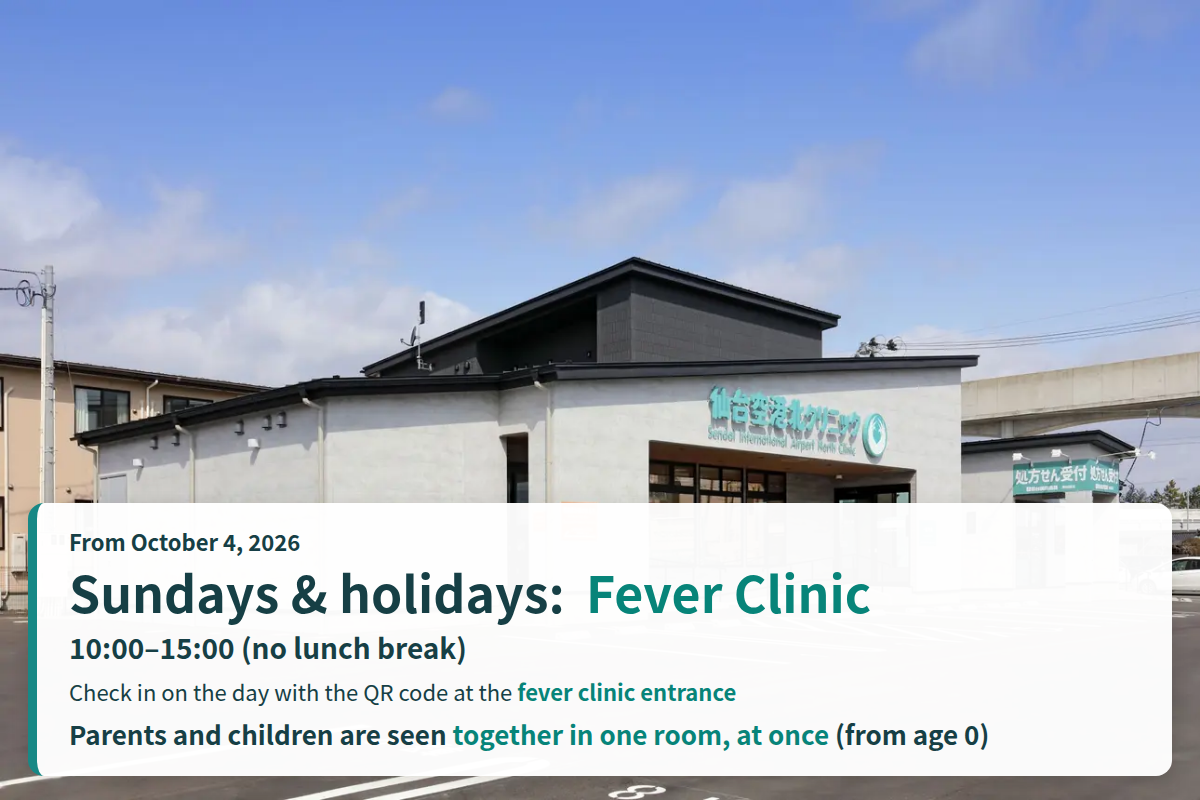
First, a note about our fever clinic on Sundays and national holidays. PCR testing for influenza and COVID (a test that copies the virus’s genetic material in order to detect it) gives results the same day.
From October 4, 2026, we also run the fever clinic on Sundays and national holidays
10:00 to 15:00 (no lunch break). You check in on the day. We give you the PCR result the same day. On Sundays and holidays we see fever patients only, and we do not offer general outpatient care or IV drips. Please check the clinic calendar for clinic dates and closed days. Notice: fever clinic on Sundays and national holidays

Shunichi Gamo, MD, PhD
Director, Sendai International Airport North Clinic
Born and raised locally, he attended Yuriage Elementary School and Yuriage Junior High School in Natori City. After graduating from Tohoku University School of Medicine, he worked at Sendai Open Hospital and Kesennuma City Hospital, and then at Tohoku University Hospital. In April 2021, in the middle of the COVID-19 pandemic, he opened Sendai International Airport North Clinic. Holding to a fever clinic that never turns patients away, he cared for well over 20,000 patients with fever in the two years before COVID-19 was moved to Class 5 under Japan’s infectious disease law.
Society memberships and board certifications
Certified Member and Board Certified Fellow, Japanese Society of Internal Medicine
Board Certified Pulmonologist, Japanese Respiratory Society
Board Certified Allergist, Japanese Society of Allergology
Board Certified Specialist, Japanese Society of Anti-Aging Medicine
PhD in Medicine (Tohoku University)
In short: How can infectious gastroenteritis at nursery school be prevented?
The most important measure for preventing outbreaks at nursery school is keeping hands clean, for example by handwashing[1]. The Children and Families Agency’s guidelines for nursery schools call for washing hands with running water and soap for at least 30 seconds[1].
 Dr. Gamo
Wash hands with soap under running water for 30 seconds or more. This is the most important measure.
The other pillar is cleaning up vomit and diarrhea. These contain large amounts of virus, and if they are not cleaned up properly, an outbreak can follow[1]. Alcohol is not suitable for wiping up vomit; the rule is to use sodium hypochlorite (a chlorine-based disinfectant)[1].
Research has also confirmed the effect of handwashing. A review that combined several studies of handwashing education in childcare facilities and schools found that cases of diarrhea fell by about one third (mainly in trials in high-income countries)[2].
- Handwashing
Soap and running water for at least 30 seconds. Do not share towels; use paper towels[1] - Cleaning up vomit and diarrhea
Wipe it up gently, then disinfect with sodium hypochlorite. Alcohol is not suitable for wiping up vomit[1] - Preventing dehydration
Give fluids a little at a time. If your child cannot drink or has not passed urine for half a day or more, see a doctor[1]
How do norovirus and rotavirus spread at nursery school?
At nursery schools, both norovirus and rotavirus spread through hands and objects that have the virus on them[1]. Hands that have touched stool or vomit, and contaminated toys or handrails, become the route of infection[1].
They are very contagious. Norovirus can infect a person with a tiny amount, 100 particles or fewer, and the vomit or stool of an infected person is said to contain 1 million to 1 billion virus particles per gram[1]. Rotavirus also infects with a small amount, around 10 to 100 particles[1].
If vomit is not cleaned up properly, it can dry, float in the air, and be breathed in, causing airborne infection (droplet nuclei infection)[1]. That is why it is important to clean up vomit promptly, before it dries[1].
| Norovirus | Rotavirus | |
|---|---|---|
| Incubation period | 12 to 48 hours[1] | 1 to 3 days[1] |
| Main symptoms | Vomiting and diarrhea[1] | Vomiting and diarrhea, often white stools[1] |
| Usual course | Most recover in 1 to 3 days[1] | Most recover in 2 to 7 days[1] |
| Severe illness | Can be complicated by dehydration[1] | Some children are admitted to hospital because of worsening dehydration or seizures[1] |
Norovirus spreads in winter when temperatures drop; the incubation period is about 1 to 2 days, and nausea, vomiting, and diarrhea last about 1 to 2 days[3]. Almost all children are infected with rotavirus by about age 5, and they can get ill with it more than once[4].
Rotavirus can cause serious complications such as seizures, encephalitis, and encephalopathy[4]. A seizure is a sign to think about calling 119 immediately.
Dr. GamoThe incubation period is short, so a child who played with yours yesterday may be vomiting today. Check notices from the nursery school early.
How should I clean up vomit and diapers? Sodium hypochlorite strength
First, gently wipe up vomit or diarrhea with paper towels or similar, working from the outside in, and then disinfect with sodium hypochlorite[1][5]. Any dirt left behind makes the disinfectant work less well[1].
When cleaning up, wear disposable gloves, a mask, and an apron, and keep the room ventilated[1][5]. Seal used gloves, cloths, and other items in a plastic bag and throw them away[1][5].
One thing to note here is the strength of the disinfectant. Sources state the strength for places soiled with vomit in different ways. Both are official statements, so I show both.
| Source | Places soiled with vomit or stool | Bag for used paper and other waste |
|---|---|---|
| Nursery school guidelines[1] | Wipe or soak with a 0.1% (1,000 ppm) solution | — |
| Ministry of Health, Labour and Welfare Q&A[5] | Wipe the floor so that it is soaked with a chlorine concentration of about 200 ppm, then wipe with water | Soak in a solution with a chlorine concentration of about 1,000 ppm and seal |
If you dilute the disinfectant yourself, the amount depends on the strength of the product. The nursery school guidelines give the following guide for a product with a strength of about 6%[1].
| Where to use | Strength | Per 1 L of water (for a product of about 6%) |
|---|---|---|
| Floors and objects soiled with vomit or excrement | 0.1% (1,000 ppm) | About 20 mL |
| Soaking clothes, doorknobs, floors, etc. | 0.02% (200 ppm) | About 4 mL |
Before diluting, always check the strength on the label of the product you are using[1]. Chlorine-based disinfectants release toxic chlorine gas when mixed with acidic cleaners. They easily rust metal and cannot be used on hands[1].
Dr. GamoWith chlorine-based disinfectants, please be sure to remember one thing: never mix them with acidic cleaners.
For the details of how to use sodium hypochlorite, the guidelines themselves refer readers to the Ministry of Health, Labour and Welfare Q&A on how to disinfect against norovirus[1].
Is alcohol enough for clean hands? Soap and running water are the basics
Alcohol disinfectant is considered to work poorly against both norovirus and rotavirus. That is why washing hands with soap and running water is the basic approach[3][4].
The Ministry of Health, Labour and Welfare Q&A also explains that soap itself does not directly kill the virus, but it removes fat and other dirt from the hands, which makes the virus easier to wash off[5]. Hand disinfection with alcohol does not replace handwashing with soap and running water[5].
Dr. GamoAlcohol is handy, but it cannot replace handwashing with soap and running water.
In a laboratory experiment testing alcohol-based hand sanitizers, 60% ethanol did not reduce norovirus by even one log (90%). Two commercial products reduced it by two logs or more (over 99%), so products differ[6]. This was a laboratory experiment and does not show the effect on real hands[6].
When you cannot wash your hands with soap right away, you can use alcohol as an aid to handwashing[5]. However, it is only an aid. When you get home and after changing diapers, wash your hands with soap and running water for at least 30 seconds[1][5].
- Before meals, and before making formula or serving food[1]
- After using the toilet and after changing diapers (especially after dealing with stool)[1][5]
- After cleaning up vomit[1][5]
Ideally, do not share towels after handwashing; use paper towels instead[1]. After washing, dry your hands well with a clean towel or a paper towel[1].
How can I keep it from spreading at home?
There are reports of infection spreading at home from a child who caught it at nursery school. In a study of a norovirus outbreak at a childcare center in Australia, the household attack rate (the proportion of people who became infected and fell ill) was 36.5%[7].
In this study, about half of the people with symptoms were infected at the childcare center, and the rest were infected at home[7]. Because infection also happens outside the nursery school, handwashing and cleaning up at home are important too.
If you are caring for your child, always wash your hands after cleaning up vomit or diarrhea[1][5]. If the person caring for the child gets infected, the infection keeps going around the home.
Dr. GamoIt also matters that the caregiver does not catch it. Please remember to wash your hands after cleaning up.
- Diapers
When your child has diarrhea, lay down a disposable sheet before changing; seal used diapers in a plastic bag and then put them in a container with a lid[1] - Towels
Never share towels; use a clean towel for each person or paper towels[1] - Laundry
Gently hand-wash soiled clothes in water with detergent. If you cannot wash them in hot water, disinfecting with sodium hypochlorite is effective[5]
Adults can catch the same gastroenteritis. For fever and diarrhea in adults, please also see our article on fever and diarrhea in adults.
What are the signs of dehydration, and when should we see a doctor? (119 and night-time)
With vomiting and diarrhea, the thing to watch out for most is dehydration. If dehydration progresses while your child cannot drink, it can wear out their strength and they can become seriously ill[5].
First, learn the signs to look for at home. The Children and Families Agency’s guidelines also say to watch for the following[1].
- Vomiting together with diarrhea
- Cannot drink
- Dry lips and tongue
- No urine for half a day or more, or small amounts of dark urine
- Eyes look sunken, the skin has lost its elasticity
If any of the following applies, see a doctor right away[1].
- Vomiting many times, with a poor color[1]
- No energy, limp[1]
- Vomiting blood or something that looks like coffee grounds[1]
- Stools with blood or mucus, or blackish stools[1]
- White, watery stools that look like the water left after rinsing rice[1]
- A seizure[1]
In particular, if your child’s consciousness seems abnormal, they are having a seizure, or they seem to be struggling to breathe, call 119 without hesitation. Material from the Ministry of Health, Labour and Welfare also says “even if you are unsure, call 119” when something is wrong with consciousness, there is a seizure, or breathing is abnormal[8]. The same applies at night and on holidays. If you are unsure what to do, you can also use the children’s emergency advice line (#8000) for your area.
In the following cases, see a doctor early, even at night or on a holiday[8].
- No urine for 12 hours or more, no tears when crying[8]
- Dazed with labored breathing, a dry mouth, and sunken eyes[8]
- Cold fingers and toes, and when you press and release them, the color takes 2 seconds or more to come back[8]
To prevent dehydration, it is recommended to start giving fluids at home early, with oral rehydration solution (a drink that replaces water and electrolytes), once vomiting or diarrhea begins[9]. Give it in small amounts, a little at a time. For details, please also see our article on oral rehydration solution.
If your child refuses oral rehydration solution and will not drink it, other fluids are fine as long as there are no clear signs of dehydration[9]. However, avoid fizzy drinks, store-bought fruit juice, sweetened tea, coffee, and similar drinks[9].
Medicines to stop diarrhea can slow recovery, so do not use them on your own judgment; ask a doctor[5]. When dehydration is severe, an IV drip (intravenous fluids) at a medical facility is needed[1][5]. See a doctor early, and let us decide together what to do.
Dr. GamoThe trick is “no drinks right after vomiting.” Wait about 30 to 60 minutes, and if there is no nausea, start with small sips[1].
When can my child go back to nursery school?
The guide for going back to nursery school is the same for norovirus and rotavirus: “symptoms such as vomiting and diarrhea have settled, and the child can eat their usual meals”[1].
There is no fixed number of days that applies to everyone. Some nursery schools ask for a doctor’s note or a return-to-school form, so follow your nursery school’s rules on when your child can return[1].
Even after symptoms settle, the virus can be passed in the stool for 3 weeks or more[1]. After your child goes back to nursery school, keep washing hands after bowel movements and diaper changes[1].
Dr. GamoEven after symptoms settle, the virus is still in the stool. Please keep washing hands after diaper changes.
The nursery school guidelines say that the week after symptoms disappear is also a period when the infection spreads easily, and that care is needed because the virus is passed for several weeks, even if in smaller amounts[1]. During this time, too, it is important to keep up careful handwashing and diaper handling.
For rotavirus, babies can receive an oral live vaccine as a routine (publicly funded) vaccination[1][4]. For the types of vaccine and the timing, see our article on the rotavirus vaccine.
Frequently asked questions
- Gastroenteritis is going around at the nursery school. Can my child still go?
-
The guide for attending is that symptoms have settled and your child can eat their usual meals. During an outbreak, the nursery school guidelines recommend telling parents to keep a child at home if they vomited the day before[1]. Follow your nursery school’s instructions on whether your child can attend.
- Can I use alcohol to wipe up vomit?
-
Alcohol works poorly against norovirus and rotavirus, so it is not suitable for wiping up vomit or stool[1][3][4]. Use sodium hypochlorite, and disinfect after wiping up the mess[1][5].
- How can I tell at home whether my child is dehydrated?
-
Signs include no urine for half a day or more, dry lips and tongue, and sunken eyes[1]. If your child has not passed urine for 12 hours or more, or has no tears when crying, see a doctor, even at night[8].
- It has spread to the family. How can we stop it spreading further?
-
Whoever is caring for the child should always wash their hands after cleaning up, use separate towels, and seal diapers in a bag before throwing them away[1][5]. One report found a household attack rate of 36.5%, so take care[7].
- Once the symptoms have settled, can my child still pass it on?
-
Even after symptoms settle, the virus can be passed in the stool for 3 weeks or more[1]. After your child goes back to nursery school, keep washing hands after bowel movements and diaper changes[1].
- My child had a seizure. Should I call an ambulance?
-
If your child is having a seizure, call 119 without hesitation. The nursery school guidelines also say that a child who has a seizure needs to see a doctor[1]. The same applies if your child’s consciousness seems abnormal or they seem to be struggling to breathe[8].
Summary: Prevent gastroenteritis at nursery school with handwashing and proper cleanup
- Infectious gastroenteritis at nursery school is prevented by washing hands with soap and running water, and by cleaning up vomit and diarrhea with a chlorine-based disinfectant (sodium hypochlorite)
- If your child’s consciousness seems abnormal, they are having a seizure, or they seem to be struggling to breathe, call 119. If your child cannot drink or has not passed urine for half a day or more, see a doctor, even at night
- Your child can go back to nursery school when “symptoms such as vomiting and diarrhea have settled and they can eat their usual meals.” The virus is still passed in the stool after they return, so keep up handwashing
- For places soiled with vomit, the nursery school guidelines give a strength of 0.1% (1,000 ppm), while the Ministry of Health, Labour and Welfare Q&A gives about 200 ppm for wiping
- To prevent dehydration, start giving fluids early once vomiting or diarrhea begins, and see a doctor if your child cannot drink or is limp
Careful handwashing and cleanup are the surest way to protect your child and your family. If you notice any worrying changes, please do not hesitate to consult us. Leave the medical care to us.
That’s all.
Disclaimer
This article is intended to provide general medical information and does not replace an examination, diagnosis, or treatment by a doctor. The content is based on medical knowledge at the time of publication, but the right course of action differs for each person. If you are worried about symptoms, please consult a medical facility.
References
- Children and Families Agency. Guidelines for infection control in nursery schools (2018 revised edition) (partially revised May 2023 [Reiwa 5], partially corrected October 2023) [PDF]. Children and Families Agency website (in Japanese). Accessed October 2026. https://www.cfa.go.jp/assets/contents/node/basic_page/field_ref_resources/e4b817c9-5282-4ccc-b0d5-ce15d7b5018c/cd6e454e/20231010_policies_hoiku_25.pdf
- Ejemot-Nwadiaro RI, Ehiri JE, Arikpo D, Meremikwu MM, Critchley JA. Hand-washing promotion for preventing diarrhoea. Cochrane Database Syst Rev. 2021 Jan;12(1):CD004265. doi:10.1002/14651858.CD004265.pub4 PMID: 33539552
- Japan Institute for Health Security (JIHS). Norovirus infection (updated October 23, 2025). Infectious Diseases Information website (in Japanese). Accessed October 2026. https://id-info.jihs.go.jp/diseases/na/norovirus/index.html
- Japan Institute for Health Security (JIHS). Infectious gastroenteritis caused by rotavirus (updated September 25, 2025). Infectious Diseases Information website (in Japanese). Accessed October 2026. https://id-info.jihs.go.jp/diseases/ra/rotavirus/index.html
- Ministry of Health, Labour and Welfare. Q&A on norovirus (prepared February 4, 2004 [Heisei 16]; last revised November 19, 2021 [Reiwa 3]). Ministry of Health, Labour and Welfare website (in Japanese). Accessed October 2026. https://www.mhlw.go.jp/stf/seisakunitsuite/bunya/kenkou_iryou/shokuhin/syokuchu/kanren/yobou/040204-1.html
- Escudero-Abarca BI, Goulter RM, Arbogast JW, Leslie RA, Green K, Jaykus LA. Efficacy of alcohol-based hand sanitizers against human norovirus using RNase-RT-qPCR with validation by human intestinal enteroid replication. Lett Appl Microbiol. 2020 Dec;71(6):605-610. doi:10.1111/lam.13393 PMID: 32964478
- Smoll NR, Khan A, Walker J, McMahon J, Kirk M, Khandaker G. A norovirus gastroenteritis outbreak in an Australian child-care center: A household-level analysis. PLoS One. 2021 Nov;16(11):e0259145. doi:10.1371/journal.pone.0259145 PMID: 34727123
- Ministry of Health, Labour and Welfare, “Smart Use of Medical Care” Project. Smart use of medical care: (1) Points for checking your child’s health (2) When emergency care is needed (3) Main symptoms and how to use emergency care (4) Emergency advice lines (5) Accidents in children [PDF slide]. kakarikata.mhlw.go.jp (in Japanese). Accessed October 2026. https://kakarikata.mhlw.go.jp/assets/pdf/slide.pdf
- Japanese Society of Emergency Pediatrics, Clinical Practice Guideline Committee, eds. Evidence-based guidelines for pediatric abdominal emergencies 2017, Part I: Clinical practice guideline for acute gastroenteritis in children [PDF]. Tokyo: Japanese Society of Emergency Pediatrics; 2017 (listed in the Minds Guideline Library) (in Japanese). Accessed October 2026. https://minds.jcqhc.or.jp/common/summary/pdf/c00577.pdf
▶ Overview of this topic: Fever clinic on Sundays and national holidays (from October 4, 2026, 10:00 to 15:00)
Related articles
For how to give fluids during vomiting or diarrhea, see our article on oral rehydration solution; for the rotavirus vaccine, see our article on the rotavirus vaccine; and if an adult catches it, see our article on fever and diarrhea in adults.