If you are in a hurry
- In Japan there is no single fixed standard for when a child with repeated tonsillitis should have surgery. Keep a record of how many times your child has had fever and throat symptoms, and decide together with an ENT (ear, nose, and throat) specialist
- If your child is having a seizure, does not respond when you call them, or suddenly has trouble breathing, call 119 (Japan’s emergency number)
- If your child cannot swallow their saliva, has trouble opening their mouth, or has a sore throat so bad they cannot eat, see a doctor the same day. It could be a peritonsillar abscess
Hello. I am Shunichi Gamo, MD, PhD, a board-certified pulmonologist and the director of Sendai Airport North Clinic.
When your child keeps getting tonsillitis, you worry: “Will this go on forever?” “Should we be thinking about surgery?” With a high fever and a very sore throat, your child cannot eat, and the parents caring for them become worn out too.
To give you the conclusion first: in Japan, there is no single fixed number of episodes that decides when a child with repeated tonsillitis should have surgery. There are several guides to the number of episodes, and they differ slightly from source to source[1]. What matters is keeping a record of how many times your child has had fever and throat symptoms, and deciding together with an ENT specialist.
In this article, I compare the main standards for the number of episodes side by side and explain, as a pulmonologist, the difference between strep and viruses, how much surgery helps and its risks, and the signs that mean you should see a doctor quickly.
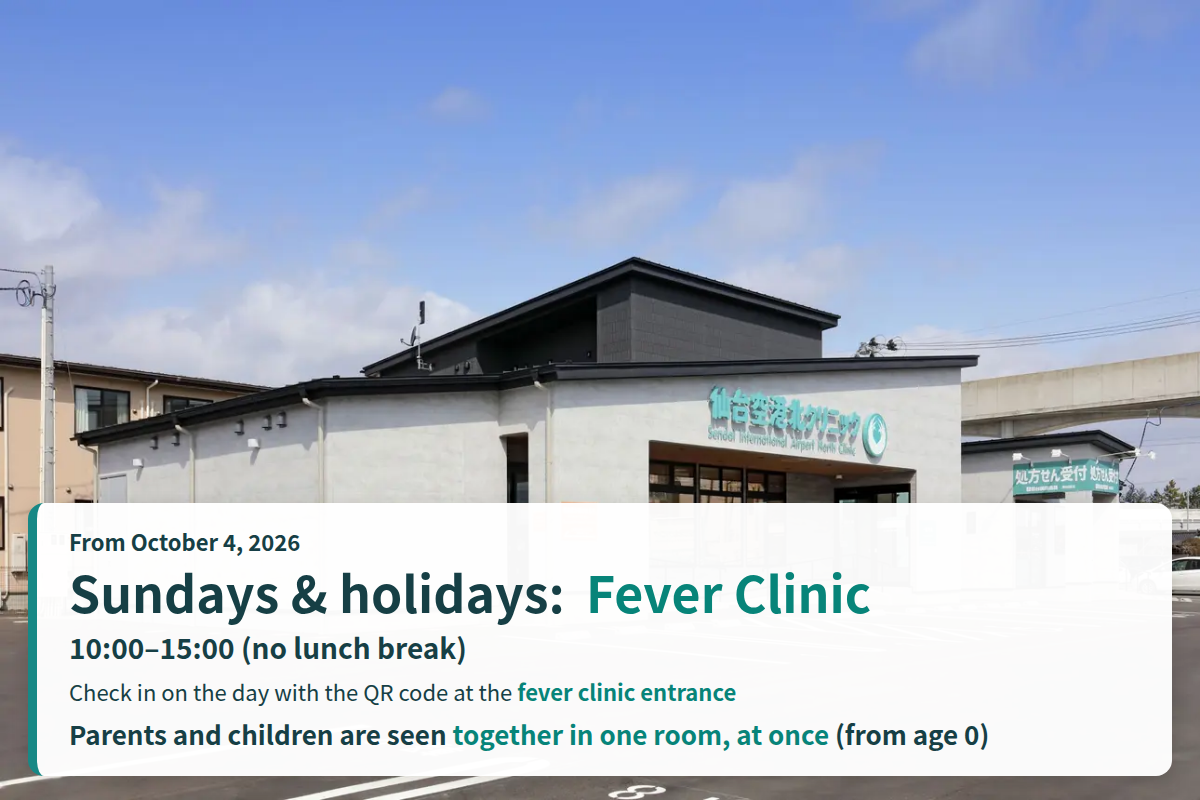
First, a note about our fever clinic on Sundays and national holidays. PCR testing for influenza and COVID (a test that copies the virus’s genetic material in order to detect it) gives results the same day.
From October 4, 2026, we also run the fever clinic on Sundays and national holidays
10:00 to 15:00 (no lunch break). You check in on the day. We give you the PCR result the same day. On Sundays and holidays we see fever patients only, and we do not offer general outpatient care or IV drips. Please check the clinic calendar for clinic dates and closed days. Notice: fever clinic on Sundays and national holidays
Shunichi Gamo, MD, PhD
Director, Sendai International Airport North Clinic
Born and raised locally, he attended Yuriage Elementary School and Yuriage Junior High School in Natori City. After graduating from Tohoku University School of Medicine, he worked at Sendai Open Hospital and Kesennuma City Hospital, and then at Tohoku University Hospital. In April 2021, in the middle of the COVID-19 pandemic, he opened Sendai International Airport North Clinic. Holding to a fever clinic that never turns patients away, he cared for well over 20,000 patients with fever in the two years before COVID-19 was moved to Class 5 under Japan’s infectious disease law.
Society memberships and board certifications
Certified Member and Board Certified Fellow, Japanese Society of Internal Medicine
Board Certified Pulmonologist, Japanese Respiratory Society
Board Certified Allergist, Japanese Society of Allergology
Board Certified Specialist, Japanese Society of Anti-Aging Medicine
PhD in Medicine (Tohoku University)
In short: Is there one fixed rule for surgery when tonsillitis keeps coming back?
In short, whether a child with repeated tonsillitis should have surgery (tonsillectomy) is decided together with an ENT specialist, using the guides to the number of episodes as a reference and also taking into account how severe the symptoms are and how much they disrupt daily life[1].
- Number of episodes
There are several guides. The Paradise criteria, a review in the journal of the Japanese ENT society, and the society’s Q&A for the public each differ slightly[1][2][3] - What the symptoms were
Fever of 38.3°C or higher, swollen lymph nodes in the neck, a white coating on the tonsils, and whether strep was positive are the points used to decide[1][2] - Record and consult
Recording the date each episode started, the temperature, and the diagnosis at each visit makes the discussion with the specialist easier[2]
In other words, rather than a blanket rule of “surgery after so many episodes,” the number of episodes and the severity of the symptoms are considered together.
 Dr. Gamo
Because it is not decided by the number of episodes alone, it is fine to think it through with a specialist when you are unsure.
How many times counts as “repeated tonsillitis”? The standards differ by source
The main guides to the number of episodes for surgery in children with repeated tonsillitis are listed below. Each differs slightly, and there is no single fixed standard in Japan[1][3].
| Standard (source) | Guide to the number of episodes | Also required |
|---|---|---|
| Paradise criteria (based on a 1984 study; adopted in guidelines such as the 2019 US guideline)[1][2][4] | 7 or more in 1 year / 5 or more a year for 2 years in a row / 3 or more a year for 3 years in a row | Each episode with at least one of: fever of 38.3°C or higher, swollen lymph nodes in the neck, a white coating on the tonsils (exudative tonsillitis), or a positive strep test[1][2] |
| Review in the journal of the Japanese ENT society, main text (2016)[1] | 3 to 4 times a year, or 5 to 6 times or more in 2 years (as a guide) | The figures differ between the main text and the table |
| Table 2 of the same review (Japan)[1] | 4 to 5 times or more a year, 5 to 6 times or more in 2 years, or a tonsillitis index (TI) of 8 or more | Presented as “other reports exist” |
| The society’s Q&A for the public (2022)[3] | Fever 4 to 5 times a year over the past 1 to 2 years | Also when the tonsils are large and make breathing difficult, or when the fever does not come down easily with antibiotics |
The Paradise criteria are originally based on a study reported in 1984[4]. These criteria were adopted in guidelines in the UK (2002), the US (2011), and elsewhere, but not every Western country has adopted them, and there is no worldwide standard[1].
Dr. GamoEven within the same review, the main text says “3 to 4 times a year,” while Table 2 says “4 to 5 times a year.” That is how hard it is to draw a line by the number of episodes alone.
Look at what each episode was like, not just the number
Besides the number of episodes, doctors also look at what symptoms each one had. Under the Paradise criteria, each episode must include a sore throat plus at least one of the following: fever of 38.3°C or higher, swollen lymph nodes in the neck (tender, or 2 cm or larger), exudative tonsillitis (a white coating on the tonsils), or strep found on a culture[1][2]. The US guideline also asks for a record of each episode[2].
The idea of a tonsillitis index (TI)
A simple measure calculated as the number of episodes per year × the number of years is called the tonsillitis index (TI), and when it is 8 or more (for example, 4 a year × 2 years), tonsillitis is said to be unlikely to settle on its own[1]. However, this was introduced in the 2016 review, citing textbooks and other literature, and it is not a national standard[1].
How are strep and viruses different? Testing and antibiotics
A sore throat with fever is often caused by a virus, but it can also be caused by strep (group A beta-hemolytic streptococcus, GAS), and telling them apart shapes the treatment. The diagnosis is made by combining the examination findings with the results of a rapid antigen test (a test using a throat swab) or a culture[5].
| Features of strep (GAS) pharyngitis[5] | Features of viral pharyngitis[5] |
|---|---|
| Sudden onset, fever, headache, nausea and vomiting, tummy pain, tender swollen lymph nodes at the front of the neck, a scarlet fever-like rash | Conjunctivitis, cough, hoarse voice, runny nose, muscle aches, diarrhea |
In a Japanese report, 16.3% of children diagnosed with acute pharyngitis were strep-positive (27% in studies from other countries)[5]. Acute pharyngitis caused by strep is most common between ages 5 and 12 and is rare under age 3[5]. Also, 10 to 30% of children without symptoms can carry strep, so not every strep found is the cause of the illness[5].
Now, how we think about antibiotics. When strep is detected, your child takes an antibiotic (such as amoxicillin) and finishes the whole course as prescribed[5]. It needs to be taken for a set period even after the sore throat goes away, and this is explained as preventing complications such as rheumatic fever and kidney inflammation[3]. When a virus is the cause, treatment focuses on easing the symptoms[5].
Dr. GamoEven after the sore throat is gone, please finish all of the antibiotics you were given.
With strep, the guide for going back to nursery school is “24 to 48 hours after starting the antibiotic”[6]. If throat symptoms continue, please also see our article on strep testing and our article on kidney inflammation after strep.
How much does a tonsillectomy help? Benefits and risks
Benefits of surgery have been reported, but the effect has been summarized as only modest when looked at one year after surgery, so it is weighed against the risks[7].
A 2014 Cochrane review (a study that combines several clinical trials) looked at 5 trials in children with 987 participants. In the year after surgery, children who had surgery had 3 episodes on average (1 of which occurred right after the operation), compared with 3.6 in those who did not, a difference of 0.6 episodes[7]. Days with a sore throat were 18 versus 23 (a difference of 5.1 days) in children with moderate symptoms. The 18 days in the surgery group include the 5 to 7 days right after the operation[7]. On the other hand, in children who were severely affected to begin with, the number of moderate to severe sore throat episodes was 1.1 versus 1.2, with no significant difference (low-quality evidence). Even so, the authors concluded that the more severely affected a child is, the more likely they are to benefit[7].
- Benefits
In the year after surgery, the number of sore throat episodes and days goes down. More severely affected children can expect more benefit[7] - Risks
A recent meta-analysis (an analysis combining several observational studies) reported bleeding after surgery in about 3%. However, results varied very widely between studies, so treat this figure as a rough guide[8] - Older report
In the 1984 study, 13 of the 95 children who had surgery (14%) had complications related to surgery, all of which could be dealt with right away or settled on their own[4]
Parents often worry that removing the tonsils will weaken the immune system, but the society explains that “there is almost no difference in immunity whether or not a child has tonsils”[3]. The 2016 review also says that temporary changes in immune markers are seen, but they are not a clinical problem[1]. It has also been pointed out that ENT doctors regard bleeding after surgery as a particularly important complication[1].
Dr. GamoThe worry that removing the tonsils weakens immunity is very understandable. Please feel free to ask about anything on your mind.
Is surgery decided by the number of episodes alone?
Even if the number of tonsillitis episodes does not reach the standard, some factors make surgery more worth considering[2]. They include the following.
- An allergy to antibiotics that makes taking them difficult[1][2]
- Severe tonsillitis with whole-body symptoms[1]
- Special conditions such as PFAPA (periodic fever, aphthous mouth ulcers, pharyngitis and tonsillitis)[1][2]
- Repeated peritonsillar abscesses[1][2]
- Tonsils that are large in themselves, so that breathing becomes difficult with each bout of tonsillitis[3]
Snoring and sleep apnea are a separate reason for tonsillectomy[1][2][3]. The detailed criteria for sleep apnea are considered separately from the standards for the number of episodes covered in this article[1][2].
Dr. GamoSnoring and how your child breathes while asleep are also information we would like you to share when asking for advice.
Signs to see a doctor quickly: cannot swallow saliva, cannot open the mouth
Being unable to swallow saliva, having trouble opening the mouth, or a sore throat so bad your child cannot eat may be signs of a serious illness such as a peritonsillar abscess[9].
Dr. GamoDifficulty opening the mouth or swallowing saliva are changes we do not want you to miss.
First, if even one of the following applies, call 119 without hesitation, however high or low the fever is. The same applies at night and on holidays.
- Having a seizure
- Does not respond when you call them, or is drowsy and confused
- Suddenly has trouble breathing, is heaving the shoulders to breathe, or has purplish lips
- Noticeable noisy breathing when breathing in (stridor), breathing in an unusual posture, or drooling that does not stop[5]
Beyond that, in the following cases, do not wait until morning; go to a medical facility with an ENT department the same day.
- Swallowing saliva is very painful, or your child cannot swallow it[9]
- Trouble opening the mouth, and the ear also seems to hurt[9]
- A sore throat so bad your child cannot eat[9]
A peritonsillar abscess is a collection of pus around the tonsil. The swelling is cut open to drain the pus, antibiotics are given by drip or by mouth, and a hospital stay is often needed[9]. If your child has these signs, please also see our article on peritonsillar abscess.
If you are unsure about surgery, what should you record and whom should you ask?
If you are unsure whether your child should have surgery, first keep a record of how many times they have had fever and throat symptoms, and consult an ENT specialist[1][2][9].
When keeping a record, it helps to note the following points[1][2].
- The date the illness started
- The highest temperature
- The diagnosis at the visit (whether strep was positive)[2]
- Whether your child took antibiotics, and how things went afterwards[3]
If you think it might be tonsillitis, don’t put up with it; please consult an ENT doctor[9]. The decision about surgery is made step by step together with an ENT specialist.
Dr. GamoJust by recording “how many times it happened,” parents make the discussion with the specialist much more concrete.
Frequently asked questions
- How many times a year does tonsillitis need to come back before surgery is considered?
-
There is no single fixed standard. It differs by source: the Paradise criteria use 7 or more in 1 year among other thresholds, the review in the journal of the Japanese ENT society uses 3 to 4 times a year (4 to 5 times in its table), and the society’s Q&A for the public uses 4 to 5 times a year over the past 1 to 2 years[1][2][3]. The number is only a guide, so the decision is made with an ENT specialist based on your records.
- If strep is the cause, is surgery more likely?
-
Surgery is not decided only by whether it is strep. Under the Paradise criteria, a positive strep test counts as one of the findings for each episode[1][2]. For treatment, whether it is strep affects what is done, separately from the number of episodes. When strep is detected, it is important to finish the whole course of antibiotics as prescribed[5]. It needs to be taken for a set period even after the sore throat goes away, in order to prevent complications such as rheumatic fever and kidney inflammation[3].
- Will removing the tonsils weaken my child’s immune system?
-
The society explains that “there is almost no difference in immunity whether or not a child has tonsils”[3]. The review also says that temporary changes in immune markers are seen, but they are not a clinical problem[1].
- Will surgery get rid of the sore throats?
-
Surgery prevents “tonsillitis,” but its effect on sore throats in general is said to be hard to predict[7]. The effect one year after surgery is described as only modest, and more severely affected children are reported to be more likely to benefit[7]. The decision is made with a specialist, weighing the benefits and the risks.
- My child has trouble opening their mouth and cannot swallow saliva. What should I do?
-
This may be a serious illness such as a peritonsillar abscess. Go to a medical facility with an ENT department the same day[9]. Drooling that does not stop, or noticeable noisy breathing when breathing in or an unusual posture, is said to carry a risk of choking within a short time[5]. In these cases, or if your child is having a seizure, does not respond when you call them, or suddenly has trouble breathing, call 119 without hesitation.
- Can my child be seen for a fever on Sundays and national holidays?
-
Yes. We also run the fever clinic on Sundays and national holidays from 10:00 to 15:00 (no lunch break). You check in on the day. Please check the calendar for open days. On Sundays and holidays we do not offer general outpatient care or IV drips.
Summary: Record the number of episodes and the symptoms, and consult a specialist
- In Japan there is no single fixed standard for when a child with repeated tonsillitis should have surgery. Keep a record of how many times your child has had fever and throat symptoms, and decide together with an ENT specialist
- If your child is having a seizure, does not respond when you call them, or suddenly has trouble breathing, call 119
- If your child cannot swallow their saliva, has trouble opening their mouth, or has a sore throat so bad they cannot eat, see a doctor the same day. It could be a peritonsillar abscess
- The guides to the number of episodes differ between the Paradise criteria (7 in 1 year, among others), the Japanese ENT society journal review (3 to 4 a year, among others), and the society’s Q&A (4 to 5 a year over 1 to 2 years)[1][2][3]
- The effect of surgery is only modest one year after the operation, but more severely affected children can expect more benefit. Discuss the balance with risks such as bleeding with a specialist[7][8]
Whether a child with repeated tonsillitis should have surgery cannot be decided by the number of episodes alone. Let us think it through together with an ENT specialist, based on your records. Leave the medical care to us.
That’s all.
Disclaimer
This article is intended to provide general medical information and does not replace an examination, diagnosis, or treatment by a doctor. The content is based on medical knowledge at the time of publication, but the right course of action differs for each person. If you are worried about symptoms, please consult a medical facility.
References
- Himi T, Takano K, Kamekura R, Yamashita K, Ogasawara N, Tsubomatsu C. Basic knowledge of the tonsils and adenoids and problems related to surgical treatment [Morning Seminar, 116th Annual Meeting of the Oto-Rhino-Laryngological Society of Japan]. Journal of the Oto-Rhino-Laryngological Society of Japan (Nippon Jibiinkoka Gakkai Kaiho) (in Japanese). 2016;119(5):701-712. Accessed October 2026. https://www.jstage.jst.go.jp/article/jibiinkoka/119/5/119_701/_pdf
- Mitchell RB, Archer SM, Ishman SL, Rosenfeld RM, Coles S, Finestone SA, et al. Clinical Practice Guideline: Tonsillectomy in Children (Update). Otolaryngol Head Neck Surg. 2019 Feb;160(1_suppl):S1-S42. doi:10.1177/0194599818801757 PMID: 30798778
- Japan Society of Otorhinolaryngology-Head and Neck Surgery. Chronic tonsillitis. Ear, nose and throat diseases in children. Japan Society of Otorhinolaryngology-Head and Neck Surgery website (in Japanese). Accessed October 2026. https://www.jibika.or.jp/modules/disease_kids/index.php?content_id=21
- Paradise JL, Bluestone CD, Bachman RZ, Colborn DK, Bernard BS, Taylor FH, et al. Efficacy of tonsillectomy for recurrent throat infection in severely affected children. Results of parallel randomized and nonrandomized clinical trials. N Engl J Med. 1984 Mar;310(11):674-83. doi:10.1056/NEJM198403153101102 PMID: 6700642
- Ministry of Health, Labour and Welfare, Health and Public Health Bureau, Infectious Disease Control Department, Infectious Disease Control Division. Manual of antimicrobial stewardship, 4th edition: outpatient medical care. Ministry of Health, Labour and Welfare website (in Japanese). Accessed October 2026. https://www.mhlw.go.jp/content/10900000/001630903.pdf
- Children and Families Agency. Guidelines for infection control in nursery schools (2018 revised edition) (partially revised 2023), Table 9. Children and Families Agency website (in Japanese). Accessed October 2026. https://www.cfa.go.jp/assets/contents/node/basic_page/field_ref_resources/e4b817c9-5282-4ccc-b0d5-ce15d7b5018c/cd6e454e/20231010_policies_hoiku_25.pdf
- Burton MJ, Glasziou PP, Chong LY, Venekamp RP. Tonsillectomy or adenotonsillectomy versus non-surgical treatment for chronic/recurrent acute tonsillitis. Cochrane Database Syst Rev. 2014 Nov;2014(11):CD001802. doi:10.1002/14651858.CD001802.pub3 PMID: 25407135
- Zhang X, Deng Q, Yang L, Yan M. Incidence and risk factors of pediatric post-tonsillectomy hemorrhage: a systematic review and meta-analysis. BMC Pediatr. 2026 Jul;26(1):1013. doi:10.1186/s12887-026-07353-w PMID: 42477597
- Japan Society of Otorhinolaryngology-Head and Neck Surgery. Diseases of the mouth and throat (acute tonsillitis / peritonsillar abscess). Japan Society of Otorhinolaryngology-Head and Neck Surgery website (in Japanese). Accessed October 2026. https://www.jibika.or.jp/modules/disease/index.php?content_id=22
More articles to read about tonsillitis
If throat symptoms continue, please also see these articles.