If you are in a hurry
- BCG is a routine (publicly funded) vaccination given before the first birthday, usually at 5 to 8 months of age. It prevents severe tuberculosis in children
- If your child is having a seizure, is unconscious, suddenly has trouble breathing, or may be having anaphylaxis, call 119 (Japan’s emergency number)
- If the vaccination site reacts earlier and more strongly than usual (the Koch phenomenon), contact the medical facility that gave the vaccine within 2 to 3 days
Hello. I am Shunichi Gamo, MD, PhD, a board-certified pulmonologist and the director of Sendai Airport North Clinic.
After a baby’s BCG vaccination, parents sometimes come to us worried, “Is it all right to leave it like this?” when the arm turns red and swollen or starts to ooze pus.
To give you the answer first: redness and pus at the vaccination site are usually part of the normal course, and if you know the timing and what to look for, you can handle it calmly. However, if you notice a worrying change, such as the Koch phenomenon, in which the reaction appears earlier and more strongly than usual, contact the medical facility that gave the vaccine.
In this article, I explain as a respiratory specialist when BCG is given and how the vaccination site changes. I also cover the Koch phenomenon, swollen lymph nodes in the armpit, and the signs that mean you should seek care urgently.
First, a note about our fever clinic on Sundays and national holidays. PCR testing for influenza and COVID (a test that copies the virus’s genetic material in order to detect it) gives results the same day.
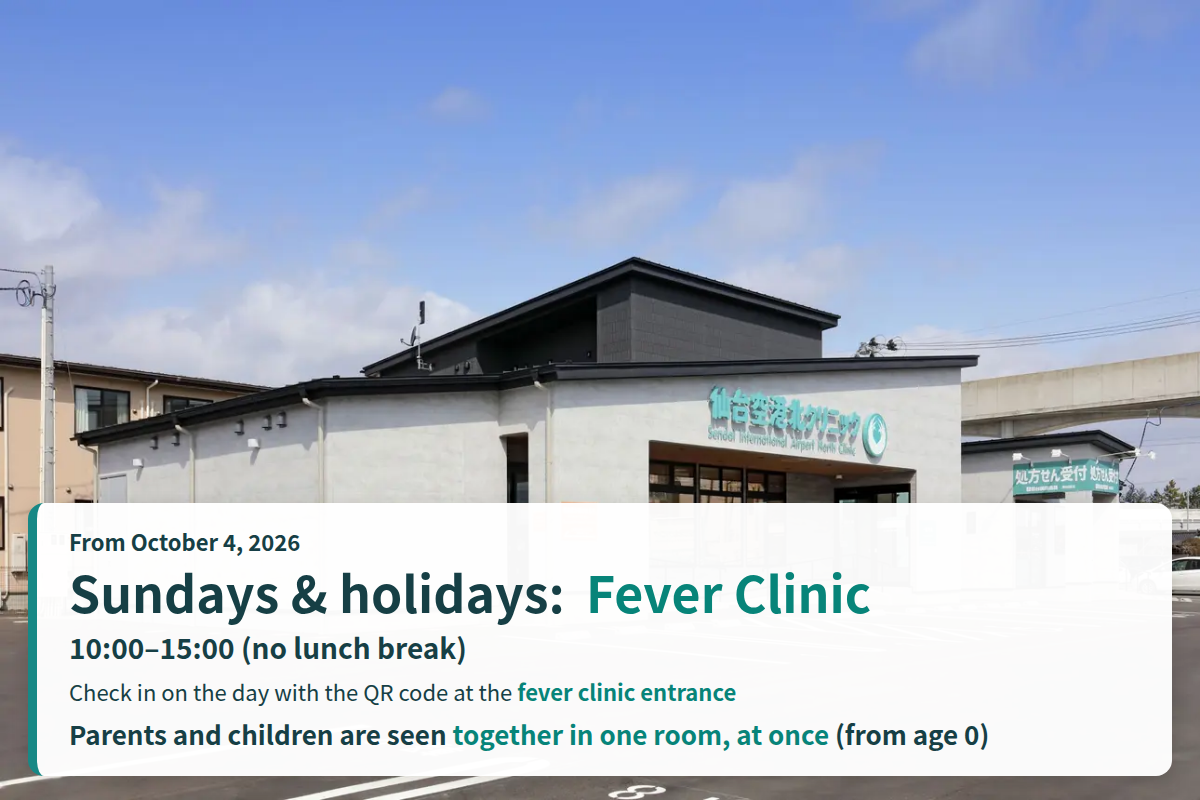
From October 4, 2026, we also run the fever clinic on Sundays and national holidays
10:00 to 15:00 (no lunch break). You check in on the day. We give you the PCR result the same day. On Sundays and holidays we see fever patients only, and we do not offer general outpatient care or IV drips. Please check the clinic calendar for clinic dates and closed days. Notice: fever clinic on Sundays and national holidays
Shunichi Gamo, MD, PhD
Director, Sendai International Airport North Clinic
Born and raised locally, he attended Yuriage Elementary School and Yuriage Junior High School in Natori City. After graduating from Tohoku University School of Medicine, he worked at Sendai Open Hospital and Kesennuma City Hospital, and then at Tohoku University Hospital. In April 2021, in the middle of the COVID-19 pandemic, he opened Sendai International Airport North Clinic. Holding to a fever clinic that never turns patients away, he cared for well over 20,000 patients with fever in the two years before COVID-19 was moved to Class 5 under Japan’s infectious disease law.
Society memberships and board certifications
Certified Member and Board Certified Fellow, Japanese Society of Internal Medicine
Board Certified Pulmonologist, Japanese Respiratory Society
Board Certified Allergist, Japanese Society of Allergology
Board Certified Specialist, Japanese Society of Anti-Aging Medicine
PhD in Medicine (Tohoku University)
Is tuberculosis still found in Japan? How many children get it?
Tuberculosis is still present in Japan, and in 2025, 9,899 people were newly registered as tuberculosis patients[1].
The tuberculosis incidence rate (the number of patients per 100,000 people) that year was 8.0, remaining at or below 10.0, the level of a low-incidence country[1]. There were 31 cases of tuberculosis in children aged 0 to 14, and in 2025 there were no cases of severe childhood tuberculosis such as miliary tuberculosis or tuberculous meningitis[1].
Childhood tuberculosis is said to occur in fewer than 100 children a year, and most cases are found through screening of contacts of adult patients[2]. Most tuberculosis patients are older people, but it is not uncommon for adults to pass it on to children[3].
Babies have little resistance to tuberculosis, and they may develop tuberculosis throughout the body or tuberculous meningitis and be left with serious lasting effects[3]. That is why it is important to give BCG in infancy and early childhood to prevent severe tuberculosis.
 Dr. Gamo
Tuberculosis may seem a thing of the past, but about 10,000 people are still newly registered each year[1]. Vaccinating your baby truly matters.
When is BCG given? What is the routine vaccination schedule?
As a routine vaccination against tuberculosis, BCG is for children up to their first birthday[4].
The standard time for vaccination is between 5 and 8 months of age[5].
Depending on local circumstances, it may be given earlier (from 3 months of age)[3]. For the exact schedule, follow the guidance from the vaccination section of your city, town, or village office[5].
Dr. GamoSchedules differ by area, so checking the guidance from your city, town or village gives peace of mind.
| Item | Details |
|---|---|
| Eligible by law | Children up to their first birthday[4] |
| Standard timing | 5 to 8 months of age[5] |
| In some areas | May be given earlier, for example from 3 months of age[3] |
| If delayed by long-term medical treatment or similar | Within 2 years from the day the reason no longer applies, until the child turns 4[3][6] |
Routine vaccinations are run by each municipality[5]. Our clinic focuses on internal medicine and respiratory medicine, and we do not give BCG. For vaccination dates and venues, please contact the vaccination section of your city, town, or village office[5].
How effective is BCG?
BCG has been reported to prevent about 50% of tuberculosis cases and about 64 to 78% of severe meningitis and tuberculosis throughout the body[5].
A review of randomized controlled trials from other countries reported that the risk of tuberculous meningitis and miliary tuberculosis in vaccinated infants, compared with unvaccinated infants, had a rate ratio of 0.1 (95% confidence interval 0.01 to 0.77)[7].
In another review, after exposure to tuberculosis (contact that gave a chance of infection), vaccinated children had a 19% lower risk of infection (risk ratio 0.81, 95% confidence interval 0.71 to 0.92). Limited to 6 studies, the risk of active tuberculosis was 71% lower (risk ratio 0.29, 95% confidence interval 0.15 to 0.58)[8]. Progression from infection to disease was also 58% lower[8].
These studies measured different things (infection or disease), so the numbers cannot simply be compared. All of them show that BCG protects babies and young children against tuberculosis, and especially against severe tuberculosis.
Dr. GamoThe numbers come from studies with different aims, so they cannot simply be compared.
How do the needle marks change after vaccination? The normal course of the reaction
In most cases, as a normal reaction, the BCG vaccination site turns red and swollen, forms pus, and then scabs over[3][5].
According to the Ministry of Health, Labour and Welfare, redness and hardening (a firm lump) appear at the needle marks about 2 weeks after vaccination and then form pus and scabs. The reaction is strongest around 5 to 6 weeks after vaccination[5].
The leaflet from Japan BCG Laboratory (supervised by the Japan Anti-Tuberculosis Association) says that red spots appear around 10 days after vaccination, with small amounts of pus in some of them. The reaction is strongest around 4 to 6 weeks, and it heals by around 3 to 4 months, leaving a small scar[3].
| Timing | Changes at the vaccination site |
|---|---|
| Around 10 days after vaccination | Red spots appear, and some may form a little pus[3] |
| About 2 weeks | Redness and hardening appear, then form pus and scab over[5] |
| Around 4 to 6 weeks | The reaction is at its strongest[3][5] |
| Around 3 to 4 months | The scabs come off, leaving a small scar[3] |
This reaction is a sign that BCG has given your child resistance (immunity)[3]. To care for it, keep the site dry and out of direct sunlight, and do not rub or scratch it[3].
The same leaflet recommends not putting a bandage or adhesive plaster on it, and simply keeping it clean[3].
Dr. GamoPus does not mean failure. It shows immunity at work, and most children go through it. So do not rub it; keep it clean.
What is the Koch phenomenon? What if the reaction is early and strong?
When the reaction at the vaccination site appears earlier and more strongly than usual, it is called the Koch phenomenon[5].
The reaction that is normally strongest around 5 to 6 weeks appears within 1 week to 10 days after vaccination in the Koch phenomenon (in most cases within 3 days)[5]. The same leaflet gives 1 to 5 days after vaccination[3].
It can also occur after infection with bacteria similar to tuberculosis (nontuberculous mycobacteria), so the Koch phenomenon does not necessarily mean your child is infected with tuberculosis[5].
Dr. GamoEven if the Koch phenomenon appears, it does not immediately mean tuberculosis. What matters is to confirm it.
However, tests are needed to check whether your child really has a tuberculosis infection. If you notice it, contact the medical facility that gave the vaccine within 2 to 3 days[3][5].
A blood test for tuberculosis infection (IGRA: interferon-gamma release assay) is done. Among 790 infants with Koch-like reactions whose IGRA results were reported in 2013-2019, 81 (10.3%) were IGRA-positive and 709 (89.7%) were negative[9]. Follow-up for 2 to 3 years is recommended for children who test positive[9].
If you think it may be the Koch phenomenon, do not wait too long; be sure to contact the doctor who gave the vaccine[3].
- If you notice a change, contact the medical facility that gave the vaccine within 2 to 3 days[3]
- If it was a group vaccination and you cannot reach the doctor in charge, contact the vaccination section of your municipal office[3]
- If your child is having a seizure, is unconscious, or suddenly has trouble breathing, call 119
What if the lymph nodes in the armpit swell?
Rarely, the lymph nodes in the armpit on the side where BCG was given may swell[3].
The Ministry of Health, Labour and Welfare reports that swelling of the lymph nodes after vaccination occurs in 1% or less[5].
In fiscal year 2013, about 900,000 children were vaccinated, and of the 174 side-effect reports, swollen lymph nodes were the most common, with 74 reports[10].
For suppurative lymphadenitis (lymph nodes that fill with pus), the period covered by side-effect reporting is 4 months after vaccination[6].
Usually it is fine to just watch, but contact a doctor if the node swells a lot, fills with pus and bursts open on its own, or your child’s general condition changes[3].
Dr. GamoSwelling in the armpit can be startling, but usually it is considered fine to just watch it.
- Fine to watch
Usually, simply watching it is enough[3] - Contact a doctor early
It swells a lot, or fills with pus and bursts open on its own[3] - See a doctor if your child’s condition changes
If your child’s general condition changes, contact the medical facility that gave the vaccine[3]. Signs to go by are anything unusual, such as a fever or a poor appetite
What serious side effects can rarely occur?
Serious side effects of BCG, such as anaphylaxis, disseminated BCG infection, osteitis and osteomyelitis (bone infection), and skin lesions resembling tuberculosis, have been reported, but all are rare[5].
Relatively mild reactions, such as swollen lymph nodes and local or widespread skin symptoms, are seen at a certain rate, but reports of serious side effects are rare[5].
BCG osteitis most often affects the thigh bone or upper arm bone, and it is usually noticed because of local pain, swelling, or an effect on walking[5].
| Side effect | Period covered by reporting[6] |
|---|---|
| Anaphylaxis | 4 hours |
| Suppurative lymphadenitis | 4 months |
| Meningitis (caused by BCG) | The period the doctor judges to be closely linked to the vaccination |
| Disseminated BCG infection | 1 year |
| BCG osteitis (osteomyelitis, periostitis) | 2 years |
| Skin lesions resembling tuberculosis | 3 months |
This table shows the periods covered by side-effect reporting, not how often the side effects occur[6]. Serious side effects are rare, but if any symptom worries you, contact the medical facility that gave the vaccine early.
What signs mean you should seek care urgently? When to call 119?
Whether or not your child has just been vaccinated, call 119 without hesitation in the following cases. The same applies at night and on holidays.
- Is having a seizure
- Does not respond when you call, is unconscious, or is drowsy and confused
- Suddenly has trouble breathing, is heaving the shoulders to breathe, or has purplish lips
- Signs that suggest anaphylaxis (hives, swelling of the face or throat, difficulty breathing, limpness)
The guide to calling 119 given here is a general safety guide that is useful whether or not a vaccine is involved. If you are unsure what to do at night, you can use the children’s emergency advice line in your area (#8000) or an emergency department.
If you are unsure about the vaccination site, the medical facility that gave the vaccine is the most reliable place to ask. For a group vaccination, contact the vaccination section of your municipal office[3].
Dr. GamoIf you are unsure about the vaccination site, please start by asking the medical facility that gave the vaccine.
Frequently asked questions
- When is BCG usually given?
-
It is for children up to their first birthday, and the standard timing is 5 to 8 months of age[4][5]. In some areas it may be given earlier, for example from 3 months of age[3]. Please follow the guidance from your local municipality[5].
- The vaccination site has become red, swollen, and is oozing pus. Should we see a doctor?
-
In most cases this is the normal course[5]. If you are worried, contact the medical facility that gave the vaccine. Do not rub it; keep it clean, dry, and out of direct sunlight[3]. See a doctor if it keeps oozing for several months, if the needle marks merge into a large ulcer, or if the armpit swells a lot or fills with pus[3][5].
- Three days after vaccination, the site became very red and swollen. Is this the Koch phenomenon?
-
A reaction that appears earlier and more strongly than usual may be the Koch phenomenon[5]. It does not necessarily mean tuberculosis, but it needs to be checked, so contact the medical facility that gave the vaccine within 2 to 3 days[3][5].
- The lymph nodes in my child’s armpit are swollen. What should I do?
-
This is a rare reaction, and usually it is fine to just watch[3]. Contact a doctor if the node swells a lot, fills with pus and bursts open on its own, or your child’s general condition changes[3].
- Can my child get BCG at this clinic?
-
BCG is a routine vaccination run by the municipality[5]. Our clinic does not give it. For dates and venues, please contact the vaccination section of your city, town, or village office[5].
- What should I do if my child has a seizure or trouble breathing after vaccination?
-
If your child is having a seizure, is unconscious, or suddenly has trouble breathing, call 119. The same applies at night and on holidays.
Summary: BCG timing and reactions; if unsure, ask the vaccinating doctor
- BCG is a routine vaccination given before the first birthday, usually at 5 to 8 months of age. It prevents severe tuberculosis in children
- If your child is having a seizure, is unconscious, suddenly has trouble breathing, or may be having anaphylaxis, call 119
- If the vaccination site reacts earlier and more strongly than usual (the Koch phenomenon), contact the medical facility that gave the vaccine within 2 to 3 days
- If the vaccination site keeps oozing for several months, becomes a large ulcer, or the armpit swells a lot or fills with pus, see a doctor early
- BCG is run by the municipality. Follow your local municipality’s guidance and make sure your child gets it
The reaction at the vaccination site is a normal course that most children go through. However, do not miss the Koch phenomenon, which appears early and strongly, or a large swelling of the lymph nodes. If you are unsure, contact the medical facility that gave the vaccine or your local municipality. Leave the medical care to us.
That’s all.
Disclaimer
This article is intended to provide general medical information and does not replace an examination, diagnosis, or treatment by a doctor. The content is based on medical knowledge at the time of publication, but the right course of action differs for each person. If you are worried about symptoms, please consult a medical facility.
References
- Ministry of Health, Labour and Welfare. Results of the 2025 annual report of the tuberculosis registry information survey. MHLW website (in Japanese). Accessed October 2026. https://www.mhlw.go.jp/stf/seisakunitsuite/bunya/0000175095_00018.html
- Horikoshi Y, Toizumi M. Pediatric tuberculosis and BCG vaccine in Japan. Vaccine. 2025 Aug;62:127564. doi:10.1016/j.vaccine.2025.127564 PMID: 40780094
- Japan BCG Laboratory (supervised by the Research Institute of Tuberculosis, Japan Anti-Tuberculosis Association). BCG vaccine is a vaccine to prevent tuberculosis (for parents of children receiving BCG vaccination). Japan Anti-Tuberculosis Association website (in Japanese). Accessed October 2026. https://jata.or.jp/wp-content/themes/jata/pdf/data/bcg/BCG_leaflet_Japanese_202602.pdf
- Ministry of Health, Labour and Welfare. Order for Enforcement of the Preventive Vaccinations Act (Cabinet Order No. 197 of 1948). e-Gov Laws and Regulations Search (in Japanese). Accessed October 2026. https://laws.e-gov.go.jp/law/323CO0000000197
- Ministry of Health, Labour and Welfare. BCG vaccine. MHLW website (in Japanese). Accessed October 2026. https://www.mhlw.go.jp/stf/seisakunitsuite/bunya/kenkou_iryou/kenkou/kekkaku-kansenshou/yobou-sesshu/vaccine/bcg/index.html
- Ministry of Health, Labour and Welfare. Ordinance for Enforcement of the Preventive Vaccinations Act (Ordinance of the Ministry of Health and Welfare No. 36 of 1948). e-Gov Laws and Regulations Search (in Japanese). Accessed October 2026. https://laws.e-gov.go.jp/law/323M40000100036
- Mangtani P, Abubakar I, Ariti C, Beynon R, Pimpin L, Fine PE, et al. Protection by BCG vaccine against tuberculosis: a systematic review of randomized controlled trials. Clin Infect Dis. 2014 Feb;58(4):470-80. doi:10.1093/cid/cit790 PMID: 24336911
- Roy A, Eisenhut M, Harris RJ, Rodrigues LC, Sridhar S, Habermann S, et al. Effect of BCG vaccination against Mycobacterium tuberculosis infection in children: systematic review and meta-analysis. BMJ. 2014 Aug;349:g4643. doi:10.1136/bmj.g4643 PMID: 25097193
- Ota M, Furuichi Y, Hirao S. Epidemiology of the Koch phenomenon of infants after bacillus Calmette-Guerin vaccination by interferon-γ release assay status, Japan, 2013-2019. Int J Mycobacteriol. 2023 Jan-Mar;12(1):43-48. doi:10.4103/ijmy.ijmy_203_22 PMID: 36926762
- Ministry of Health, Labour and Welfare. Q&A on tuberculosis and the BCG vaccine. MHLW website (in Japanese). Accessed October 2026. https://www.mhlw.go.jp/seisakunitsuite/bunya/kenkou_iryou/kenkou/kekkaku-kansenshou/bcg/index.html
Related articles
For vaccine schedules and side effects, please also see our article on the Japanese encephalitis vaccine. Danger signs during a fever are explained in our article on influenza encephalopathy.