If you are in a hurry
- Even if a fever takes away your child’s appetite, first check: “Are they drinking?” “Are they passing urine?” “Do they have energy?”
- If your child does not respond when you call them, is having a seizure, or seems to be struggling to breathe, call 119 (Japan’s emergency number) without hesitation
- If your child cannot drink, is urinating less, is limp, or keeps vomiting or having diarrhea, see a doctor the same day
Hello. I am Shunichi Gamo, MD, PhD, a board-certified pulmonologist and the director of Sendai Airport North Clinic.
When your child has a fever, what worries you most is probably that they “won’t eat” and “won’t drink.”
“My child isn’t eating anything. Is it all right to leave things like this?”
We often hear this question at our fever clinic. Losing appetite is common when a child has a fever.
To give you the conclusion first: when your child has a fever, what we look at first is not how much they eat, but whether they are drinking, passing urine, and have energy. If your child cannot drink, is urinating less, and is limp, please see a doctor the same day.
In this article, I explain, as a pulmonologist, how to give fluids, the signs of dehydration, when to see a doctor, and how to think about fever reducers (acetaminophen, such as Calonal).
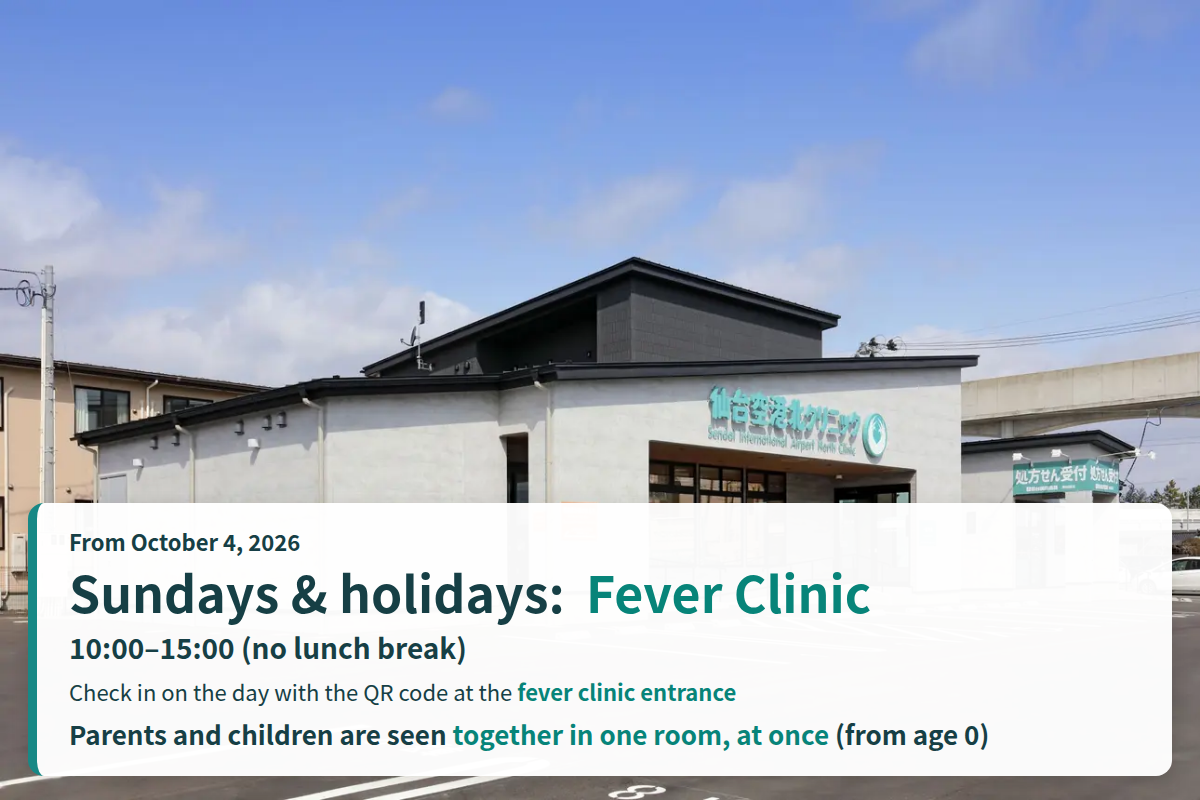
First, a note about our fever clinic on Sundays and national holidays. PCR testing for influenza and COVID (a test that copies the virus’s genetic material in order to detect it) gives results the same day.
From October 4, 2026, we also run the fever clinic on Sundays and national holidays
10:00 to 15:00 (no lunch break). You check in on the day. We give you the PCR result the same day. On Sundays and holidays we see fever patients only, and we do not offer general outpatient care or IV drips. Please check the clinic calendar for clinic dates and closed days. Notice: fever clinic on Sundays and national holidays
Shunichi Gamo, MD, PhD
Director, Sendai International Airport North Clinic
Born and raised locally, he attended Yuriage Elementary School and Yuriage Junior High School in Natori City. After graduating from Tohoku University School of Medicine, he worked at Sendai Open Hospital and Kesennuma City Hospital, and then at Tohoku University Hospital. In April 2021, in the middle of the COVID-19 pandemic, he opened Sendai International Airport North Clinic. Holding to a fever clinic that never turns patients away, he cared for well over 20,000 patients with fever in the two years before COVID-19 was moved to Class 5 under Japan’s infectious disease law.
Society memberships and board certifications
Certified Member and Board Certified Fellow, Japanese Society of Internal Medicine
Board Certified Pulmonologist, Japanese Respiratory Society
Board Certified Allergist, Japanese Society of Allergology
Board Certified Specialist, Japanese Society of Anti-Aging Medicine
PhD in Medicine (Tohoku University)
In short: When a fever takes away your child’s appetite, what should you check first?
Even if a fever takes away your child’s appetite, the first things to check are: “Are they drinking?” “Are they passing urine?” “Do they have energy?”
The Ministry of Health, Labour and Welfare recommends checking whether a child can “eat,” “sleep,” “play,” and “go to the toilet” when you look at how they are doing[1]. Check these four points at home as follows.
| What to look at | What to check at home |
|---|---|
| Fluids | Is your child drinking, even a little at a time? |
| Output | Is your child passing urine? Are diapers as wet as usual? |
| Energy | Does your child smile when you play with them? Are they not limp? |
| Eating | Even if your child cannot eat, first check whether they are drinking |
The Ministry of Health, Labour and Welfare says “height of fever ≠ how sick the child is,” meaning a higher fever does not mean a more serious illness[1]. Rather than the number itself, look at these four points.
 Dr. Gamo
Rather than the number on the thermometer, please watch whether your child is drinking and smiles when you play with them.
My child has a fever and won’t eat: how worried should I be?
When your child has a fever, whether they are drinking matters more than how much they eat.
The Tokyo Metropolitan Government’s children’s medical guide says that appetite is important information for understanding a child’s overall condition, and that if the child is drinking well, there is not much need to worry[2]. However, this is on the condition that “the child is drinking well”. If your child is drinking and urinating less and is limp, go to the section on when to see a doctor below.
The same Tokyo pages also say to see a doctor right away if your child is limp and has no energy[3]. A Japan Pediatric Society document for healthcare professionals also urges families to contact a medical facility promptly for advice if there is even one sign such as not being able to drink or feed, passing less urine, or being limp[4].
Sometimes the cause of poor appetite is in the mouth. With mouth ulcers (painful sores inside the mouth) and similar problems, salty, sour, or hot foods sting. Lightly seasoned food served lukewarm is easier to eat[2].
Dr. GamoWhen the mouth seems sore, mildly seasoned, lukewarm foods are easier to eat.
What fluids should I give, and how?
When there is vomiting or diarrhea, the basic approach is to give oral rehydration solution (ORS: a drink with balanced amounts of salt and sugar) a little at a time.
The Children and Families Agency’s guidelines for nursery schools say to give fluids such as oral rehydration solution, cooled boiled water, or tea, and that if the child is not nauseous, you may let them drink as much as they want[5]. The guidelines of the Japanese Society of Emergency Pediatrics also recommend starting oral rehydration at home promptly once vomiting or diarrhea begins[6].
| What to give | Tips |
|---|---|
| Oral rehydration solution | Start with small amounts, a little at a time[1] |
| Cooled boiled water, tea | As much as your child wants |
| Drinks to avoid | Fizzy drinks, store-bought fruit juice, sweetened tea, coffee[6] |
If your child refuses oral rehydration solution and cannot drink enough, other fluids are fine as long as there are no clear signs of dehydration[6]. However, if there are signs of dehydration or a change in consciousness, see a doctor promptly[6].
Right after your child vomits, do not give a drink straight away[1]. The Children and Families Agency’s guidelines say that if there is no nausea about 30 to 60 minutes after vomiting, you can give small amounts while watching how your child is doing[5]. The Tokyo page on fever also suggests foods that slip down easily, such as ice cream[3].
For detailed steps on making oral rehydration solution and giving it to your child, see When a child with fever and vomiting can’t drink: how to use oral rehydration solution and when to see a doctor.
Dr. GamoDon’t try to give a lot at once; the trick is one small spoonful at a time, with patience.
How can I spot signs of dehydration at home?
At home, look at urine, tears, a dry mouth, and whether your child is limp.
The Ministry of Health, Labour and Welfare lists signs of dehydration such as “no urine for 12 hours or more” and “no tears when crying”[1]. The Children and Families Agency’s guidelines list dry lips and tongue, no urine for half a day or more, small amounts of dark urine, sunken-looking eyes, and loss of skin elasticity[5].
- Urine
No urine for half a day or more, peeing less often, dark urine[1][5] - Tears and mouth
No tears when crying, dry lips and tongue[1][5] - Eyes and skin
Eyes look sunken, the skin has lost its elasticity[5] - Consciousness
Dazed, limp[1][5]
On the other hand, reassuring signs at home are that your child “is drinking,” “is passing urine,” and “smiles when you play with them”[7]. The Japan Pediatric Society’s “Children’s Emergency” guide also uses items like these to judge whether a child needs to see a doctor[7].
Dr. GamoIf your child is drinking, passing urine and smiles when you play with them, that is a reassuring sign.
However, you cannot measure how dehydrated your child is accurately at home. A systematic review of the signs of dehydration in children found that a combination of several signs predicts dehydration better than any single sign, and that even doctors find it hard to estimate the exact degree of dehydration[8]. That is exactly why I ask you to think: when in doubt, see a doctor.
Can a fever reducer (acetaminophen) help my child drink?
Fever reducers are used to bring down a fever and make the body more comfortable. When your child feels more comfortable, drinking may become easier.
The Ministry of Health, Labour and Welfare explains that fever reducers (acetaminophen) are “used to make the body comfortable, and do not cure the illness”[1]. The Tokyo page says “it is all right to use acetaminophen,” and that when your child is miserable from the fever and seems unable to sleep, you can consider using the fever reducer that was prescribed[3].
The Japan Pediatric Society also says that for a fever, it is acceptable to use fever reducers as needed, including over-the-counter medicines for children, and watch how things go[4]. A report from the American Academy of Pediatrics states that the aim of fever reducers is to improve the child’s overall comfort rather than to bring the body temperature back to normal, and that encouraging fluid intake is also important[9].
Use them exactly as your doctor instructs or as the package insert says. If you use an over-the-counter medicine, take care not to double up with other medicines, and follow the product instructions for the dose and the interval between doses.
Dr. GamoWhen your child seems miserable, use a fever reducer to make them comfortable; if they can drink even a little, that is enough. You do not need to force them to drink everything.
When to see a doctor: If your child won’t eat or can’t drink, when should you go?
If your child cannot drink, is urinating less, is limp, or keeps vomiting or having diarrhea, see a doctor the same day.
The Japan Pediatric Society urges families to promptly call a medical facility for advice if there is even one sign such as not being able to drink or feed, passing less urine, cold hands and feet, a poor color, breathing problems, limpness, not being fully alert, a seizure, or repeated vomiting[4].
- Cannot drink, or no urine for half a day or more (signs of dehydration)[4][5]
- Limp, pale, and seems to be suffering[5]
- Repeated vomiting or diarrhea[5]
- You think “Could this be dehydration?”, or your child is limp (see a doctor early, even outside regular hours)[1]
The Children and Families Agency’s guidelines say that when a child has no appetite and cannot take fluids, the parents should preferably be contacted, and that frequent vomiting or diarrhea is considered to require an urgent visit to a doctor[5].
For babies, the Tokyo Metropolitan Government says that “if a baby takes nothing at all for about two feeds (6 hours), not counting sleep at night, it is better to have them seen by a doctor right away”[2]. This is a guide for babies, so do not apply the same length of time to older children. Also, if a baby under 3 months has a fever of 38°C or higher, they need to be seen right away, even outside regular hours[1][3][5]. For details, see Fever in a Baby Under 3 Months: Always See a Doctor at 38°C.
 Dr. Gamo
The time guide is for babies. For older children, please go by how much they drink and how much urine they pass.
Oral rehydration works in most cases, but sometimes it does not. A study of children with dehydration from gastroenteritis reported that oral rehydration failed in about 1 in 25 children, who then needed an IV drip[10]. At a medical facility, the doctor assesses the degree of dehydration and considers an IV drip or other treatment if needed.
What if my child is having a seizure, does not respond, or has trouble breathing?
If your child is having a seizure, does not respond when you call them, or seems to be struggling to breathe, call 119 without hesitation.
The Ministry of Health, Labour and Welfare says that when consciousness seems abnormal, there is a seizure, or breathing seems abnormal (purple lips), “even if you are unsure, call 119”[1]. The Tokyo page also says that if a child is limp with a high fever, vomiting, and headache, and develops impaired consciousness or a seizure, “please call an ambulance”[3].
The Children and Families Agency’s guidelines say that an urgent visit to a doctor is considered necessary when the child is not fully alert, has a seizure, has flaring nostrils and fast breathing, or is pale and seems to be suffering[5].
If things are not bad enough to call an ambulance but you are unsure what to do, you can use the children’s medical advice line (#8000)[1][4]. #8000 is for children only, and the hours it is available differ depending on the local government that runs it[1]. However, if there are clearly dangerous signs, call 119 directly without calling the advice line first.
Dr. GamoThe hours of #8000 differ by local government. Checking the hours for your area gives peace of mind.
For seizures with a fever, please also see Febrile Seizure in a Child: What to Do for 5 Minutes, and When to Call 119.
What should I tell the doctor at the visit?
At the visit, tell the doctor about your child’s appetite, fluids, urine, stools, and mood. These are clues for the diagnosis.
The Tokyo page lists these points to explain at an outpatient visit: “when the symptoms started and what they are,” “whether your child has an appetite,” “whether they are drinking,” “whether they are passing urine and stools,” and “how their energy and mood are”[3]. The Japan Pediatric Society also recommends encouraging your child to drink at home and watching closely for changes in their condition[4].
- When the fever started and what symptoms there are
- How much fluid your child is taking, and how often and how much they urinate
- How their appetite is, what they have managed to eat, and whether there is pain in the mouth
- How their mood and energy compare with usual
- The time you gave a fever reducer, any medicines your child usually takes, and any chronic conditions
Pain in the mouth can cause poor appetite. If you notice it, tell the doctor about that too[2].
Dr. GamoNoting what your child could eat, and what stung too much to eat, makes it easier to explain.
Frequently asked questions
- My child won’t eat because of a fever. Should I make them eat?
-
There is no need to make your child eat. When there is a fever, whether your child is drinking matters more than how much they eat[2]. First, check that your child is drinking and passing urine. If your child cannot drink, is urinating less, or is limp, see a doctor the same day. The Japan Pediatric Society’s document also asks families to contact a medical facility promptly for advice if there are signs like these[4].
- My child refuses oral rehydration solution. Are other drinks all right?
-
If there are no clear signs of dehydration, fluids other than oral rehydration solution are fine[6]. Avoid fizzy drinks, store-bought fruit juice, sweetened tea, and coffee[6]. Try small amounts of whatever your child wants to drink, such as cooled boiled water or tea[5]. If there are signs of dehydration, see a doctor[6].
- My child has not passed urine for half a day or more. What should I do?
-
No urine for half a day or more is a sign of dehydration[5]. See a doctor the same day. If your child does not respond when you call them, is having a seizure, or seems to be struggling to breathe, call 119 without hesitation[1].
- Will a fever reducer help my child drink?
-
Fever reducers are used to bring down a fever and make the body more comfortable[1]. When your child feels more comfortable, drinking may become easier. Use them exactly as your doctor instructs or as the package insert says. If your child cannot drink, is urinating less, or is limp, do not just give a fever reducer and wait; see a doctor[4].
- My child had a seizure at night. What should I do about seeing a doctor?
-
If your child is having a seizure, does not respond when you call them, or seems to be struggling to breathe, call 119 without hesitation[1][3]. A seizure is considered to require an urgent visit to a doctor[5]. If you are unsure what to do, you can also use the children’s medical advice line (#8000)[1].
- My baby under 3 months has a fever. Can we wait until morning?
-
Do not wait; see a doctor. If a baby under 3 months has a fever of 38°C or higher, they need to be seen early, even outside regular hours[1][3][5]. For details, see our article on fever in babies under 3 months.
Summary: Look at fluids rather than appetite, and at energy
- Even if a fever takes away your child’s appetite, first check: “Are they drinking?” “Are they passing urine?” “Do they have energy?”
- If your child does not respond when you call them, is having a seizure, or seems to be struggling to breathe, call 119 without hesitation
- If your child cannot drink, is urinating less, is limp, or keeps vomiting or having diarrhea, see a doctor the same day
- For fluids, give oral rehydration solution a little at a time. Drinks to avoid are fizzy drinks, store-bought fruit juice, sweetened tea, and coffee
- Fever reducers are used to make your child comfortable, and feeling better can make drinking easier. Use them as your doctor instructs
The first people to notice that something is “not quite right” with your child are the family members who are always by their side. Even if your child’s appetite drops, first look at fluids, urine, and energy. If your child cannot drink, is not passing urine, or is limp, please consult us early. Leave the medical care to us.
That’s all.
Disclaimer
This article is intended to provide general medical information and does not replace an examination, diagnosis, or treatment by a doctor. The content is based on medical knowledge at the time of publication, but the right course of action differs for each person. If you are worried about symptoms, please consult a medical facility.
References
- Ministry of Health, Labour and Welfare, “Smart Use of Medical Care” Project. Smart use of medical care: (1) Points for checking your child’s health (2) When emergency care is needed (3) Main symptoms and how to use emergency care (4) Emergency advice lines (5) Accidents in children [PDF]. kakarikata.mhlw.go.jp (in Japanese). Accessed October 2026. https://kakarikata.mhlw.go.jp/assets/pdf/slide.pdf
- Tokyo Metropolitan Government. Poor appetite: explanation. Tokyo Children’s Medical Guide (in Japanese). Accessed October 2026. https://www.guide.metro.tokyo.lg.jp/symptom/syokuyoku/index.html
- Tokyo Metropolitan Government. Fever: explanation. Tokyo Children’s Medical Guide (in Japanese). Accessed October 2026. https://www.guide.metro.tokyo.lg.jp/symptom/netsu/index.html
- Japan Pediatric Society, Committee on Immunization and Infectious Disease Control. Management of fever in children during epidemics such as COVID-19: for healthcare professionals including pediatricians (August 23, 2022; revised June 3, 2026). Japan Pediatric Society website (in Japanese). Accessed October 2026. https://www.jpeds.or.jp/society-activities/pediatric-medical-care/vaccination/vaccinations-infectiousdiseases/20454.html
- Children and Families Agency. Guidelines for infection control in nursery schools, Appendix 3: Children’s illnesses: responding to each symptom [PDF]. Children and Families Agency website (in Japanese). Accessed October 2026. https://www.cfa.go.jp/assets/contents/node/basic_page/field_ref_resources/e4b817c9-5282-4ccc-b0d5-ce15d7b5018c/cd6e454e/20231010_policies_hoiku_25.pdf
- Japanese Society of Emergency Pediatrics, Clinical Practice Guideline Committee, eds. Evidence-based guidelines for pediatric abdominal emergencies 2017, Part I: Clinical practice guideline for acute gastroenteritis in children [PDF]. Minds Guideline Library (in Japanese). Accessed October 2026. https://minds.jcqhc.or.jp/common/summary/pdf/c00577.pdf
- Japan Pediatric Society (Ministry of Health, Labour and Welfare research group; supervised by the Japan Pediatric Society). Children’s Emergency (ONLINE-QQ): Fever (38°C or higher). Children’s Emergency (kodomo-qq.jp) (in Japanese). Accessed October 2026. https://kodomo-qq.jp/index.php?pname=hatsunetsu
- Steiner MJ, DeWalt DA, Byerley JS. Is this child dehydrated? JAMA. 2004 Jun;291(22):2746-54. doi:10.1001/jama.291.22.2746 PMID: 15187057
- Sullivan JE, Farrar HC; Section on Clinical Pharmacology and Therapeutics, Committee on Drugs. Fever and antipyretic use in children. Pediatrics. 2011 Mar;127(3):580-7. doi:10.1542/peds.2010-3852 PMID: 21357332
- Hartling L, Bellemare S, Wiebe N, Russell K, Klassen TP, Craig W. Oral versus intravenous rehydration for treating dehydration due to gastroenteritis in children. Cochrane Database Syst Rev. 2006 Jul;2006(3):CD004390. doi:10.1002/14651858.CD004390.pub2 PMID: 16856044
▶ Overview of this topic: Fever clinic on Sundays and national holidays (from October 4, 2026, 10:00 to 15:00)
More articles to read when you have a fever
For details on using oral rehydration solution, see When a child with fever and vomiting can’t drink: how to use oral rehydration solution and when to see a doctor; for fever in babies under 3 months, see Fever in a Baby Under 3 Months: Always See a Doctor at 38°C.